

So which of these two messages is the more effective?

Or
both are correct but only the second … that a bag of popcorn has as much fat as three heavy meals … will remain in our minds and influence us long term.
Why?
I recently re-read a great book by brothers Chip & Dan Heath called “Made to Stick” about how we can make our messages and ideas stick into people’s minds.
We often know what we want to communicate but the question we have is how to communicate in a way that motivates people to act upon it? The Heath’s analysed the most effective messages from the commercial and non-profit sector and identified six elements that make our message “sticky” – interesting enough for people to notice it, understand it, care about it, remember it, and act upon it.
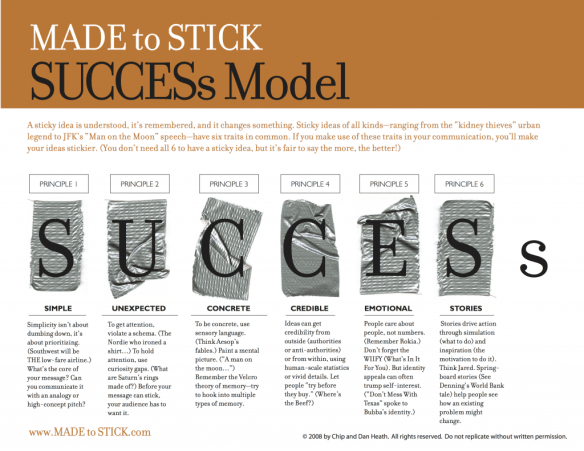
THE MOST EFFECTIVE MESSAGES ARE:
SIMPLE: Simplify your message as much as you can; think about how you can trim it down to its core, with nothing extra. If your audience remembers nothing else from your communications, what is the one key message you want them to retain?
This is especially important if your message is likely to receive only fleeting attention (e.g. due to being a poster or on radio), reduce it to eight words or less which communicate the key fact, benefit, or action you want the audience to take away. Your message has value if it motivates and helps people take concrete action. (What type of message should you focus on ? well this differs as you move through the persuasion process… Check out my views on AITA- awareness, interest, trial & action)
UNEXPECTED: If you want to get someone’s attention, show something about your issue that is counterintuitive and surprising. Surprise is triggered when the way we think things are fails, and it motivates us to try to understand why the failure happened (“Why is something not the way I thought?!”). People want this “Huh?” effect to be followed by an “Aha!” experience. While this helps to generate people’s initial interest, we also need to maintain it. According to the “gap theory”, the best way for doing so is to raise people’s curiosity – a situation when we feel there is a gap in our knowledge. To convince people that they need our message (to fill their “gap”) ask an interesting question to which they are unlikely to know the answer.
CONCRETE: As much as possible, do not give general messages, such as “Protect the environment!”. The only response you will get is “Umm, okay, so what EXACTLY am I supposed to do?!”. Concrete messages are much easier to remember and act upon. Therefore, make sure that when hearing or reading a message, people understand what exact action they are asked to take.
CREDIBLE: People must believe in your message in order to act upon it. So the question is: What makes people believe ideas? According to the Heath brothers, we believe because:
- our family members or friends believe (that is why peer-to-peer approaches can be so effective)
- we have had experience that led us to believe (e.g. when a farmer sees that the promoted practice works)
- we trust authorities (such as a doctor) or “anti-authorities” (such as drug addict who decided to quit)
- the message has “internal credibility” – adding vivid details (e.g. about a place/ person/ context) or engaging statistics (e.g. comparing one thing with another) makes your message more trustworthy
EMOTIONAL: The goal of making messages “emotional” is to make people care – because that is when they are most likely to take action. The best way to do that is to appeal to the things that really matter to them, to find a convincing answer to their question: “Okay, so what is in it for me?” The fact that you know why people should care does not mean that they feel the same. Use your formative research to understand what people really value (the last question of the BA asks about Universal Motivators).
A STORY: Stories tend to include many of the “sticky” elements already listed: providing a simplified version of the message, showing an unexpected twist, making an intangible issue concrete, offering credibility through course and details, and evoking emotions. They have the remarkable capacity to allow us to “perfink” – perceive, feel, and think, all at once. There is no need for us to start inventing new stories – in the countries where we work, there are plenty of interesting stories of people who manage to overcome difficulties or who successfully tried new behaviours. The key is to find them.
When you design your key message – for a poster, community event, radio show or a meeting with decision makers – check it against the Heath brothers’ scorecard. Effective messages do not always need to tick all the boxes; however, it may help you to realize what your message may be missing in order to be strong.
SCORECARD Is your message … ?
- Simple
- Unexpected
- Concrete
- Credible
- Emotional
- a Story