I’ve been involved in Executive education (andragogic learning) for almost five years and have slowly built up experience about how we executives learn best. Here’s me at the beginning as I spent a lot of time talking and not enough time encouraging learning.

Here’s three ideas from my experience
Our participants are well past childhood when they were looked after by their parents or looked up to their teachers! Later in university, the student is in the position of subservience created by a fear of failing. In contrast the executive participant sees themselves as autonomous and self-directing. Thus at school or university the pupil sees the teacher as a font of knowledge and accepts the relevance of the instruction. In contrast, our participants, especially the experienced manager, will be willing to challenge the trainer and demand that the teaching is relevant.
The differences between the academic learner and the business learner suggest a purely academic approach loved by business school faculty may not provide effective and efficient learning when training businesspeople on short courses, and this is my clear experience. the content needs to be completely rebuilt to add a context of WHY is this learning relevant and important to my situation. Without this focus from the outset no learning takes place.
All too often we attempt to download as much knowledge as possible as we believe knowledge is useful, and more knowledge must provide more usefulness. For executive learning focused knowledge and its use in an application enabling some learning is the critical outcome. So less knowledge and more application and discussion result in a better outcome for participants. It took me a long time to realise this- less is more -especially if time is left for more group discussion of the actions and decisions taking in applying the learning.
My experience actually using business learning in the classroom has illustrated the need to design learning taking into account cognitive load and to reduce cognitive load and to focus it on learning. In the context of experiential learning, this is to focus more on reflection and concept formulation and less on knowledge, facts, active experimentation and concrete experience, and the load from external factors (i.e. work). Less knowledge content and more concept creation, discussion and application
- Find the best way to engage me
With continuous pressure to reduce the amount of time spent on training there is a desire to run the shortest courses possible. And this involves considering the trade-offs between learning effectiveness and efficiency. One aspect of this is the relationship between learning method and the amount of retention
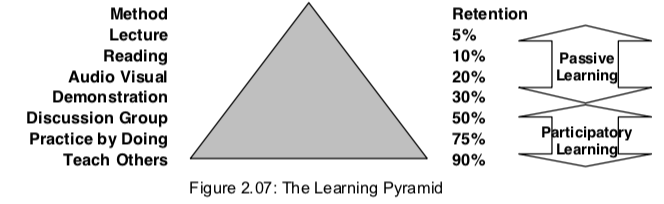
The Learning Pyramid (Mororola University, 1996) shows that the first four (lecture, reading, audio visual and demonstration) are passive learning methods. In contrast, the bottom three (discussion group, practice by doing and teach others) are participatory (active) learning methods. Arguably, the difference in retention between passive and participatory (active) methods is due to the extent of reflection and deep cognitive processing.
Practice by Doing (the method employed through simulation) is fifteen times more effective than the lecture. In the context of Kolb’s Experiential Learning Cycle this may be because during a lecture it is difficult to reflect. And, if the simulation’s learners are working in small teams with diverse business experience and knowledge, then the team members will spend time teaching each other and this will increase retention further.
So there are my three BIG tips to engage better in executive education… I’ll provide more next week.

