
I work in Executive Development, the premise is we help facilitate Executives learning. We don’t teach.
The basis of this idea is how we seek assist our participants ebcome more successful.
A nice concept to understand tis is the Business Learning Ladder which attempts to present the work of educationalists in a form that relates to business people and provides a strategic structure for managerial development initiatives. The concepts behind the Business Learning Ladder are drawn from the work of Bloom, Bateson, Kolb and Knowles etc.

The top rung emphasises that adult learning focuses on business success.
The penultimate rung emphasises the need to practice and test decision- making.
The middle rung emphasises the need for learning to develop managerial wisdom.
The second rung emphasises the need to develop experience in a simulated, coached and controlled way.
The bottom rung emphasises the need to explore, challenge and use knowledge and this is the first step.
The real world is not quite like the theoretical world… but lets make a try at applying this concept…

In the cartoon, the first step to painting a house is concerned with having knowledge of the types of paint that are suitable, so one can choose the right one to paint the house. But, although a necessary starting point, this knowledge is not sufficient. When house painting, climbing the ladder carrying the paint aloft may be experiential and, perhaps, the wise painter hauls the paint up on a rope! Then one has to make decisions about how much one can paint before having to move the ladder in turn this can add to knowledge, experience and wisdom. Finally, the job is done (successfully).
Exploring, challenging & using acquired knowledge
Metaphorically, just as one can learn about the covering power and colour of paint from the can in the store, we learn things in the class room. But, the colour is always slightly different from the colour on the can and the covering power is never quite the same. So, before starting using knowledge, it is necessary to explore and practice using it. This is just how our person is approaching her painting project. She has acquired several sample paints, opened them and has explored their use. Executive Development is a way of exploring knowledge, developing understanding and embedding the knowledge in a real-world context.
Team Learning
“Learning is enhanced when it is more like a team effort than a solo race. Good learning, like good work, is collaborative and social, not competitive and isolated. Working with others often increases involvement in learning. Sharing one’s own ideas and responding to other’s reactions improves thinking and deepens understanding. (Chickering and Gamson, 1987).
I believe that the most effective managerial learning involves small groups (teams) of participants sharing knowledge and experience and presenting, promoting and negotiating views.
Why is team learning needed? Because business management is not black and white. It is not even grey. Rather it is different colours shapes and textures depending on the current situation and the perspective of the individual. So for participants, learning must be concerned with developing wisdom rather than just gaining knowledge and remembering facts. Understanding that incorporates different viewpoints and encourages thought outside the box!
The world is changing not just in the context of technological change but in what is regarded as good management. Change that means that tomorrow’s manager must continuously update and up-rate his business knowledge and be able to solve new, unforeseeable business problems.
Working in Teams
Some 40% of a manager’s working time is spent working as a member of a team (Boston University). Thus learning as a member of a team allows you to develop the experience and skills associated with team working and this is a key aspect of our simulations.
What does team learning deliver?
It primarily assists learning in ensuring participants present, promote and negotiating different, clashing, views. This is a process that forces the learner to think critically. This deep processing ensures (rehearsal in short- term memory (Driscoll, 2005)) ensures assimilation and retention. The Learning Pyramid ( see last week) suggests that practicing by doing and discussion have retention rates of 75% and 50% respectively. And this contrasts with the lecture (5% retention rate) and audio- visual (20% retention rate).
Sharing knowledge and experience while working in a team is, in effect, teaching others. Again the Learning Pyramid suggests that this ensures a ninety percent retention rate. Thus working in a team helps embed the learning.

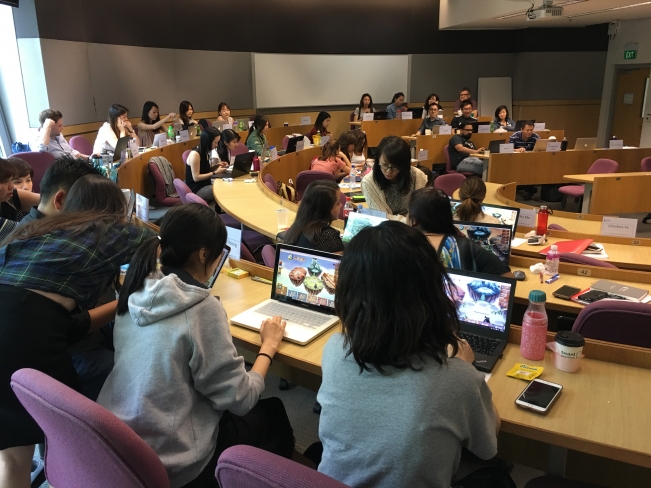
A typical group of business people on an exec development course will have different prior learning, knowledge and experience and working in a team of four or five provides a means of sharing this. And the amount and diversity of knowledge and experience contrasts with university learning. With university business students it is reasonable to suggest that their management and business knowledge will reasonable, consistent and generally knowledge based. However, they will have limited experience. For our executives the situation is the reverse. Those who have a business qualification may have forgotten much of what they learned and for those that moved from another discipline in to management will not have management or business knowledge. However, in work and in life they will have gained considerable experience. As both their knowledge and experience sets are diverse this is a resource for learner centred learning and a challenge to the trainer.
Working as a team member helps build team-working skills. Additionally, if the team consists of colleagues, the process helps build the team and is particularly useful in building links in a diverse organisation. If the colleagues are from different functions or cultures, this diversity enhances learning as team members share their individual viewpoints and experiences.
The team working process both recognises the expertise of the team members and allows them to direct the learning process. Both of these are needs of adult learners and hence are emotionally rewarding. (In contrast, for student learners the ambiguity and uncertainty with this may be demotivating.)
Kolb describes Learning as “the Process of Creating Knowledge”. To decide which delivery process (classroom or Internet) is the most appropriate we must consider what knowledge is to be created. Dewey (1938) suggests two classes of learning – apprehension and comprehension.
Apprehension involves assimilating knowledge. In management terms it involves knowing, for example, the content and difference between a Profit & Loss Account and the Balance Sheet; what makes up the “Marketing Mix” and so on. It involves building up a mental “database”. This acquisition of new “factual” information is also known as cerebral learning (Bateson, 1973).
Comprehension involves organising knowledge – building the links between the mental “data base” and linking the new “data” to the existing “data base”. This “transformational” learning involves a process of structuring and restructuring mental schema (Kelly, 1991). It results in a general understanding and an ability to apply the knowledge successfully. In management terms it means that the links and dynamics between management actions, the P & L account and Balance Sheet are understood so that appropriate decisions can be made.
Both these two processes are necessary and may be regarded as two steps in knowledge creation.
The use of business cases, team projects and simulation enhance learning in the following ways
- To Explore Knowledge and Test Understanding of knowledge in a group setting
- To Practice and Develop Skills and apply them in real to life situations
- To Motivate and Engage Learners as part of a group experience
- To Enhancing Learning experience and assist knowledge and skill retention
Real world experience is messy.
Reflecting on this learning process, consider the important things you have learned. Were these in the classroom or were they from (often bitter) experience? Yet, learning in the real world (like our painter’s experience) is messy. Even if you take time to reflect on what you have learned from the experience, you may not be able to identify the learning and generalise it so that it does not happen again. The executive development environment where the experience creation is risk free and much less messy than the real-world.
Wisdom involves applying knowledge and experience to solve problems.
Wisdom can be defined as the possession of experience and knowledge together with the power of applying them critically. Executive development is in the business of developing critical thinking skills – the ability to use our knowledge and experience in a wise and effective way to solve problems. One aspect we are increasingly using is team based projects or business simulations as both of these provide ways of testing and developing problem-solving skills and preparing business people to handle new challenges.
Ultimately we are concerned with personal and business success.
Business success, like learning success (and house painting), is multidimensional. It must be efficient, effective and consistent and, like our purple house, involves judgment.
Efficiency is not just cost reduction. When painting our house we could reduce costs by buying a cheaper paint and applying it thinly. But, to adequately protect our investment (in the house or learning) we must ensure that the (paint and learning) does not fade with time and that it does not crack and peel (become outdated).
Effectiveness means that like the paint there must not be gaps in learning and everything must be covered properly.
Consistency means that every business person should gain from the learning initiative.
Judgment means that perceptions of what is regarded as managerial success change over time and, like our purple house, formulaic management solutions may become outdated. But, if learning has been directed towards creating wisdom, the business person is able to handle these changes.
In this and last weeks session on the three critical elements of executive learning I hope to identify the foundations- to me- of the executive learning experience.