

Whilst preparing for two ”leadership laboratory’s” I’m reading up on leadership.
Here’s a great read about a very successful if much maligned style- if based in results and devoted follower-ship. Many will argue that her style is old fashioned- both in terms of clothing and management style. But few will argue with her consistent results and consistency of leadership. If you work for her, her leadership style certainly shouldn’t be a surprise – see here or here and is remarkably consistent.
We experience the intangible economy and it increasingly accounts for ever more of the world’s wealth. In it, success is driven less by your ability to produce things (which is being routinized and off-shored to low cost producers) than by your ability to capture the zeitgeist and mobilize creative people to create intangible value. Management gurus are more or less in agreement that the rise of this intangible economy is presaged by a shift from command-and-control management to ‘empowerment’. Successful managers in our new world are “servant-leaders” who provide a nurturing atmosphere in which creative types lounge on beanbags, play ping-ping and “bring their true selves to work.”
Wintour’s career suggests, at the very least, that this assumption is not universally the case; indeed, quite possibly, it is self-deluding tosh.
Her example suggests seven lessons
1. Devote your life to your vocation with the same discipline that Jesuit priests devote theirs to God. work harder than anyone that works for you and delegate everything you don’t need to do, and focus explicitly on what makes a difference and creates a sustainable advantage.
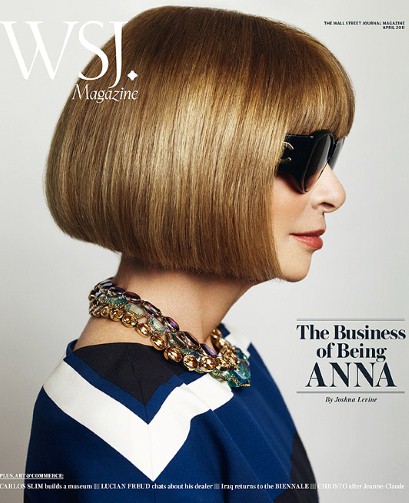
2. Turn yourself into a brand. For me great brands are relevant (to target market), distinctive (from competitors and alternatives ) , motivating (to get buyers to act) and consistent (over the ling haul in everything you do) … thats Anna turning herself and her leadership into a brand.
3. Control everything (that you must control). Wintour micromanages everything that needs to have a SINGULARITY of VISION, from the pages of the magazine to the world she inhabits.
4. Don’t waste time (on small talk). “With Anna you get two minutes — the second is a courtesy,” says an insider. Like everyone we only have 24 hours a day AND NO MORE use this scarce resource to its best.
5. Focus on creating and then dominating ecosystems. Wintour has appeared to turn herself into the managing director of the entire fashion industry — and has created fantadtic synergies within it. From offering fashion companies advice, to promoting young talent (she matched John Galliano with LVMH-owned Givenchy in the mid-1990s), and then acting as the fashion world’s spokesperson to the worlds of politics and philanthropy as the leaders of these seek icon status.
Wintour understood what gurus of empowerment have failed to grasp: that “total quality management” is just as applicable to culture as it is to car-making but that, in the case of culture, TQM means that a single all-powerful and well-informed boss needs to keep a tireless eye on every detail of the process… magazines can only thrive if they are the product of a single coherent vision. They court with disaster if they allow themselves to be edited by their staff or, still worse, the Twitter mob.
The intangible economy may like to wrap itself in the language of “lifestyle workshops” and “flat management,” but it is just as much in need as the tangible economy of of firm direction and clear decision-making, especially if singular micro-management obviates the need for alignment and the trappings of success generate commitment and loyalty.
The full article is worth the read… no one is forced to work for Wintour, and many will- despite the challenges- as long as she remains fashions icon.