

If your CEO has a problem making money during a Covid-19 crisis – here’s an easy solution: visit your local bank borrow several billion dollars at Super Low interest and buy back shares.
It certainly doesn’t propel performance, but it makes earnings per share look much better.
And for greedy investors who are looking for good quarterly performance and an ability to sell out at a moments notice … it’s great.
For the organisation, its workers, its suppliers, its customers… for all of us… it’s not good.
Companies overburdened with non-productive borrowing are unable or unwilling to ready themselves for the future.
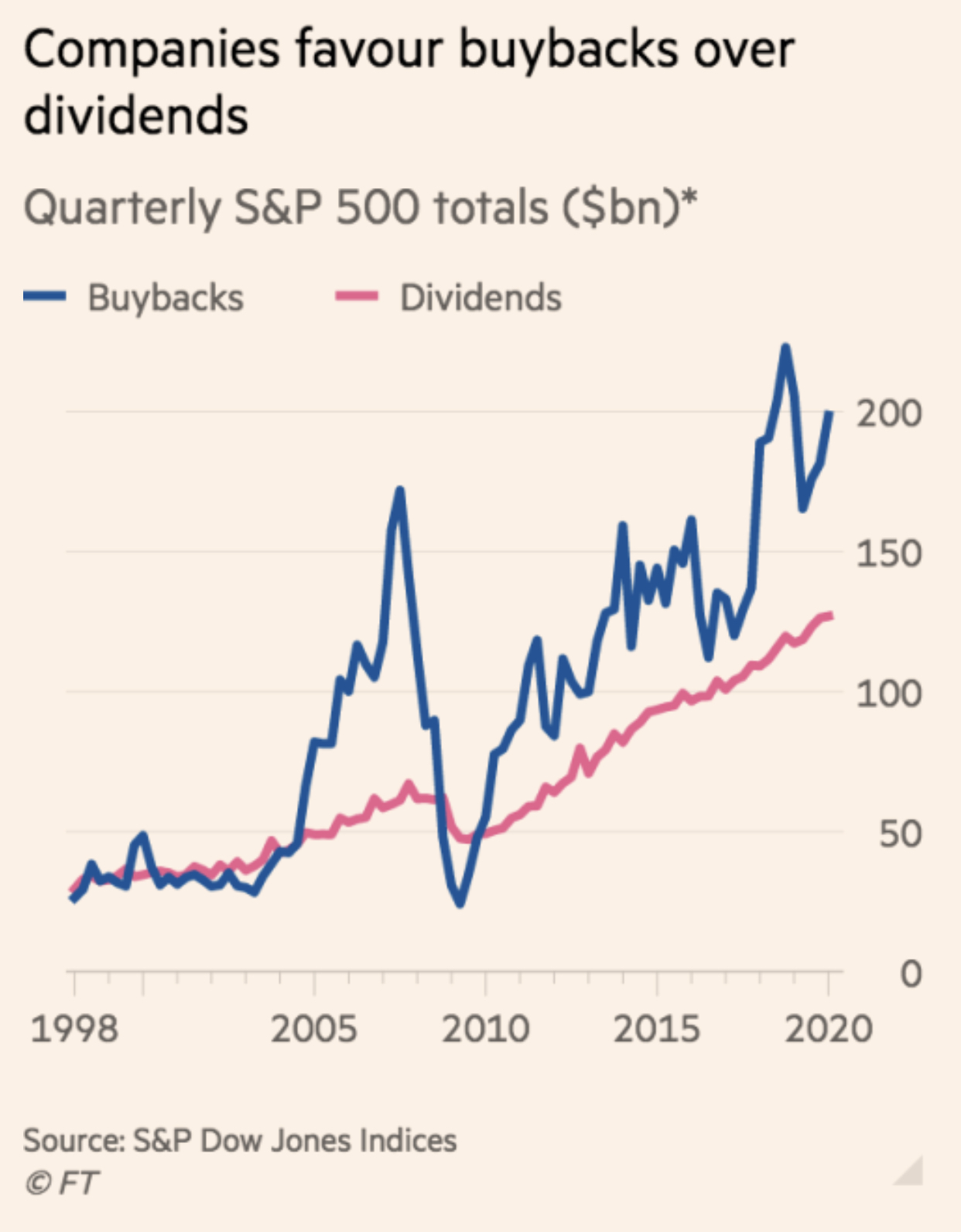
Here are some recent examples from the FT: Google’s parent company Alphabet spent $6.9bn on buybacks for the quarter, up 92 per cent from a year prior, the company revealed in its earnings results on Thursday.
Microsoft, the second-largest listed US company, purchased $5.8bn of its own stock in the period, up 25 per cent from a year earlier.
Drugmaker Biogen spent $2.8bn on buybacks for the period, up 17 per cent from last year.
Celanese, a chemicals group, increased its planned buybacks for the year by $500m to $1.5bn in July, after selling its stake in a Japanese joint venture.
Apple, which has spent the most on its own shares among S&P 500 companies in recent years, repurchased $16bn in the second quarter, down 6 per cent on the period last year, the company disclosed on Thursday.
Berkshire Hathaway, the investment and insurance group run by billionaire Warren Buffett, ploughed about $5.3bn into stock repurchases during the quarter, according to estimates from Edward Jones.