

You’ve inherited what you consider a dysfunctional team, but what makes you think they are dysfunctional? We’re on our last leg now. The team trust one another, have productive meetings where positive conflict is mandated, share commitments and hold each other accountable… but a lack of focus on results can ruin a happy group.
Patrick Lencioni created a very understandable model about how and why teams are dysfunctional and how you can assist them to function better. Lets work at the base, the most fundamental dysfunctions, and work our way up.
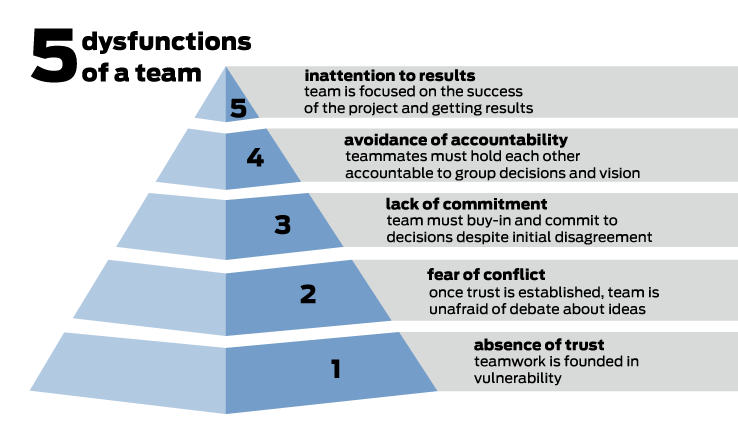
5. Inattention to results
The evidence of this dysfunction is the presence of high ego and office politics.
There’s a reason that sports are so prevalent when it comes to teamwork, the score at the end of the game that determines if you won or lost, there’s little room for interpretation or ego-driven success.
The key is to define goals for the team in a simply measurable way which leaves no room for interpretation when it comes to success. Otherwise it only creates the opportunity for individual ego to sneak in. And that’s where politics will prevail.
Having experience of a major European multinational as a shareholder, I’ve known senior people who have built their career about creating problems that they can solve, and I’ve had experience with this organization as it emphasised effort over result. People seemed to take pride in fighting fires more than in preventing the fire in the first place. The incentive to improve efficiency and quality was lost, the game appeared to be to preserve the illusion of long working hours and nose to the grindstone effort. When this culture seeps in the next things to go are the competitive edge and team morale. Good people leave; leaving only mediocre time servers.
The politics I saw in this shareholder were astounding. You knew there were clear parties within the company and promotions were made to keep a balance of power (it was partly created by the shareholder not trusting the CEO and wanting to create a check and balance system… but two teams can’t run a company). I think this was a result both of ownership lack of trust and of of everyone being far too ambiguous about what we are trying to accomplish, and that makes it easy to focus on individual success.
When I mention “Office Politics” what I mean is when people choose their words and actions based on how they want others to react rather than based on what they really think. Views were based on who they are talking to, our group or the other group, and actions were ambiguous so the other group didn’t quite know what was going on.
Team Assessment: Does the failure to achieve team goals affect morale significantly? Or does everyone just think it’s not their fault? What’s most important to people, team results or your team’s status or individual status.
Many teams simply do not live and breathe in order to achieve meaningful objectives, but rather merely to exist or survive. Unfortunately for these groups, no amount of trust, conflict, commitment, or accountability can compensate for a lack of desire to win. Teams that are not focused on external performance and objective results, rarely defeat competitors, lose achievement-oriented employees, encourage members to focus on their own career and individual goals, and are thus easily distracted.
Suggestions:
- Make results clear, and reward only those behaviours and actions that contribute to those objective and external results.
- avoid changing things just because a new person what’s to change them to win a promotion
The leader must set the tone for a focus on results. If the team members sense that the leader values anything other than results, they will take that as permission to do the same.
If you’ve inherited a dysfunctional team, I believe I’ve set out the ways in which you can remedy this. Its essential to start at the foundation- trust- and then work upwards from there. Work with commitment and the team will start functioning like a champion.