
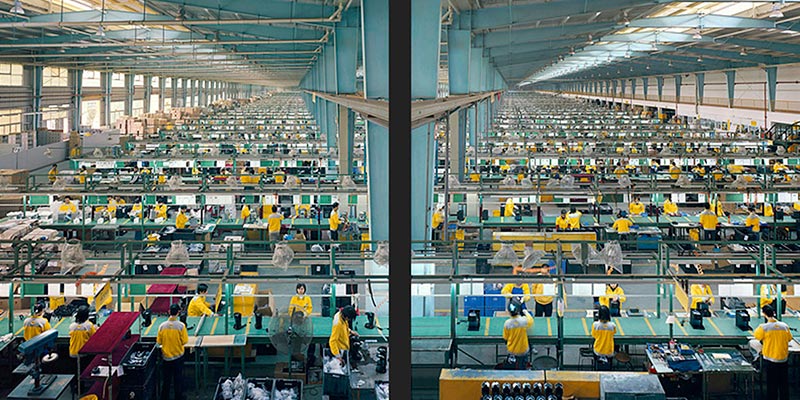
China is the world’s manufacturing hub… and while it innovates occasionally and has few world class Brand’s, China has one outstanding advantage… it still makes stuff.
And because Chinese workers produce most of the world’s goods, it means that they’re capturing most of the process and manufacturing knowledge that comes from the production process.
i teach strategy and the basis for great strategy is your internal advantage meeting an external opportunity creates potential success. And one of the greatest advantages are internal capabilities.
Few consider the importance of technological capabilities — in the form of an experienced workforce — as a basis for innovation, efficiency and growth.
Let’s consider technology in three forms: tools, direct instructions (like blueprints and IP), and process knowledge.
The third is easily the most important: Process knowledge is hard to write down as an instruction. Here’s a great analogy to illustrate— you can give someone a well-equipped kitchen and an extraordinarily detailed recipe, but absent cooking experience, it’s hard to for them make a great meal. The human application of knowledge to tangible resources is the foundation of innovation success. In touching tech as it’s made we can find ways to reinvent it.
We should think of technology as a live skill, which has to be practiced for knowledge even to be maintained at its current level. The example of the Ise Grand Shrine, which Japanese caretakers tear down and rebuild anew every generation so that they don’t lose its production knowledge.
Today, Chinese workers produce most of the world’s goods, which means that they engage more than anyone in the technological learning process. Few Chinese firms are world-leading brands. But workers in China are using the latest tools to manufacture many of the most sophisticated products in the world. They’re capturing the marginal process knowledge, and this puts them in a better place to develop the next technological advancements. To be more concrete, Chinese workers will be able to replicate the mostly-foreign capital equipment they currently use, utilise current IP make more of their own IP, based on their own technological mastery from manufacturing to build globally-competitive final products.
so this is the insight for western firms— don’t send your manufacturing off-shore as you are sending future knowledge and insight off-shore as well.
Every year over the last decade, Apple trained a million workers in Shenzhen and other cities to manufacture the world’s most complex consumer electronics. The smart narrative on the iPhone has been that Chinese workers are engaged in mere assembly, of mostly foreign parts to boot, while Apple keeps all the profits. That story is true, but it misses a great deal. First, even if most of the workforce learns little, a few thousand line engineers become the world’s greatest experts in electronics assembly. Combine that fact with the billions of dollars invested in the smartphone supply chain, and it’s no wonder that Shenzhen is driving the marginal innovation on hardware today, from consumer drones to scooters. Second, Chinese brands were able to tap into the same supply chain and learn how to make pretty good products; collectively they make up around 40% of global smartphone sales (though they earn little profit). Third, the Chinese share of added value per phone has zoomed up, from 4% to 25% over the course of a decade, according to an academic estimate. It’s no longer the case that China is responsible only for assembly; Chinese firms have figured out how to make the more valuable parts of the phone as well.
By aggregating the smartphone supply chain, Chinese firms learned how to make sophisticated components and become exportable brands. They’re still far behind on making the underlying software of the phone, but if one leaves that aside, isn’t it a pretty good success story for Chinese firms? The power of compounded workforce training pulled Chinese capabilities to the technological frontier, and now these firms are in a good place to push that frontier forward. Chinese firms are now also leading in all the follow-up technologies of the smartphone, like the consumer drone.
Now consider that it’s not just the electronics supply chain that is centered in China. Design and production of many goods, from furniture to heavy industry, are concentrated in gigantic Chinese production hubs. These hubs allow for tight connections between R&D and manufacturing, shortening the circulation of knowledge in a production loop.
China is now responsible for around a fifth of the world’s total manufactured exports because few multinationals have resisted moving production there. US, German, and Japanese firms like to say that they’ve kept the most valuable work domestically. That’s true for the most part, but they’re betting that the Chinese workforce many of them are training will fail to digest foreign technologies and replicate it. That bet has failed at least in technologies that include high-speed rail, shipbuilding, and telecommunications equipment. And I expect that as China’s economy grows more sophisticated, its absorptive and learning capacity will improve as well.
Technological learning in the labor force is a supply-side factor pulling forward the capabilities of Chinese firms. They benefit also from a demand-side factor: the domestic market is really big. People tend to forget that fact. It’s true that Chinese firms haven’t yet had much success in creating global brands, but perhaps they can be forgiving for focusing on the world’s fastest growing large market. The size of the market can overwhelm many deficiencies, like problems with the education system stifling creativity. And although consumer internet companies are not strategically so important, they buy upstream components, and are in a more credible position than European and Japanese firms in developing future digital technologies. China today is a huge internal market made up dynamic firms, ingenious workers, and a strong interest in technology. That’s rather like the US in the second half of the 19th century, which built the largest firms in the world mostly by relying on domestic demand.
So, the moral of the story is manufacturing capabilities are really at the heart of creating the firms future success. Sacrifice those capabilities and you sacrifice an ability to innovate quickly and easily.