

Five years ago Binet & Field shot to marketing effectiveness fame with the launch of their first book – The Long and Short of It, a long term analysis of business effectiveness case studies from the 1980s through to the present day.
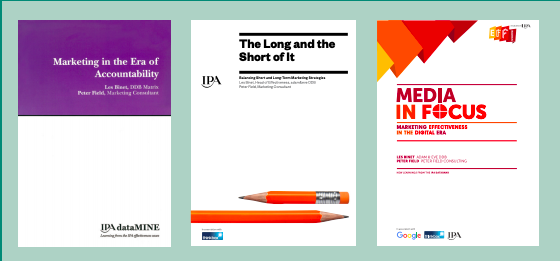
The title is a reminder of the marketers biggest challenge investing for today vs investment for tomorrow. How much should you focus on sales activation compared to brand image building inn a B2B environment. The much-ignored as being contradictory to “common-sense” Erhenberg-Bass institute had conclusively shown that investments in long-term brand building are the foundation of B2C brand growth. But the case for B2C remained open.
Binet & Field’s recommendation was for a 60:40 media spend split, in favour of branding activity as the best means to grow your business both in terms of short term sales and long term branding. The theory was whilst short term activation works short term its effectiveness withers with repeated use, and only through investment in branding can the base grow giving a stronger support for activation. As the most comprehensive and evidence-based theory on marketing effectiveness, it’s difficult to argue with the results.
However, despite encouraging B2B brands and marketers to invest in brands, the industry continued to veer towards short-termism. Being counter-intuitive means intense skepticism, especially if marketers believe in benchmarking (see my comment on benchmarking here)
In 2018 Binet & Field released the first part of their follow-up, Marketing Effectiveness in the Digital Era, with the key takeout now reiterating the need to invest in brand and that the offline/online spat on where to focus your spend was fake as you need both to grow your imagery and to impact activation. Both new and old media were shown to work more effectively together.
Recently, part two of their research was released: Effectiveness in Context. It amplifies the discussion on brand and activation and the old 60:40 rule across different categories, consideration types, brand types and even life stages.
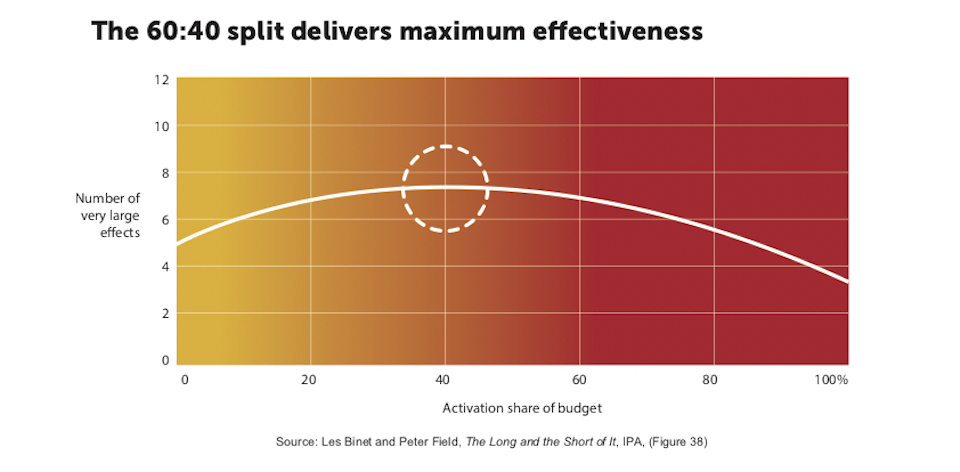
And despite what tech and digital businesses may say to marketers about the effectiveness of their own digital vehicles to build brands, digital companies consistently use legacy media AND emotional campaigns
 Effectiveness in Context p32
However, a couple of headline factors should be heeded by all. For one, the optimum spend on branding is increasing. Where in 1998-2010 the recommended split was 55:45 brand to activation, in the most recent period analysed, 2004-16, the percentage of branding required in for-profit sectors has increased to 76:24.
The main reason for this shift is digital. Just as online media has made offline media more effective, the rise of online has made it easier for brands to activate.
With more research and sales happening online, where the consumer has more control and access to more competitive brands, investing in brand is critical to cut through.
Digital practitioners appear to me to be ever more focused on the role of digital to build rational thought process 9use the internet to find the objectively “best”). But in fact, when overwhelmed with options, buyers are more guided by the emotional cues formed in brand building communications.
As a result, categories either researched or bought online require a higher investment – close to three-quarters of spend – on branding.
But it’s not just online brands needing to be mindful of over-investing in the short-term. In the paper’s final blow, Binet & Field demonstrate a 76% correlation between categories increasingly reliance on short-termism and a loss of effectiveness of marketing spend.
Once more the takeout is: whatever the short-term targets, focusing on longer-term brand building is all-important for brand health and marketing effectiveness.
Over the next few weeks I’ll be examining more information from these publications.