

I am embarking on a new teaching topic that of enhancing strategic growth in Asia- and this excites me. a typical approach is to survey the field, identify what market leaders are doing and identify how to benchmark against and replicate this.
The challenge I have is this;
The most profitable ideas are contrarian ideas.
The value of contrarian thinking is well understood especially in the world of finance, but much less well understood in the commercial world of business where benchmarking remains a standard approach.
If your performance is worst in class… obviously benchmarks can assist;

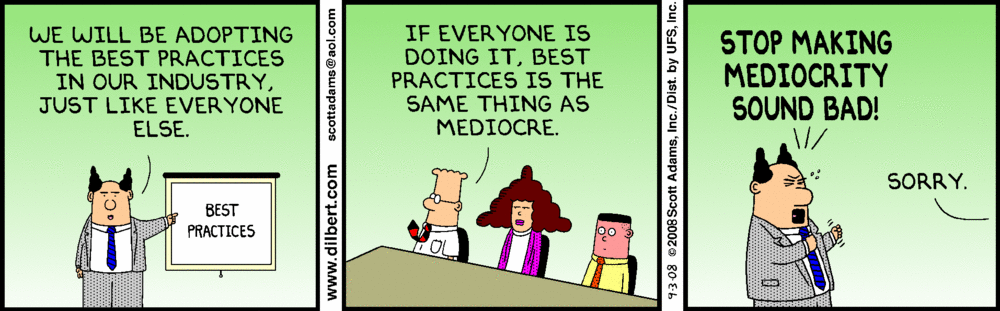
But thinking further on this, if your business strategy is based on consensus opinion a benchmarked approach— even if that consensus approach is correct — then you are destined to be at best mediocrely average, the same as your competition. If your competitors are doing exactly what you are doing, then you have no advantage, by definition.
To find the upside in business you need to be doing what no one else is doing AND doing what is effective. You need to be right when everyone else is wrong.
Some interesting trends have been occurring in B2B sales over the past decade… which if benchmarked against will certain Ing mean significantly less effectiveness
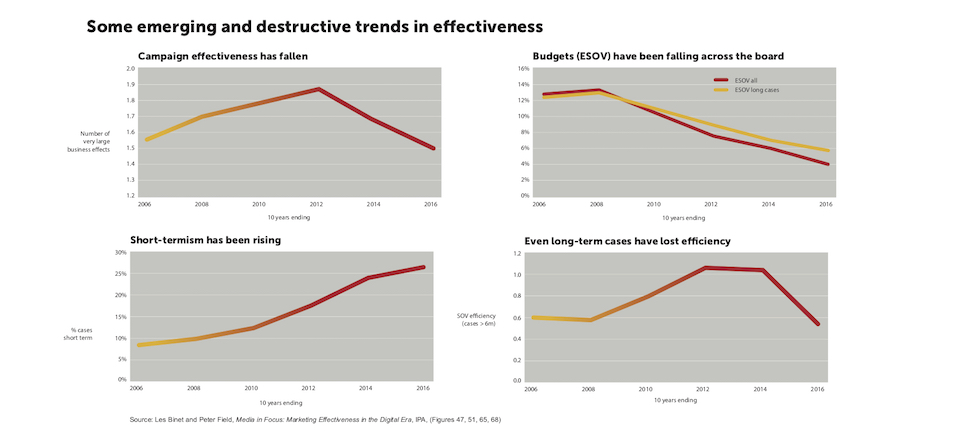
This is from researchers Les Binet and Peter Field’s, latest work on B2B growth.
One means of being contrarian in B2B sales is to find the most effective balance between short-term sales activation and long-term brand building, two different types of growth activation that require different creative, media, and measurement strategies.
In my next content series i’ll explore the contrarian principles of growth in B2B explored by Binet and Field and outline five principles for effective B2B growth.
These principles are supported by evidence and also by a certain amount of underrated common sense. I’m confident that these ideas are effective; but are these ideas sufficiently contrarian to create a competitive advantage?
One example is the focus on Long-term B2B brand building rather than short-term promotion: according to a recent LinkedIn survey, only 4% of B2B marketers measure business growth impact beyond the first six months.
I’ll also consider the dichotomy between bringing in new customers versus loyalty building; again according to the survey, only 30% of B2B marketers believe advertising has an impact on enhancing pricing, and over 65% believe that businesses grow by increasing loyalty, not customer acquisition.
This discrepancy presents us with a unique opportunity: to be both right and contrarian. I believe B2B leaders who are brave enough to reject benchmarked consensus opinion and bet big on these upcoming principles will out-perform their competition.