
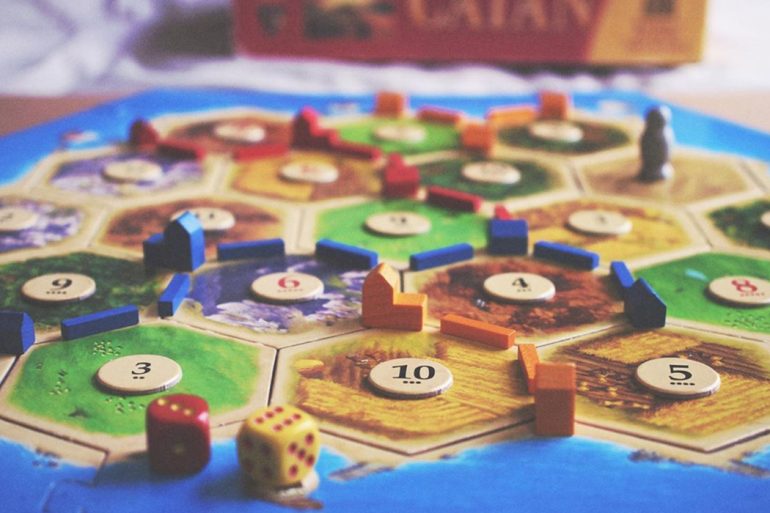
“Strategy” is a tough topic to move from abstract theory into understanding practical application.
I have used case studies often in the past … but I feel this is great at engaging the mind and enables conceptual understanding and discussion without fear of the consequences of failure. It’s great for knowing; not so good for doing. Also, live case studies ALWAYS have a right answer or wrong answer that absent in real life.
In my research on the best ways to engage learning participants, I have been scouring the internet to identify serious games to link theory with hands-on application without a pre-programmed right answer, involves participants intimately in creating the ‘environment’ and with some ability to bring a visceral fear of the consequences of failure into the mix.
One approach that has resonated are practical situations – and here I have created “Yamashita’s gold” ( based loosely on Neal Stephenson’s book Cryptonomicon) where participants are challenged to make a series of decisions individually and then as a group – this stimulates discussions about the paradoxes of strategy intent, capabilities, environmental issues, risk perception, risk-reward trade offs, trust, delegation, and management. But again, it’s a discussion… nothing really hands-on and it does have a “right” answer so it can be gamed. (I may turn this into a game… if there’s another lock-down).
Also, there are many online business strategy simulations that I have sought out. They tend to be expensive, specific and, I feel, have lots of moving parts which tends to focus participants on tactical decision making rather than strategic concept learning. Such business games are great for week long engagements or capstone projects… but to learn the fundamentals of strategy in a morning, thats tough.
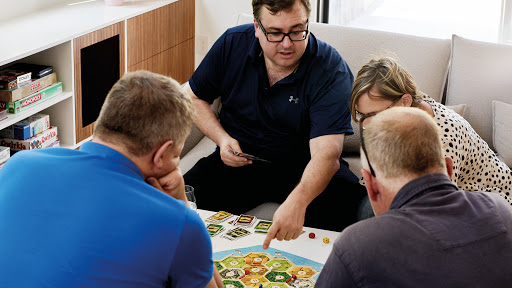
Along the way, I learned that Reid Hoffman, founder of LinkedIn, plays The Settlers of Catan, an old-school board game, and he was drawn to the game because it “most closely approximates entrepreneurial strategy” and he encourages tech founders to play.
I agree and so I have created a hands-on introduction to fundamentals of strategy around playing (basic) Settlers of Catan. It can easily be used to support a variety of different strategy theories (see picture) it especially supports an understanding of Laffley & Martin’s “Strategy Cascade” as a means of planning and assessing strategy.
Such serious games provide relatively inexpensive (time money) real time feedback on strategy decisions and implementation approaches. Games enable low-risk engagement with ideas that easily transfer into real life situations. Such games enable managers to assess the thought processes of team members (as long as there’s an effective after-action review). Such games enable people to test out ideas and approaches. Used appropriately, games like Catan can help business build strategic skills in a timely, cost effective and focused manner—a critical capability in today’s dynamic business environments.

Here are the Critical learning points that playing a modified session of Settlers of Catan can engage participants with …
- What outcome do you seek; what vision do you have (know your winning intent) Does anyone need to lose for me to win?
- Where are opportunities available in your market (know where to play)
- How can resources / capabilities enable you to win (know how to win)
- Which set of resources /capabilities do you select to create an advantage to achieve your outcomes.(create a competitive advantage)
- What new capabilities are needed now and in the future of the game (know how to pivot your advantage)
- When to flex your strategy in response to environmental changes or competitive pressures (know when to flex)
- What is winning? Competition and/or Co-operation in a market (negotiation skills)
- Good or bad luck will always play a role in strategy … how prepared are you for it.
Playing time is 60-90 minutes after a ten minute introduction to the game with a 60-90 minute debrief discussion.
Additional benefits from engaging in strategic thinking through playing Catan…
Catan teaches you to be more aware and analytic about your environment. The board is filled with resources ranging from the seemingly worthless to the most beneficial ones. The value of resources changes through the course of the game or the strategy you pursue. The initial position taken up on the Board rewards first mover advantage, but strategies develop for those positioning later or thinking more long-term. Awareness will definitely grow as players become more observant of the benefits of various resources and capabilities, and they will be more open to critical and deep thinking in analysis of the environment, especially on how the resources can be of use.
Catan lets you hone your negotiation skills, which will come in handy when coming up with strategies in real life. Building settlements and strengthening your position requires some negotiation with other players, encouraging skills how to convince and persuade others to come to a solution that will (supposedly) benefit everyone.
Catan teaches you how to manage your resources well. Most team members have resources, but they don’t know what to do with them in order to make them grow. A game of Catan will give you some practice on how you can go about it.
It’s a great focus for a half day introduction to a team or corporate strategy session, or to engage new hires to think about strategy in their own roles. Positively, unlike many games… no one has to lose to enable you to win.
Interested? It’s available through SMU-ExD Executive Development
Ref: https://hbr.org/amp/2015/09/games-can-make-you-a-better-strategist