

I’m a big fan of models; shortcuts that we can reference or leverage in various learning settings to address common business problems. They aren’t perfect but they are useful.
The best models have simple concepts yet are robust enough to apply in many different situations.
Perhaps unlike most executive development professionals I’m also a big fan of hands on activities and games to enable our participants to learn concepts. And I think there’s a correlation. Let me explain.
A well-constructed game, like a well thought out model, is fairly simple and quick to learn, yet robust enough to allow for creativity within the confines of its defined universe.
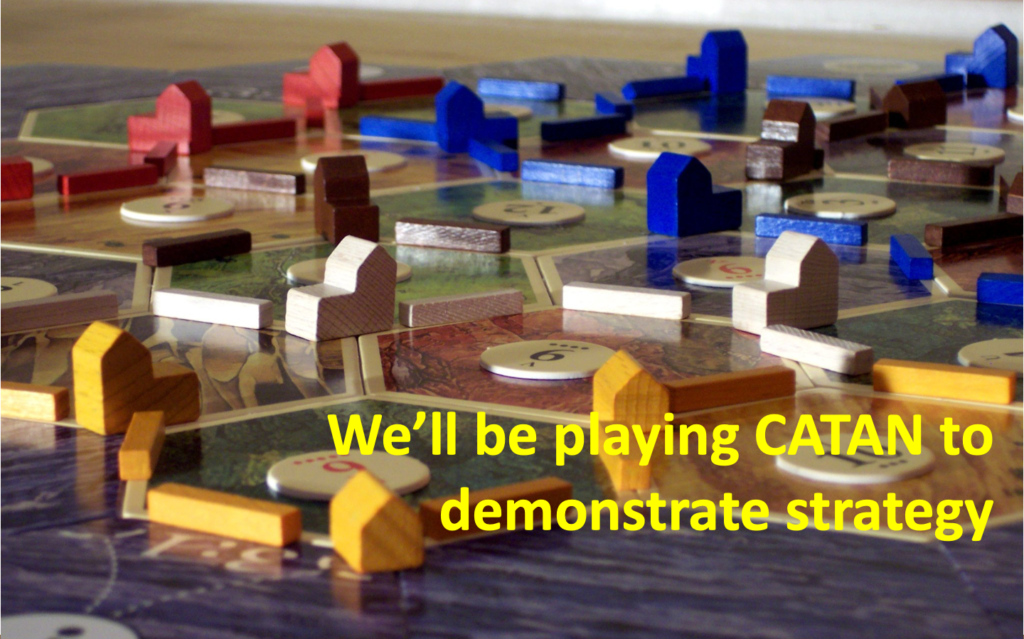
Like good models, games need to be clear and straightforward… but flexible enough to allow for robust play. Nobody wants to play a game with no rules neither one that’s complicated by a folio of rules … hence I like using Catan, which can be easily learned in fifteen minutes, played in 45-90 minutes and provides strong feedback on strategy creation and implementation.
Let me explain further …

Catan focuses on some key strategic ideas. Identify what resources are useful to capture various different Opportunities. Then how to create a position to access desired resources, despite competition, then transform resources in skilful and advantageous ways. The challenge complicated as resource needs change through the game as well as necessitating working with others who may be competing for similar resources and opportunities.

Focusing on Catan, I see Opportunities as the various ways to collect Winning Points – from settlements, cities, largest army, longest road, development cards- and therefore “win” the game. Various resources are provided by the hexes (hexagonal pieces) in the game-board. Different hexes provide different resources and the likelihood of a hex providing a resource is governed by chance- but you can easily see which hexes are likely to produce more resources than other – these are obviously more desirable.
Skill is tested by how players convert resources into settlements (which accrue further resources), roads, or cities (claiming double resources). Additionally, there are various different other ways to find more winning points through “buying” various cards. Different combinations of approaches each can yield a winning position.
Skill is applied not only in planning an initial “position” on the game board but also in how to move on the board to seek out new resources. There is skill needed negotiate trade with competing players of different resources that may be needed.

Additionally, Catan enables players to learn about “competitive advantage”. How, during the game, they can create different and more valuable ways to more skilfully utilize available resources.
And so playing Catan, we are able to get people to discuss these critical elements.

Firstly, in prompting a discussion about strategic intent and desired outcome; and differing appetites for risk vs reward. Interestingly about this iteration of Catan, no one has to lose for anyone to win- as its timed. The game tries to encourages collaboration possibly more than competition.
Secondly, the game players experience that there are a large variety of opportunities available. This introduces the idea of formulating a “Where to Play” to win discussion. Hopefully, players recognise that some opportunities are better than others; and realise other opportunities are more costly than alternates to reach.the same outcome. A great discussion to then link to a corporate growth agenda and observing the business environment.
Thirdly, the game Catan enables players to experience formulating an approach on “How to Win” in the environment they play in. Looking the the game board and considering how create a position, assessing how others will respond, deciding how to progress the search for resources. This is a great base for a discussion on identifying the resources, skills, competencies and capabilities organisations need to survive or grow.
So what for me is the key learning.
In my experience, regrettably, the majority of team members of most organisations have no idea what their organisation strategy is, nor how to conceive what strategy is. Using a gameified approach is foundational to enabling people within organisations realise what strategy is and how to possibly explain their own strategy. Without this, leaders are unable to ebvision their future plans, lack the ability to align their team around their plans, and execute this in real life. I highlight this by focusing on what I see as the two most critical questions leaders must communicate for all know to be able to work within any firm. What- fundamentally- do we do; and Why are we doing it?

If you’d like to experience using the game CATAN to understand business strategy or growth strategy… its what I do with SMU Executive Development.