

Whilst I don’t claim to be an expert on serious games and teaching business strategy, I often come across interesting ways in which games can be used to enhance learning. One such game is Settlers of Catan, (or Catan) which can teach players a lot about life and leadership while having a lot of fun.
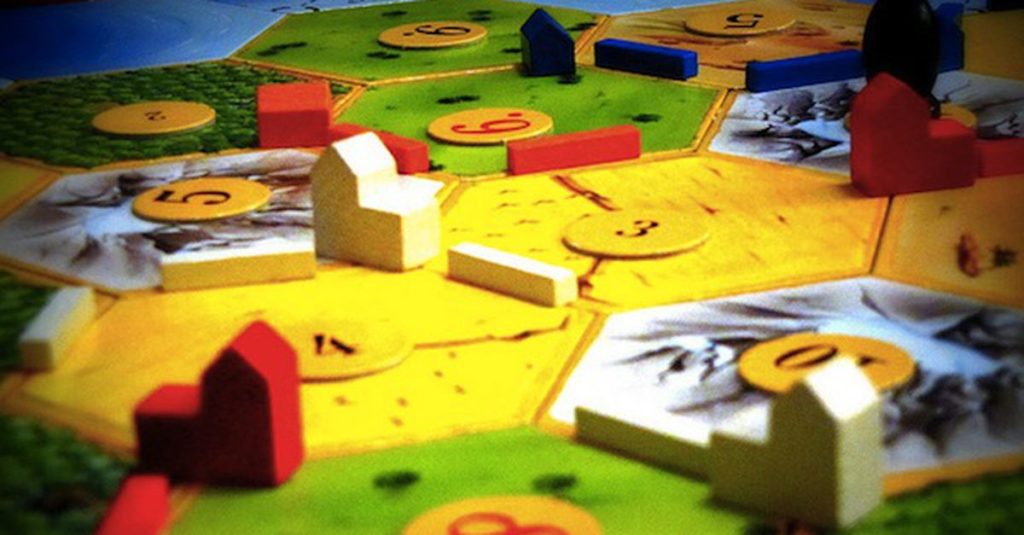
Catan, is a board game that revolves around building settlements and amassing resources. The goal is to acquire victory points before other players. In my version there is a fixed time limit to play, typically one hour. Victory points can be obtained by building settlements, upgrading them to cities, or collecting development cards that generate victory points. Players collect resources by acquiring various spaces on the board, and they can trade resources with other players to gain an advantage. Beyond being an incredibly fun board game, Settlers of Catan, or simply “Catan” as we call it, can teach you a lot of lessons about life and leadership. Here are five about leadership I’ve learned from playing.
1. YOUR SUCCESS DOES NOT DEPEND ON THE FAILURE OF OTHERS.
One of the aspects of Settlers of Catan that makes it so appealing is that players can pursue their goals without having to worry about stomping on other players en route. Unlike many other metaphors this is not win-lose. While there are ways to impede the progress of others, sometimes doing so can hinder your own progress. In leadership situations, we are often more concerned with thwarting the competition than pursuing our own goals. Settlers of Catan teaches us that we can pursue success without using others as our steppingstone on the way.
2. YOU HAVE TO BE AWARE OF RELATIONAL DYNAMICS.
In Catan, players can trade resources with each other to gain an advantage, if they wish. Players need to be aware of how many points the other players have and what strategies they are deploying to reach their goals. They need to be relationally aware and navigate the relational dynamics present among the players to be able to use other players as a resource as well as the game board itself. This lesson is valuable in leadership situations, where understanding the motivations and goals of your team members or even suppliers, customers or competitors is critical to success.
3. YOU CANNOT IGNORE HOW THE NEEDS OF OTHERS CAN IMPACT YOUR OWN NEEDS.
Trading in Catan is critical to success. Players who actively trade resources with other players to get what they need typically perform better. However, they cannot be so focused on their own needs that they forget what other people need. In life and leadership, when we make compromises with people, we have to be as aware of the needs of others as we are of our own.
4. YOU HAVE TO MANAGE YOUR RESOURCES WELL IN ORDER TO SUCCEED.
Resource management is critical in Catan. More than that resource needs and values change during the game and so what strategy may have brought you early success may not bring victory. The more resources you collect, and the better able you are to access scarce resources the more likely you are to win. Success in the game ultimately boils down to resource management. In life and leadership, if you are unable to manage your resources well and figure out what resources are most valuable to you, you will not succeed.
5. SUCCESS CAN BE ACHIEVED IN A NUMBER OF WAYS.
In Catan, the goal is always to acquire victory points, but there are many ways to achieve that goal. There are many different strategies to pursue to win, and you may need to amend your strategy should the board or your fellow players impede your progress. If you play repeatedly the board can be set up differently each time, which makes it fun and unpredictable. Leadership is the same way. As a leader, you need to consider the resources you have at your disposal and figure out the best way out of many different ways to achieve your goal.

While Catan can be a valuable tool for teaching business strategy, there are some downsides to consider. Firstly, its a game! Secondly, one less obvious downside is that the game can be time-consuming, and players may become too absorbed in actual game mechanics to consider the strategic implications of their decisions. To address this I have recently discovered Catan Junior- which is a version of Catan that can be played in half and hour and which retains much of the strategic decisions of the longer-form. In so doing I hope to highlight strategic learning to more executives in a fun and absorbing way.