

Our contemporary business landscape is has increasingly swift transformations and growing complexity, driven by factors such as rapid technological progress, globalization, evolving consumer preferences, and a volatile competitive climate. Businesses and individuals must comprehend and make decisions amid a vast interconnected network of variables, often with incomplete information and under the pressure of stringent deadlines. Modern business is complex. Within this demanding environment, the potency of simplicity, especially as encapsulated in mental models, should be strikingly evident.
All to often, though, participants in my learning sessions appear to be seeking complex theories to consider. We are at a University, things should be academically complex and hard to understand? They seek novelty and newness, and I believe have little desire to actually take these ideas away and implement them.
Thats why I choose to share simple models. Humans naturally look for patterns and connections, strive to understand cause and effect, and seek to make sense of the world in a way that enables us to predict, plan, and take effective action.

At first glance, business landscapes can seem simple, defined by basic market interactions cause and effect. However, upon closer inspection, we are confronted with an intricate web of factors — rapid technological evolution, globalization, changing consumer behaviours, and competitive dynamics — that morph this landscape into a complex intertwined ecosystem. This complexity is overwhelming and demands cognitive dexterity to make informed decisions. Yet, an overemphasis on complexity can lead to indecision and stagnation as you try to find more and more data to make the right decision. The challenge is to ascend from the simplistic through the complex to arrive at a higher level of simplicity — a simplicity on the other side of complexity (from famous Jurist Oliver Wendell Holmes). This enlightened simplicity involves distilling the complexity down to its essence to facilitate understanding and action. It is about creating simple but robust mental models that cut through the noise, providing clarity amidst chaos. These models, while being easy to grasp, encapsulate the multifaceted nature of business, turning the daunting complexity into a navigable landscape, a competitive advantage.
Complex academic theories or exhaustive strategic models, although comprehensive and robust, are impossible to apply in the fast-paced, high-stakes world of business. They demand significant time and effort to understand and implement, and their high level of abstraction can make it difficult to translate them into tangible actions. Equally such plans are often out of date them moment implementation starts. Conversely, simple mental models act as cognitive shortcuts, enabling us to understand and respond to complex situations quickly and efficiently and are better able to provide robust and effective modes of action.
For example, a detailed strategic analysis model involving in-depth market research, competitor analysis, financial modelling, and risk assessments might be theoretically rigorous, but it can overwhelm decision-makers, leading to delays and indecision. In contrast, a simple mental model for strategy can slice through this complexity, facilitating faster understanding, decision-making, and active implementation, in 90% of cases.
In essence, simplicity helps manage complexity by providing clarity, enhancing understanding, accelerating decision-making, and promoting robust action. Simple mental models arm business leaders with the tools to navigate the intricate, dynamic business world, turning their quick effective response to complexity into a competitive advantage.
Next, let’s reexamine your mental models in the context of their roles in strategy development and implementation. The key is to understand how simplified mental models lead to better alignment and, as a result, more effective action in a complex business environment.
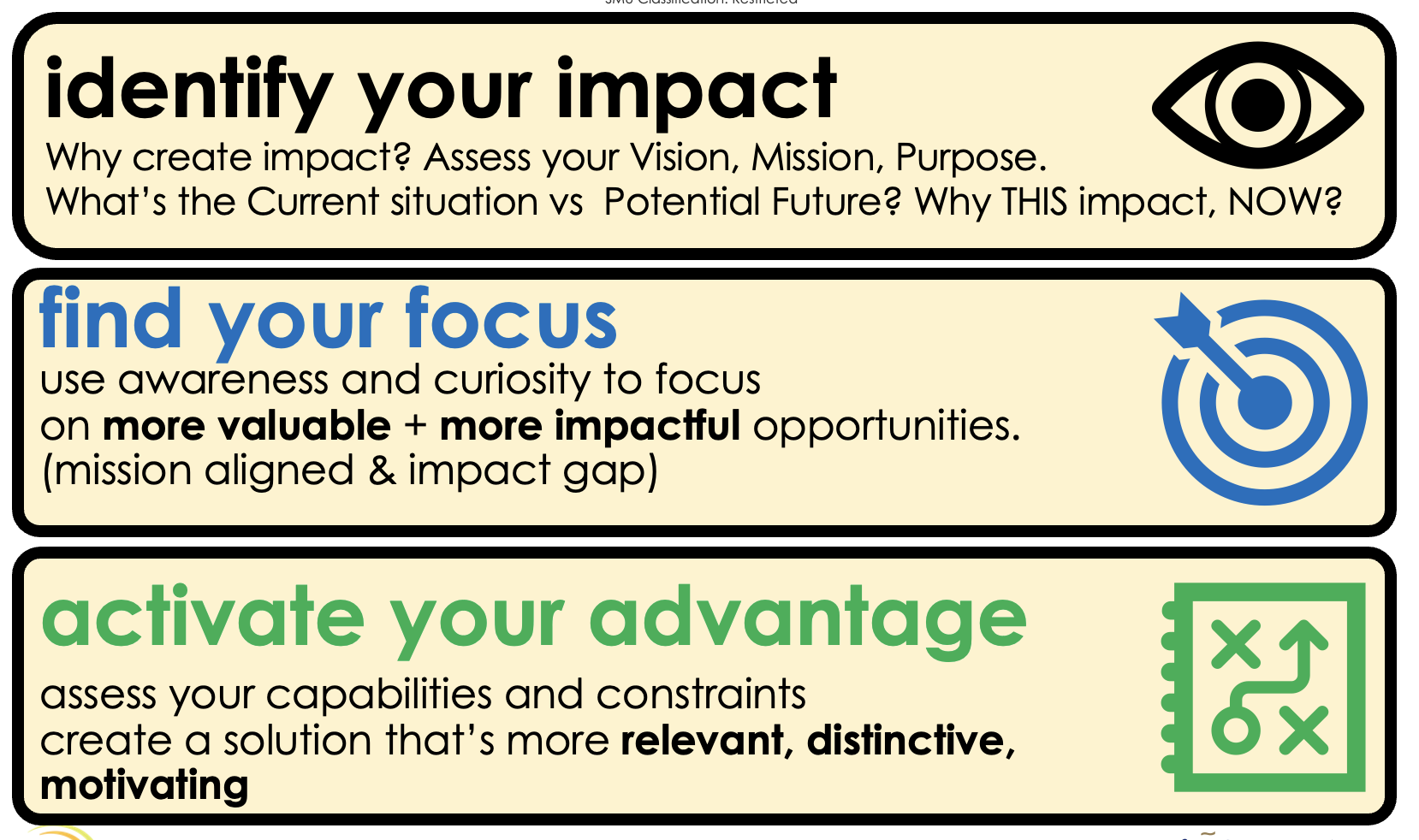
The first mental model is to enable you to consider and then explain your business strategy. Its based on Lafley and Martin’s approach and has three steps, (1) Identify your Impact, (2) Find your Focus, (3) Activate your Advantage. I believe this distills strategy development into three components, reducing complexity and enhancing understanding.
For instance, consider a technology company aiming to make advanced technology accessible to the wider public. The initial step, ‘Identify Your Impact,’ assists in defining the organization’s purpose. By aiming to democratize advanced technology, the company lays out a clear, inspiring mission that resonates with all stakeholders, from executives to employees. This step simplifies a complex strategic vision into a single, digestible objective.
Next, ‘Find Your Focus’ helps the company recognize that its needs to channel its resources and efforts where it can have the most significant impact – in this case, for example, consumer electronics. This step provides clear direction, preventing decision paralysis and maintaining alignment throughout the organization.
Lastly, ‘Activate Your Advantage’ nudges the company to utilize its unique capabilities – such as a superior user interface design team or proprietary technology, or exceptional customer relationships. This step clarifies the company’s competitive advantage and allows it to swiftly mobilize its resources, propelling the implementation process.
(as an aside, you may wish to toggle “find your focus” and “activate your advantage”, for example if you have a sustained advantage you may seek to find other places where you may focus, expanding your business based on existing capabilities)
This mental model, in its simplicity, aids the organization in navigating the complexity of the business landscape. By simplifying the strategy development process, the model ensures that the entire organization aligns behind a shared understanding of its mission, focus, and unique advantages. It enables leaders to identify where barriers are and quickly overcome them.

A second mental model, the other side of the strategy coin, assists strategy implementation. By considering “Trigger Awareness, Believe in your Ability, and Motivate Commitment” will assist in implementing the strategy we’ve developed.
Starting with ‘Trigger Awareness,’ the leadership team’s job is to effectively communicate both the challenges of the business environment and their strategic response across the organization. Everyone should know what’s going on – that the goal is to democratize advanced technology, with a focus on consumer electronics, and that the company will lean into its unique strengths to do this- and that this impact is urgent and important.
Triggering this awareness isn’t just a matter of sending out a memo or a document and expecting everyone to fall in line. Consider a large organization with thousands of employees spread out over multiple locations. Simply sending out an plan outlining the new strategy won’t suffice. Instead, think of this as the start of a campaign that needs to be actively managed. Town halls identifying why we need to make this impact and why action is urgent and important followed by Q&A sessions, and smaller team meetings should all be part of this effort to ensure everyone not only knows about the business environment the organisation is in, understands how the strategy affects their day-to-day work, and all realise why implementation is urgent and important.
Next is ‘Believe in our Ability.’ This part is about making sure your people have the skills, knowledge, resources and connections to implement the strategy AND the confidence they need to contribute to the new strategic direction. This step will involve stopping less important initiatives to release capacity, providing internal or external skill building, pilot programs, support from management.
Consider our organization where the new strategy has identified the need for a bigger emphasis on customer service. That might mean not just training for customer-facing staff but a change in company culture to ensure everyone, from the CEO down, prioritizes customer satisfaction. Initially a pilot program is created to show to all that the new approach works, followed by extensive service skill building. This phase is crucial because it’s about bridging the gap between understanding the strategy and being able to put it into practice.
Lastly, ‘Motivate Commitment’ is about creating a work environment where every stakeholder can buy in and take ownership of the strategy implementation plan. This stage is where the company needs to create a sense of shared responsibility, which is key to the successful execution of the strategy, it may involved restructuring in response to stakeholder feedback, obviously revision of KPIs, and maybe new types of recognition and rewards.
Returning to our previous example, motivating commitment might involve linking existing performance metrics to new customer satisfaction measures or including customer feedback in product development discussions. It may need the marketing team to be more focused on client understanding and to be more infield. By making everyone a part of the process and showing how their contribution matters, you can foster a commitment to the strategy across the organization.
In essence, the simplicity of these mental models helps manage the complexities of strategy development and implementation. The models create a shared understanding of how your organization does things, speeds up decision-making, and encourages unified, effective action. By translating the complexities of strategy and implementation into simpler understandable and actionable terms, these models ensure organizational alignment, crucial for successful execution in our ever-evolving business landscape. By using these simple models, organizations can cut through complexity and use it to their advantage, rather than being hindered by it.