

Cognitive diversity, the variance in problem-solving approaches and perspectives within a team or organization, is often seen as a valuable asset. The comparison between the mindset of an entrepreneur and that of an engineer grand master provides a fascinating exploration of this concept.
The Entrepreneur: The ‘No Ice’ Approach
Entrepreneurs epitomize a mindset of ‘proving it right.’ They are quintessentially innovators, willing to take calculated risks, pushing boundaries, and constantly seeking opportunities for growth. The ‘no ice’ analogy applies aptly to this entrepreneurial mindset, referring to their inherent propensity to seek out undiscovered territories quickly, akin to exploring unchartered oceans with no ice, in the quest for novel solutions, avoid barriers and problems, seek the path of least resistance.
Entrepreneurs value speed, decisiveness, and adaptability, often making decisions based on incomplete information and iterating as they move forward. They are comfortable with ambiguity and uncertainty, thriving in fluid situations where the path forward isn’t always clear. This flexibility and readiness to pivot are cornerstones of entrepreneurial success, often leading to disruptive innovations that redefine industries.
The Engineer Grand Master: The ‘Proving it Wrong’ Approach
Contrast this with the mindset of an engineer grand master, who typically adopts a ‘proving it wrong’ approach. These individuals excel in deep dives into complex problems, carefully examining each potential solution to eliminate incorrect ones meticulously. They prefer exhaustive exploration and examination, akin to the highly strategic, thoroughly analytical approach of a chess grandmaster.
Engineer grand masters bring a different kind of value to an organization. Their focus is on precision, detail, and comprehensive understanding, often resulting in exceptionally well-crafted solutions and innovations. They approach challenges systematically, breaking them down into manageable parts, and carefully evaluating every aspect to ensure accuracy and reliability.
Cognitive Diversity Advantage: A Powerful Fusion
By combining these two distinct cognitive styles – the entrepreneurial and the engineer grand master – organizations can achieve the cognitive diversity advantage. This fusion leads to a robust problem-solving mechanism that allows for both rapid, innovative decision-making and meticulous, comprehensive analysis.
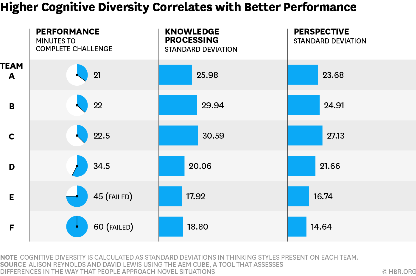
Studies, such as the one reproduced above consistently show that cognitive diversity consistently out performs

The heart of diversity and the real benefit diversity brings in not in and of itself, but lies in how diversity of thought and of problem solving, engagement, leadership can add sustained value
The entrepreneurial approach ensures the organization remains agile, adaptive, and forward-thinking, constantly seeking opportunities and ready to pivot when necessary. Meanwhile, the engineer grand master mindset ensures the organization maintains a rigorous, methodical approach to problem-solving, reducing errors, enhancing reliability, and driving sustained, high-quality performance.
In essence, the cognitive diversity advantage represents the best of both worlds – the dynamism and innovativeness of the entrepreneurial mindset paired with the precision and thoroughness of the engineer grand master. This combination fosters a culture of continuous learning, improvement, and innovation, leading to exceptional outcomes that surpass what either approach could achieve on its own
Pitfalls ahead…
The biggest pitfalls in implementing this approach in real life could be managing and integrating such diverse ways of thinking within a team or an organization.
- Inclusion challenge: While cognitive diversity is beneficial, it also requires an inclusive culture where diverse thoughts are valued and respected. Without such a culture, cognitive diversity can lead to alienation and decreased morale among team members.
- Communication challenges: With varying ways of thinking and approaching problems, communication can become challenging. Each person may understand and interpret information differently, which could lead to misunderstandings and confusion.
- Conflict management challenge : Differences in problem-solving approaches and viewpoints can lead to conflicts. All to identify we focus on perceived affective slights and “take offence” where none is given, rather on cognitive conflict to create better solutions. If not managed well, these conflicts can escalate and affect team dynamics and overall productivity.
- Alignment Challenge : It might be challenging to achieve alignment on decisions and strategies, as people with diverse cognitive styles might have different perspectives and opinions.
- Time and resources: Leveraging cognitive diversity means creating an environment where all voices are heard, and all ideas are considered. This can take more time and resources than a more streamlined, less diverse approach.
Balancing cognitive diversity with effective teamwork and common goals requires skilled management and an open, inclusive culture that respects and values diverse.
Cognitive diversity, like the complementary yet distinct perspectives of an entrepreneurial ‘no-ice’ player and a meticulous ‘engineer grand master’, is a powerful driver for innovation and problem-solving in business. However, capitalizing on this asset requires an understanding of individual work styles and the ability to mediate potential conflicts. This is where the DISC model, a well-known behavioral assessment tool, comes into its own.
The DISC model categorizes individuals into one or more of four work styles: Dominance, Influence, Supportive, and Conscientiousness. By understanding these styles, organizations can foster empathy, build trust, and navigate conflicts more effectively.
Empathy through DISC
The first step towards leveraging cognitive diversity is fostering empathy among team members. For instance, an entrepreneurial ‘no-ice’ individual (likely a Dominance/Influencing style) may focus on expressive thinking, quick decisions and focus on fast results, while an ‘engineer grand master’ (possibly a Conscientiousness/Supportive style) might be detail-oriented and meticulous perfectionist, even in the face of slower progress. By understanding each other’s cognitive work styles, they can empathize with each other’s approaches, fostering mutual respect and cooperation.
Trust Building with DISC
Trust is essential for effective teamwork, especially when cognitive diversity is high. DISC can help build this trust by providing transparency about individual work styles. For example, the Influence style may learn and understand that the Conscientiousness style isn’t being overly cautious, but is merely meticulous in their process perfecting approach. This understanding can help build trust, fostering a cohesive and productive team dynamic- same outcome differing approach.
Conflict Resolution through DISC
When different cognitive styles collide, conflicts can arise. However, these conflicts can be effectively managed through an understanding of DISC work styles. For example, the Supportive style team member, known for their patience and diplomacy, might mediate between the ‘no-ice’ entrepreneur and the ‘engineer grand master’. By leveraging their understanding of different work styles, they can help navigate conflicts and bring about resolutions that respect everyone’s perspectives. Simply by understanding that people behave differently and accepting that difference and trying to flex one’s own style can certainly assist in preventing affective conflict.
In conclusion, by applying the DISC model, organizations can harness the potential of cognitive diversity. This understanding leads to improved empathy, trust, and conflict resolution, making it an invaluable tool for maximizing the benefits of the ‘Cognitive Diversity Advantage’.