

It’s coming to Halloween and to have a halloween theme post (as Brexit will be yet again delayed) I’ve chosen a great zombie company to consider.
Netflix now the home of famous Zombie series “Kingdom” and “the Walking Dead” but much like its favourite series, Netflix is a zombie company and I don’t mean because of Kingdom, The Walking Dead, Z Nation, iZombie, Santa Clarita Diet, Dead Set, Containment, & Helix their top ten zombies highlighted for this Halloween.
Netflix was founded in 1997 and has been modestly cash-flow positive in the distant past but has recently plunged into leaking cash. Analysts think by 2023 the company will be cash flow break even and it will be 26 years old. It has to go incredibly well in the meantime if the company can finally reach cash-flow “breakeven” – not even cash-flow positive – 26 years after it was founded.


Its balance sheet is a mess.
After years of borrowing cash and then burning it, the company now has $12.1 billion in “content liabilities” and $12.4 billion in long-term debt, for a total of $25.5 billion that it owes. That $2 billion in new debt to be issued will bring its long-term debt to $14.4 billion, and the total to $27.5 billion.

Those pesky “content liabilities.”
The “content liabilities” are incurred when Netflix enters into a contract to obtain future movie titles, and it puts the amount it owes for those titles on its balance sheet as a liability when the title becomes available to be streamed. It also records an equivalent asset on its balance sheet, which is added to “content assets” that, as of its third quarter SEC filing last week, amounted to $23 billion.
These $23 billion in content assets are future expenses that Netflix is very fast in acquiring and very slow in letting them trickle down via “amortization” to the income statement where they would hit its profit.
These “content liabilities” have to be paid in the future. Of them, the “current content liabilities,” which have to be paid over the next 12 months, amount to $4.86 billion. This explains the need to borrow $2 billion now by issuing the bonds, and to borrow another $2+ billion that way early next year.

The “content assets” are movie titles to be streamed and made money off in the future. But they’re not expensed on the income statement when they’re acquired; instead they’re parked on the balance sheet. And then, very slowly, they’re amortized over many years – meaning they’re bought in huge amounts very quickly but expensed on the income statement in tiny drips. So on a quarterly and annual basis, the amortization expense Netflix recognizes on its income statement, where it hits profits, is tiny compared to the amount Netflix pays over the same period for these titles.
There is some accounting justification for that method – in that these content assets will produce income in the future, hopefully. But clearly, Netflix is going way too far in pushing its interpretation of the accounting rules. And this wild interpretation of accounting rules is one of the reasons why Netflix shows a profit and a huge negative cash flow at the same time, year after year.
And this turns its income statement into garbage.
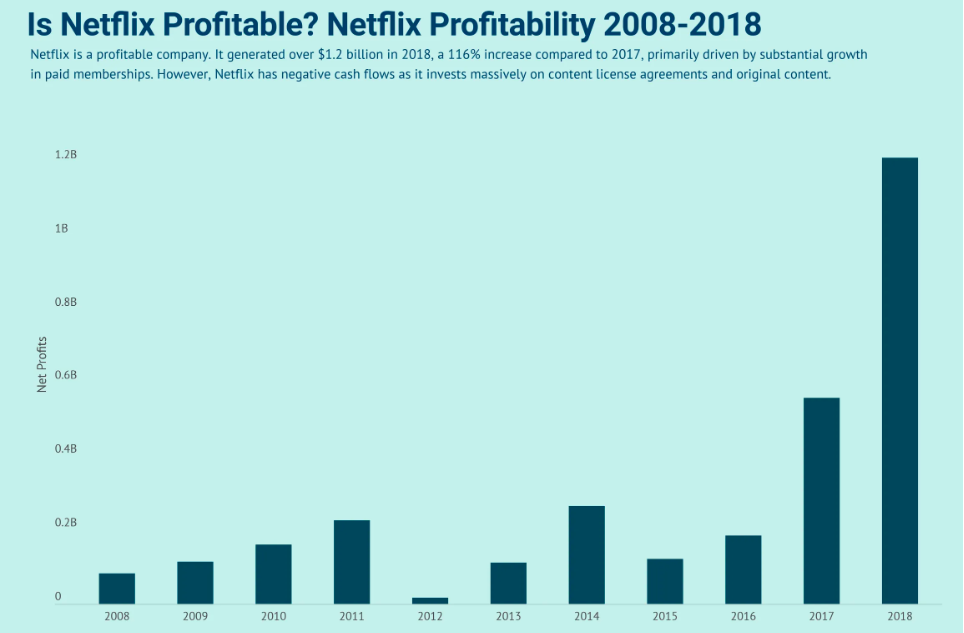
For the first nine months of 2019, the income statement showed a net income of $1.28 billion and a negative cash flow (or “free cash flow” as Netflix calls it) of -$1.6 billion, for a huge gap between net income and cash flow of $2.89 billion.
Netflix says in its filing that the huge $2.89 billion gap between net income and negative cash flow so far this year was “primarily due” to the fact that the “cash payments” it made for its “streaming content assets” exceeded the amortization expense of content assets over the same period “by $3.46 billion.”
In other words, the income statement that Netflix offers – though it likely conforms to a wild interpretation of GAAP – is garbage. In terms of Netflix, cash flow and the pileup of liabilities (content liabilities and debt) are the metrics that matter the most. But they’re too ugly to behold.
So Netflix and Wall Street analysts hammer home that the only metric that matters is subscriber growth because the rest is by now too ugly to behold. Except that Subscriber numbers are not that nice either

something needs to be done to keep this Zombie alive as its paying almost US$600M per annum in interest, with a few billion loans due for repayment, obviously more debt will be needed to roll this debt over.