

The most critical challenge becoming a new manager, having a new team member join you or the challenging move from being a team member to becoming team leader is how to get your team to follow you? In my experience this is the most challenging facet of leadership, managing interpersonal relationships before trust is established. And while we always say build trust; rarely are there practical suggestions on what to do.
My typical advice would be to have the team complete a DISC assessment and then use this to identify their behaviour preferences. But sometimes this does not go far enough. For example, where should you focus if a number of different issues come up… what are the most important? As an example, here is Sarah’s story. Imagine she asks your opinion of what to do. How could you structure your suggestions and ensure they cover all potential problems?
Sarah’s recent promotion from team member to newly minted manager had been a joyful occasion for her, yet her first team meeting seemed to have some undercurrents. As she walked into the meeting room, she could sense the shift in dynamics; the previous Boss had just retired after 30 years in the role. These were the same people she used to laugh with at lunch breaks for the last three years, but now, their faces were masks of professional neutrality, and in some cases, something else.
During the meeting, John, who had been with the company for over a decade and had vied for the managerial position himself, seemed to question everything Sarah suggested. His underlying message seemed clear to Sarah —he questioned her experience and capability to lead as he was older, and more experienced. It seemed Sarah’s new role disrupted the existing social hierarchy within the team.
A key project they were working on was high stakes, and recent shifts Ministry policy had led to frequent changes in project directives. This lack of stability left the team feeling uncertain and demoralized. Sarah noticed the furrowed brows and the side conversations that halted as soon as she drew near. Was the team’s certainty about roles and the project’s goals wavering?
Autonomy had been a sore point under the previous manager. He had micromanaged leaving little room for individual initiative. Sarah recalled a recent incident where a team member, Lisa, had hesitated to make a small decision without checking-in first. Sarah knew that Lisa felt handcuffed but was unsure what to do.
At lunch Sarah saw that the old lunch groups were still there. She tried to have lunch with both – the older experienced staff and the newbies (well those who had less than 5 years in the team. During the coffee break, Sarah overheard two newer team members, Tom and Lisa, discussing how they felt left out of key communication loops, dominated by the oldies as they were called.
There has always been comments about the old Boss playing “favorites” sharing the best assignments for the oldies or the oldies to receive team recognition awards at Head Office. At one point, Sarah overheard Tom and Lisa talking about how the oldies seemed to get all the perks while they were overlooked, no matter their input or results.
A DISC assessment categorizes individuals into four primary behavioral styles:
- Dominance (D): Direct, results-oriented, and decisive.
- Influence (I): Outgoing, enthusiastic, and relationship-focused.
- Supportiveness / Steadiness (S): Patient, reliable, and team-oriented.
- Conscientiousness (C): Analytical, detail-oriented, and quality-focused.
In Sarah’s team, she can use DISC to identify the behavioral styles of her team members. For example:
- John (D): As a dominant personality, John values control, results, and respect for his expertise. He may be critical of Sarah’s leadership because he feels she is not direct and proactive enough, but is that all.
- Emma (I): An influential team member who thrives on collaboration and recognition but is that why she is acting the way she is.
- Mike (S): A supportive (steady) team member who values stability and harmony. He may be struggling with the lack of certainty and frequent changes in the project.
- Lisa (C): A conscientious team member who values clarity, structure, and fairness. Why is she frustrated?
What could Sarah do? What advice do you have? In this case how could we augment DISC to assist Sarah
Let me introduce you to the SCARF model, developed by David Rock in 2008. This model focuses on the brains reaction to the perception of threat or reward and brings conscious awareness into inter-personal interactions. It helps you to become aware of people’s core concerns and assist understand what behaviour of yours or situation within the environment can prompt the emotion of threat or reward? It is widely recognized in the fields of neuroscience, psychology, and organizational behavior for its practical application in improving interpersonal relationships and workplace dynamics. Grounded in neuroscience, the SCARF model explains how the brain responds to social threats and rewards, offering leaders a framework to understand and influence behaviour.
The SCARF model is named after its five key domains—Status, Certainty, Autonomy, Relatedness, and Fairness—that influence human behaviour and motivation. For new leaders, the SCARF model provides valuable insights into managing teams effectively. By understanding and addressing concerns related to these five areas, leaders can enhance team cooperation, reduce resistance to change, and improve overall engagement.
However, to truly maximize the impact of the SCARF model, it can be powerfully combined with the DISC assessment, a tool that identifies individual behavioural styles. While SCARF helps leaders understand the “why” behind behaviour—what drives people socially and emotionally—DISC helps leaders understand the “how” —how individuals naturally behave and communicate. Together, these tools create a comprehensive approach to leadership.
Why and How SCARF Adds Tangible Value to a DISC Assessment for New Leaders
The SCARF model adds significant value to a DISC assessment for new leaders by addressing the “why” behind behaviour, complementing DISC’s focus on the “how”. While DISC provides insights into individual behavioural styles—how people communicate, make decisions, and respond to challenges—SCARF delves into the social and emotional drivers that influence motivation, engagement, and performance. Together, these tools create a holistic framework for leadership development.
New leaders often struggle to understand why certain behaviours occur, even when they know how their team members typically act. For example, a Dominant (D) team member might become confrontational, not just because of their natural assertiveness (DISC insight), but because they feel their status is threatened (SCARF insight). Similarly, a Supportive (S) team member might disengage not just because they prefer stability (DISC insight), but because they lack certainty about their role or the project’s direction (SCARF insight). By combining DISC and SCARF, leaders can diagnose both behavioural and emotional root causes, enabling them to address issues more effectively and foster a positive, productive work environment.
New leaders can use SCARF to enhance their DISC insights by:
- Identifying Emotional Triggers: Use SCARF to pinpoint which of the five domains (Status, Certainty, Autonomy, Relatedness, Fairness) might be causing stress or disengagement. For example, if a Conscientious (C) team member is underperforming, it might be due to a lack of autonomy or fairness.
- Tailoring Solutions: Combine DISC behavioural insights with SCARF emotional insights to create tailored solutions. For instance, if a Dominant (D) team member feels their status is threatened, a leader can reaffirm their expertise and involve them in decision-making, aligning with their need for respect and control.
- Adapting Communication: Use DISC to adapt communication styles while applying SCARF principles to address emotional needs. For example, when providing feedback to an Influential (I) team member, a leader can focus on maintaining their sense of relatedness and fairness while leveraging their preference for enthusiastic, collaborative communication.
- Building Trust and Engagement: By addressing both behavioural and emotional needs, leaders can build trust, reduce resistance to change, and enhance team cohesion. For example, fostering a sense of certainty and autonomy for a Steady (S) team member can increase their engagement and loyalty.
Please see Appendix 1 for SCARF DISC insights and how to use both models together .
In essence, the SCARF model and DISC assessment are complementary tools that, when used together, empower new leaders to diagnose challenges, adapt their approach, and build high-performing, engaged teams.
What are the Key Strengths of the SCARF Model:
- Neuroscientific Foundation: The model is based on research showing that the brain processes social threats and rewards similarly to physical threats and rewards. This makes it a scientifically grounded tool for understanding behavior.
- Practical Application: The SCARF model is highly actionable, providing clear guidelines for leaders and managers to improve engagement, collaboration, and performance in teams.
- Broad Relevance: It applies to a wide range of contexts, including leadership, team dynamics, conflict resolution, and change management.
- Simplicity and Accessibility: The model’s five domains are easy to understand and remember, making it accessible for practitioners without deep expertise in neuroscience or psychology.
- Positive Feedback in Practice: Many organizations and leadership coaches have reported success in using the SCARF model to address workplace challenges, such as reducing resistance to change and improving communication.
While the SCARF model is widely accepted and utilized, it is not without criticism. Some of the key limitations and complaints include:
1. Oversimplification: Critics argue that the model reduces complex human behavior to just five domains, potentially overlooking other important factors that influence motivation and engagement. But a model should be easily applicable and while there are other elements five are more than sufficient to cover more than 90% of issues.
2. Cultural Bias: The model may not fully account for cultural differences in how individuals perceive and prioritize status, autonomy, fairness, and relatedness. For example, Asian collectivist cultures might place less emphasis on individual autonomy compared to individualist cultures. And so please be aware that this is a western culture model as you use it.
Please also note that the SCARF model should not be considered static. Don’t assume that all individuals respond similarly to the same threats and rewards in the five domains. Remember that different work styles may perceive the same actions in different ways so please be mature about using this. Also consider how the importance of each SCARF domain may shift over time or in different contexts or situations. For instance, during a crisis, certainty might become more critical than autonomy. So please be pragmatic about utilising it
Is the SCARF Model Valid and Useful?
The SCARF model is valid in the sense that it is grounded in well-established neuroscience principles and has been widely adopted in practice. However, its simplicity and lack of extensive empirical validation mean it should be used as a heuristic tool rather than a definitive framework. The model is highly useful for practical applications, particularly in leadership, team management, and organizational development. Its strengths lie in its simplicity, accessibility, and actionable insights. However, practitioners should be aware of its limitations and consider complementing it with other models or frameworks to address its gaps, such as cultural differences and individual variability.
The MODEL itself

In the SCARF model, understanding the concepts of ‘Threat’ and ‘Replenishment’ (or as some may refer to it, ‘Reward’) is crucial for new leaders. These concepts are based on neuroscience research that shows how social interactions can activate the same pathways in our brains as physical pain or pleasure. Essentially, ‘Threat’ refers to social experiences that might trigger a negative (gut felt) response, making a person feel less safe, valued, or certain about their environment. Conversely, ‘Replenishment’ involves social experiences that generate (gut felt) positive responses, enhancing feelings of security, value, and understanding.
Understanding the SCARF Model:
1. Status is about an individual’s relative importance compared to others. A threat to someone’s status might be feeling demeaned or unimportant, which can occur through negative feedback or public criticism. To replenish status, leaders should focus on recognizing contributions, offering praise, and clarifying roles to make individuals feel their value to the team is understood and respected.
2. Certainty concerns an individual’s ability to predict the future. Uncertainty can be a threat because it creates stress by making it difficult for individuals to anticipate what’s expected of them. Leaders can replenish certainty by setting clear goals, providing transparent updates, and maintaining consistency in policies and practices.
3. Autonomy refers to the sense of control over one’s life. When micromanagement occurs, it can threaten autonomy as individuals feel they have no control over their work or decision-making processes. Replenishing autonomy can be achieved by delegating responsibilities, encouraging independent decision-making, and allowing team members to explore different ways of achieving goals.
4. Relatedness is the sense of safety and belonging with others. Feeling excluded or isolated is a threat to relatedness. Leaders can foster a replenishing environment by promoting teamwork, encouraging social interactions, and building trust among team members through open and honest communication.
5. Fairness involves transparent and equal interactions. Perceived bias or injustice can threaten fairness, leading to resentment and disengagement. To ensure fairness is replenished, leaders should implement equitable systems and standards, ensure all team members are treated equally, and decisions are transparent and based on objective criteria.
How Understanding SCARF Can Help Diagnose Problems
SCARF identifies WHY there are problems, DISC can assist HOW you address them.
1. Status
Problem: John’s criticism of Sarah’s authority and his feeling undervalued are threats to his sense of status. DISC Insight: John has a Dominant (D) behavioural style. He values respect, control, and recognition for his expertise. His criticism likely stems from feeling his status is threatened by Sarah’s promotion. SCARF Solution: Sarah can reaffirm John’s importance by publicly acknowledging his experience and contributions. She can hold one-on-one meetings with him to seek his input on key decisions, showing respect for his expertise. For example, she might say, “John, your experience in this area is invaluable. I’d like your input on how we can approach this project.” By involving him in decision-making and giving him a platform to share his ideas, Sarah addresses his need for status while leveraging his natural leadership tendencies.
Additionally, Sarah can use DISC to tailor her approach with other team members. For example, with Influential (I) team members like Emma, she can highlight their unique strengths and contributions in team meetings, ensuring they feel recognized and valued.
—
2. Certainty
Problem: The team is struggling with unclear priorities and frequent changes, leading to stress and disengagement. DISC Insight: Team members with Steady (S) and Conscientious (C) styles, like Mike and Lisa, are particularly affected by uncertainty. Mike values stability and harmony, while Lisa thrives on clarity and structure. SCARF Solution: Sarah can provide clarity by setting clear goals, timelines, and expectations where possible. For example, she can create a project roadmap with milestones and share it with the team. When changes are unavoidable, she can act as a buffer between upper management and the team, communicating changes transparently and explaining the rationale behind them.
To address the emotional impact of uncertainty, Sarah can share examples of past challenges the team successfully navigated, such as during COVID-19. For instance, she might say, “I know this feels uncertain right now, but remember how we adapted during COVID? We can handle this too.” Regular updates and check-ins will help maintain a sense of stability, particularly for Mike and Lisa, who need predictability to feel secure.
—
3. Autonomy
Problem: Team members have felt micromanaged and lack the freedom to make decisions. DISC Insight: Team members with Dominant (D) and Influential (I) styles, like John and Emma, value independence and control. They are likely most frustrated by micromanagement. It is also possible that Mike and Lisa appreciated the security of micromanagement. SCARF Solution: Sarah can empower some of her team by delegating desired outcomes rather than specifying how tasks should be achieved. For example, she might say, “John, I need this report to include these key metrics, but I trust you to decide how best to present the data.” She can establish clear boundaries (e.g., red lines not to be crossed) and set regular check-ins to provide guidance without stifling creativity.
For Conscientious (C) team members like Lisa, Sarah can provide more detailed guidelines initially, gradually increasing autonomy as trust builds. This tailored approach ensures that everyone feels empowered while respecting their individual preferences.
—
4. Relatedness
Problem: The team is fragmented, with cliques and a lack of collaboration. DISC Insight: Team members with Influential (I) and Steady (S) styles, like Emma and Mike, are most affected by a lack of relatedness. Emma thrives on relationships and collaboration, while Mike values harmony and teamwork. SCARF Solution: Sarah can foster a sense of belonging by organizing team-building activities, such as informal lunches or collaborative workshops. She can also mediate open communication by pairing members of different cliques on projects. For example, she might assign Emma and a more reserved team member to work together on a task, encouraging them to share ideas and challenges.
To strengthen the team’s unity, Sarah can celebrate team achievements and highlight how collaboration led to success. For instance, she might say, “This win was a team effort—Emma’s creativity and Mike’s attention to detail made all the difference.” This approach not only builds relatedness but also reinforces the value of diverse contributions.
—
5. Fairness
Problem: Perceptions of favoritism and unequal treatment are causing resentment. DISC Insight: Team members with Conscientious (C) and Steady (S) styles, like Lisa and Mike, are particularly sensitive to fairness. They value equity and transparency. SCARF Solution: Sarah can ensure transparency by establishing objective criteria for performance evaluations and recognition. For example, she can create a scoring system for project contributions and share it with the team. She can also seek regular feedback on fairness and address concerns promptly.
To address individual needs, Sarah can tailor her approach based on DISC profiles. For Influential (I) team members like Emma, she can provide public recognition for their contributions, while for Conscientious (C) team members like Lisa, she can focus on providing detailed, objective feedback. By treating everyone equitably while respecting their unique preferences, Sarah can build trust and reduce resentment.
Outcome of Combining DISC and SCARF
By integrating DISC and SCARF, Sarah can understand where she should focus first, with the key emotional challenges her team faces with new leaderhsip:
- Diagnose Challenges More Accurately: DISC helps her understand individual behaviors, while SCARF helps her identify the underlying social and emotional drivers.
- Tailor Solutions to Individual Needs: She can address each team member’s unique needs based on their DISC profile and SCARF domains.
- Adapt Her Leadership Style: She can adjust her approach to balance her natural tendencies with the team’s needs.
- Build a Cohesive, Motivated Team: By addressing both behavioral and emotional factors, Sarah creates an environment where everyone feels valued, understood, and empowered.
For example, Sarah’s approach with John (D) focuses on reaffirming his status and involving him in decisions, while her approach with Mike (S) emphasizes providing certainty and stability. Similarly, she empowers Emma (I) by fostering collaboration and recognizes Lisa’s (C) need for fairness and clarity.
Key Takeaway for New Managers
Combining DISC and SCARF provides a powerful framework for new managers to understand and address both the *how* and *why* of team dynamics. DISC helps managers adapt their communication and leadership style to individual behavioral preferences, while SCARF helps them address the social and emotional needs that drive engagement and performance. Together, these tools enable managers to diagnose problems, implement targeted solutions, and build high-performing teams.
For Sarah, this combination allows her to transform a struggling team into a cohesive, motivated, and productive unit, setting her up for long-term success as a leader.
The SCARF model enables you to start diagnosing the root causes of your team’s or individual members issues and for you to consider considered solutions. Over time, your team will become more cohesive, motivated, and productive. Team members feel valued, clear about their roles, and empowered to contribute effectively. Such leadership fosters a positive and collaborative work environment, setting the stage for future success.
Les Buckley 2025
Appendix 1 DISC and SCARF Insights

REFERENCES
Baumeister, R. F., Bratslavsky, E. & Vohs, K. D. (2001). Bad is Stronger Than Good. Review of General Psychology, 5(4) 323-370.
Elliot, A. (2008). Handbook of Approach and Avoidance Motivation. New York: Psychology Press.
Jung-Beeman, M., Collier, A. and Kounios, J. (2008). How Insight Happens: Learning From the Brain. NeuroLeadership Journal, (1). 20-25.
Lieberman, M.D. & Eisenberger, N.I. (2008). The Pains and Pleasures of Social Life, NeuroLeadership Journal, (1) 38-43.
Rock, D. (2008). SCARF: A Brain-Based Model for Collaborating With & Influencing Others. NeuroLeadership Journal, (1) 44-52.
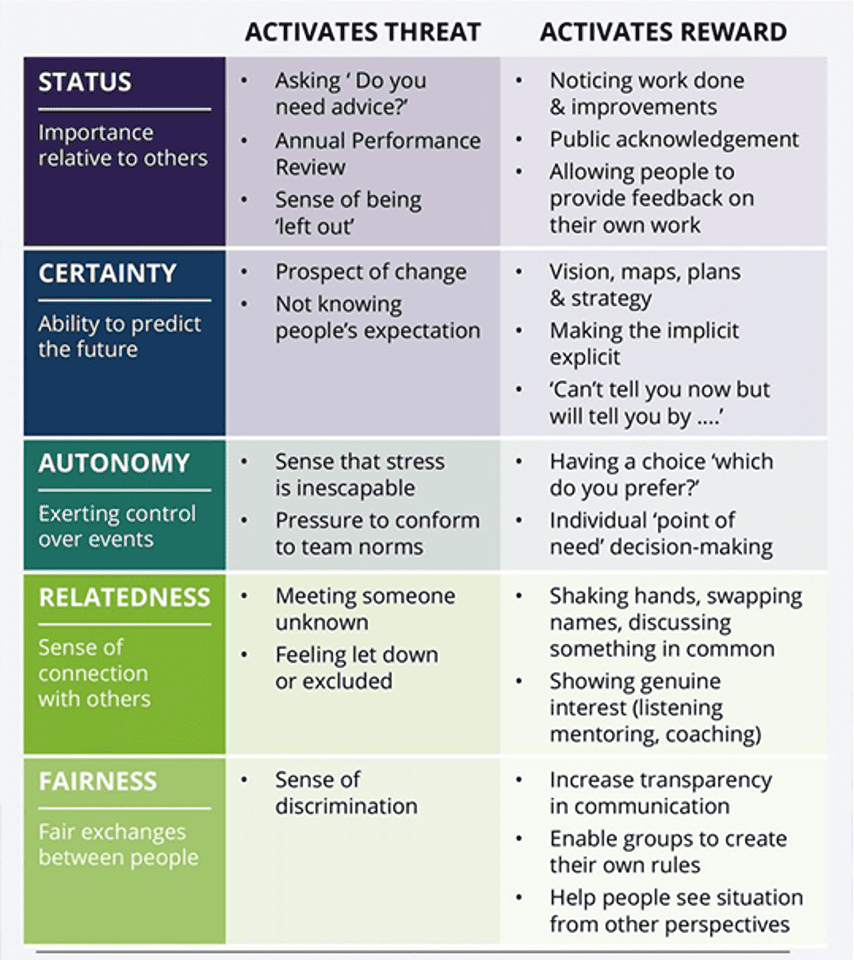
From Paul Brown Joan Kingsley Sue Paterson (2015) The Fear-free Organization: Vital Insights from Neuroscience to Transform Your Business; Culture Paperback