

The world is in the grip of a new oil shock. The shock is that prices have been collapsing.
Last week crude oil dipped briefly below US$70 a barrel. That’s about one-third cheaper than in June 2014. Prices are back at levels not seen since September 2010, when demand was still in a post-financial crisis slump.
The big reason often quoted now is that US production is going through the roof. Lets explore this…
America is fracking its way to the verge of energy self-sufficiency – short term. It is becoming clear that this will have enormous economic and political ramifications. The controversial practice of fracking – effectively squeezing the last drops of oil and natural gas out of the ground by pumping chemical solutions into the earth at high pressure – has rapidly restored the US as a fossil fuel superpower.
America has doubled its oil production in less than a decade and is not alone – Canada and Russia are using fracking to boost production.
How did this come about?
The previous high price of oil was a result of a lack of prior capital investment in exploring new oil opportunities as well as the increased demand from developed and developing economies growth. Demand was also greatly spurred by China. Increased demand with low or static supply results in increase in pricing.

Responding to the previously high price of oil- up to US$140 per barrel- oil producers, in the last few years have increased production from both existing and new oil wells and also by exploiting by fracking the newly identified but high-cost shale oil deposits in North America.
IN addition Libya, Iraq and Iran oil has recently come back on stream just as the economies of the world have gone into recession. In similar circumstances OPEC has cut back their production, but now- led by Saudi Arabia- they have not cut back. Hence significant oversupply linked to insufficient demand resulted in collapsing pricing.
So why don’t these producers just cut back production to keep pricing at the current levels?
Simply put the producers- Russia, Middle East, Venezuela – need the revenue from oil to keep their countries running. Oil companies have invested heavily recently, and they need to show revenue to off set the investments made.
The key country that could cut back is Saudi Arabia, appears to want to punish other oil suppliers (Iran, Russia) and will keep their production high. But this is for political reasons not for financial reasons.
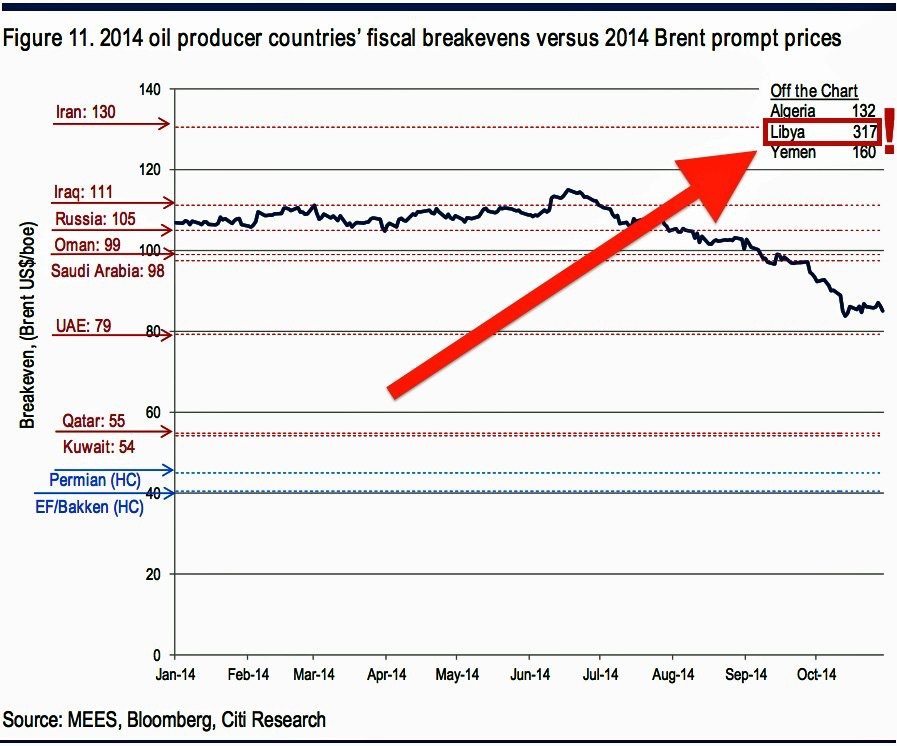
Many commentators have said that oil producers have a break even point of around US$80-$100 per barrel or higher (see above graph). And that at current pricing below $80 per barrel many producers are (theoretically) losing money and this will provide a break to the oil price decline.
Such a statement is true if you include the total cost of production- land purchasing or leasing, licenses, exploration, cost of failed exploration, drilling equipment- the total breakeven for most oil producers is in excess of US$80 per barrel.
For most producers, though, almost all of these costs sunk costs- spent already whether oil is produced or not, and as such we should not look at the total price of the oil but the marginal price to pump the next barrel of the oil to assess viability. Of that US$80 break-even around half is historial costs associated with setting up fields, around half is cost of setting up the specific well and only around US$2-5 is the actual cost of extracting a barrel of oil!
For many producers, the marginal cost of producing new wells in current fields or the “half-cycle” production costs (drilling and extraction equipment and machinery) was pegged at between US$37 to $45 a barrel, by analysts at Citibank last week . While the marginal cost of producing oil from current wells is around US$2 per barrel (with $12 per barrel considered expensive). So as long as pricing remains above US$50 / barrel then a substantial amount of oil will flow from the US to the world.
So lets summarize… there are four separate influencers of oil pricing
1. Supply/demand (as we’ve mentioned- the demand for oil and the minimum pricing suppliers can accept)
2. Corporate and National revenue needs (noting that trading is in US$ and this has appreciated by 10-20% this year off setting the actual decline in Oil pricing for non-US markets)
3. Fiscal policy – especially US$ interest rates influencing demand for oil and general economic sentiment.
4. Geopolitics– especially Saudi Arabia and Russia wishing to serve their own political agendas and using oil supply to do this,
At current supply/demand projections it’s hard (not impossible, but hard) for oil prices to get much below $70 and stay there for a long time if you believe in a fundamentals-driven “explanation” of oil pricing. If you believe oil pricing is simply a supply/demand question then falling demand won’t influence pricing much once it hits US$70/barrel.
Nations and Corporates still have to generate revenue so even at depressed pricing there is a strong pressure to continue to raise, albeit lower, revenues from oil by continuing to sell.
BUT…. but if you think that monetary and foreign policy have an impact on pricing then you have to assess what will China and the US do with their monetary policy, and what will Saudi Arabia and Russia do with their foreign policy?
With this insight, plus the need of many oil producing countries to continue to sell oil to remain financially viable suggests that the price oil oil may well continue to be below US$100 for much of 2015. Here are two charts detailing ground oil reserves, and below that Shale oil and gas reserves… in 2012 the world used 32 BILLION barrels of oil… and this is useful only if you believe supply and demand are the only influencers on pricing.


While this is possibly good news for oil and gas consumers short term, it certainly puts a dampener on seeking out alternative sources of energy medium and long term.
One Reply to “Oil SHOCK!”
Comments are closed.