

Last week I was inspired by a children’s book, today I’m inspired by a brilliant artist… more about Picasso at the end of this post. So we started, last week, by reframing the questions we ask of ourselves to create the raw materials for our business strategy the evergreen SWOT.

Why I like SWOT is that not only is it essential in identifying what to take note of in the environment, but it also enables us to identify how we turn what can be a lifeless list into action. Yes, action not planning is the essence of strategy.
First we take our Scary, Wild, Outrageous and Threatening trends and ideas and information then transcribe it into the traditional SWOT.
What do we do or have that are STRENGTHS? That enable us to…
- Identify and deliver better value for customers?
- Create lasting beneficial relationships with stakeholders?
- Consistently act with greater agility than competitors?
- Create action orientated engagement with our employees?
What do we do or have that could be considered WEAKNESSES? That PREVENT us from…
- Delivering the product attributes and performance most important to and valued by customers?
- Staying well ahead of competitors’ most impactful strategic moves?
- Leading market disruption to our benefit?
- Cultivating a workforce with the greatest potential to create an amazing customer experience?
What are OPPORTUNITIES in the external environment relative to
- Market needs and unclaimed customer value that we have yet to address? (See my next post on Hair on fire opportunities)
- Better supporting employees in delivering an incredible brand experience?
- Entering new markets where our brand would have an underdog’s advantage? Or a leaders advantage?
- Better capturing the best, most attractive potential customers that are not doing business with us right now?
What are THREATS in the external environment relative to…
- Emerging competitors (or alternative solutions) not playing by the same rules we and other industry players do?
- External forces beyond our influence that are redefining marketplace competitiveness?
- Gaps customers perceive in how the brand delivers its promise and experience?
- Systems and processes that are working fine, but whose failure could readily jeopardise future success?
Use this strategic thinking exercise in a group to help stretch thinking beyond the norm. Into areas that might otherwise be ignored – by reframing the questions you ask, and then by focusing them back into the business.
Bored with SWOT try TOWS Analysis?
If action is the essence of strategy how can we create a purposive strategy? Create actionable ideas by using a TOWS Analysis which is a variant of SWOT Analysis. Where SWOT can become merely descriptive; TOWS creates actionable strategies… here’s how.

TOWS analysis first matches internal factors to external factors to help identify relevant strategic options that an organisation could pursue. By combining the external environment’s opportunities and threats with the internal organization’s strengths and weaknesses, we can come up with four basic strategic streams. This can help a business see how it can take advantage of opportunities, reduce threats, overcome weaknesses or exploit strengths- which ever is the more pressing.
Four TOWS strategy streams
As a result, we can restructure our thinking to cover all strategic perspectives with corresponding action items:
Strengths/Opportunities (SO):
Consider all strengths one by one listed in the SWOT Analysis with each opportunity to determine how each internal strength can help you capitalize on each external opportunity.
Strength/Threats (ST):
Consider all strengths one by one listed in the SWOT Analysis with each threat to determine how each internal strength can help you avoid every external threat.
Weaknesses/Opportunities (WO):
Consider all weaknesses one by one listed in the SWOT Analysis with each opportunity to determine how each internal weakness can be eliminated by using each external opportunity.
Weaknesses/Threats (WT):
Consider all weaknesses one by one listed in the SWOT Analysis with each threat to determine both can be avoided.
Here’s an example

TOWS vs SWOT Analysis
SWOT matrix is a planning tool, and the TOWS matrix is an action tool. In a typical SWOT analysis Strengths, Weaknesses, Opportunities, and Threats are identified in point form and displayed in a neat matrix describing the current situation. Each can be abstract concepts that can be hard to think about without context.
Whereas, TOWS matrix forces you to identify the relationships between factors and force you to consider the implications of each. Action naturally is created as you have already identified ways to capture or evade the results.
So we’ve reinvented the humble SWOT… brought it up-to-date and action orientated it. By reframing the questions you ask, and then exploring the relationships with them, your strategy planning has an action outcome.
Good luck.
OK Picasso… I occasionally use a series of sketches by Picasso in strategy discussions. The collection of images drawn by Pablo Picasso (1881 – 1973) date from 1945-46. He created eleven portraits of a bull in which they consciously embody the abstract intent becoming more minimalist. The series goes from a relatively detailed and faithful lithograph of a real-life bull in to a mere outline of shape.
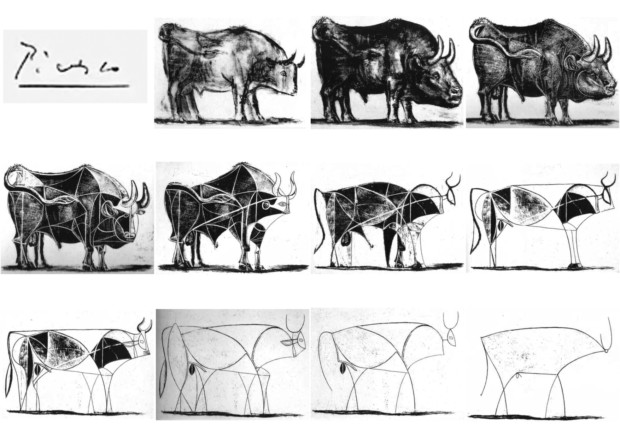
In so doing, Picasso expresses the essence of great strategy development. Distilling strategy into its most simple form, that fully captures the complete essence of the idea with sufficient and appropriate detail (horns, genitals, tail) to ensure the strategy is understood (its a bull, not a cow, not a horse) yet with the minimum of effort, so that the strategy can be easily understood and reproduced. If you have time, its a great idea to encourage similar creativity – asking your team to condense their strategy descriptions (even to where meaning is lost) to encourage them to become more economical with description but to still get the essential message through.