
Covid-19 has given us the gift of free time and perspective comes from using this well. While I have been considering the content of my executive education sessions and how I could enliven my facilitation I’ve come to the stark realisation that three of my “courses” really would have been career changing for me at the career stage of our typical participant.
THE most beneficial, I consider, is the Harvard Business School/Forio simulation “Change Management; Power and Influence“. Which takes on the topic HOW leaders actually lead within organisations? It also encourages, forces, something Managers do too little of, that is actually practicing their skills in a high trust, low impact, forgiving environment.

(By the way, the second most important, I’ve posted here, is the Everest simulation that looks at leadership and team dynamics… and the third is a session I run about DISC and understanding others behaviours and how we can engage more effectively with colleagues.)
There are lots of cases, exercises, & simulations dealing with making strategic decisions – i have several of my own- but few (*see appendix) that deal with executing strategy. The implied assumption is that get the strategy right and everything is simple; people will fall over themselves to support you and implement your ideas. Which we hope is true and all know this is a false hope.

For organisational implementation of change programs to happen, people have to change their behaviours. Leaders of organisational change therefore need to develop their abilities to influence others, sell issues, and overcome resistance to gain buy-in within organizations. Since this is a major component of and an enormous hurdle to achieving a successful strategy, this can leave an important gap in traditional executive learning.
This gap is filled by “Change Management; Power and Influence” a single-player, online simulation that can be played over the internet (as I did yesterday) or in the classroom; with no minimum or maximum numbers in class. The simulation can be used to teach a variety of change management concepts such as Kotter’s 8-Step Model of Change, resistance to change, stages of adoption, organizational change phases, power as related to authority in the organization, and change urgency resulting in reactive or proactive change.
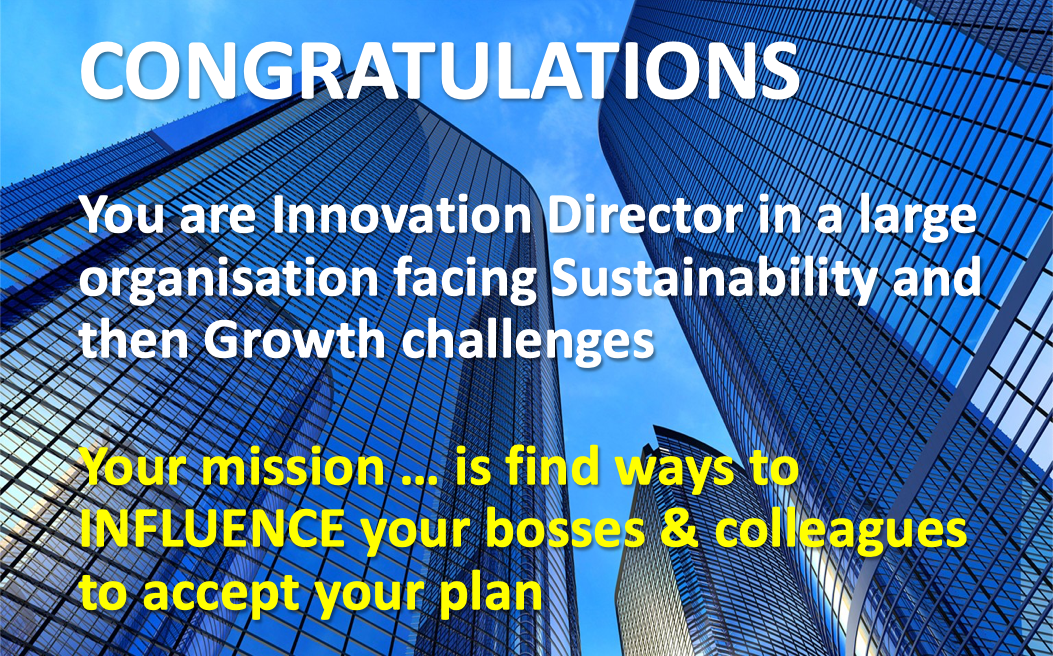
Our manager participants play the role of a change agent trying to convince other managers and team members to adopt their proposed green strategy. Participants can either be placed in the middle of an organisation as a mid-level Innovation manager, or they can play the role of CEO. The simulation treats these two roles differently with different actions and consequences.

I like this simulation as it mirrors real life… almost; just like good practice. Participants can ignore strategy content (which typically occupies all of their minds) and are forced to think about HOW they can influence colleagues to accept and implement their desired strategy in this fictitious US organisation.
By way of preparation, participants have access to a how-to-play video with a transcript , background reading on the organisation, and scenario introduction readings. The background reading provides common information about the company (e.g., financials, organizational chart, company status, information about the change initiative), while the scenario introduction readings provide unique information about the change agent role(s).
The simulation is not exhaustive in means of engaging or levering influence, obviously. It focuses on 18 of the most typical means to influence; from personal interviews (where you can find out peoples attitudes and needs) to changing remuneration (which you use at your peril as it is dangerous if activated with low personal credibility and should only be used towards the sustain phase of the simulation- mirroring real life).
For example, some decision options or levers help colleagues gain Awareness of the change initiative (e.g., Conduct Private Interviews, Walk the Talk) and can be more effective in the Mobilization phase. Other decision options (e.g., Provide External Skill Building) are more effective if the individual has already progressed to the Interest or Trial stage of adoption and the organization is in the Movement phase.
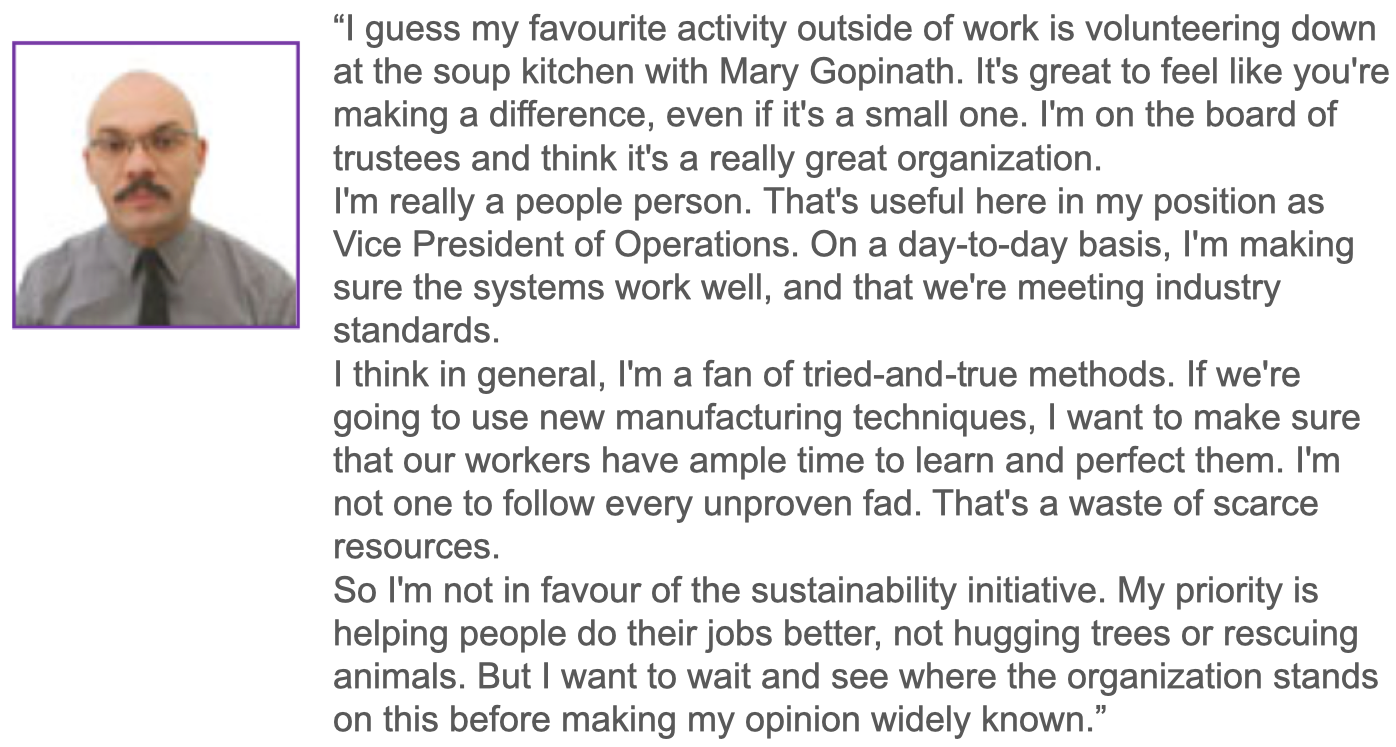
Within the game there are formal hierarchical networks easily seen and informal social networks embedded that are only revealed as stakeholders are interviewed – again mirroring real life. And so, if you engage with and persuade a highly connected colleague, who convinces others based on their informal social ties. (one caveat here, as its a US based simulation, there are significantly fewer informal social ties compared to Asia).
Here’s an example of the private conversation content…
The simulation is enabled for four scenarios- high or low authority (CEO vs Innovation manager) and high or low urgency (a customer crisis vs capturing market opportunities) and so facilitators can focus on the dynamics of leadership impact or of urgency.
Once participants play one round I debrief how they found success- remember this is practice NOT a competition and co-operation should be encouraged within the group. We discuss the role of leadership credibility extensively and how leaders can build this in the simulation and in real life. This is a great way to introduce notions of informal and formal power and influence, the need for change preparedness, leadership challenges, dynamic capabilities, balancing financial and social imperatives, and the organization and environment interface.
After a second round, where prior practice and discussion enhances performance (and while practice and discussion enhances performance in the class, participants almost always forget that this too can be taken from the class back into real life application). We discuss how participants could apply this in their upcoming projects or general work. For example, I encourage discussion of how the change agent in real life can “establish a sense of urgency” and “form a powerful guiding coalition” (the first two steps in Kotter’s model) by reviewing the different decision options in the simulation and then linking this to real life. There are options to also discuss how some decision options, for example, “restructuring the organization” are highly disruptive and require appropriate timing—if used at all—to positively affect the change.
Typically we discuss resistance, and here I make the point (again it is NOT obvious from the simulation but is in real life) that all successful organisations are actually set up to be resistant change – thats why we have SOPs and ISO, targets, KPIs and merit promotions, efficiency measures have been embedded inside organisations to keep them they same, to resist change. And so I leave my participants with the thought that they have to dismantle the organisations foundations to ensure their implementation or change program succeeds… and at the end on rebuilding these efficiency measures in the “sustain” phase of change in the simulation.
The simulation is very rich and can be used for half a day (a little rushed and covers key topics only) or part of a full day engagement on implementation and change.
If you would like to explore this further, please click here and speak to my colleagues at SMU Executive development.
References – Change Management Power and Influence from HBS and Forio who retain all copyright.
* INSEAD Professor Albert Angehrn developed a similar simulation in 2012, two years after the HBR simulation. I have experience with it; Pros – is group based decision making, has a Chinese and a Public Service option. Cons -takes significantly longer, has less engaging interface and is much more expensive Alpha Simulations