

You’ve inherited what you consider a dysfunctional team, but what makes you think they are dysfunctional? Last week we analysed the first cause of dysfunction- a lack of trust. Now we move on.
Patrick Lencioni created a very understandable model about how and why teams are dysfunctional and how you can assist them to function better. Lets work at the base, the most fundamental dysfunctions, and work our way up.
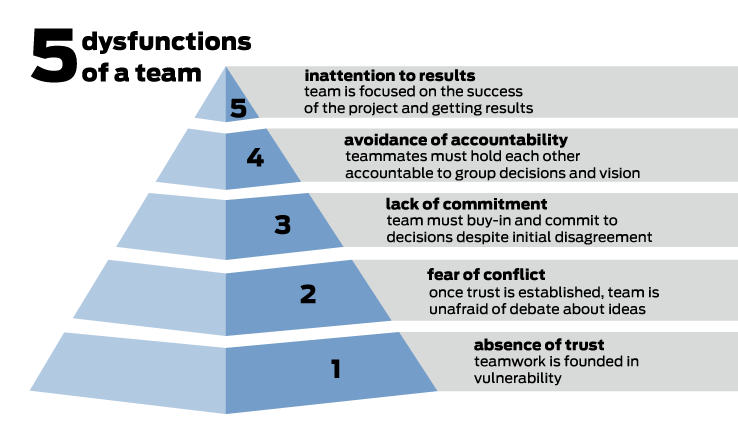
2. Fear of Conflict
The evidence of this dysfunction is the presence of artificial harmony, a conflict free team.
Within a dysfunctional team there will be the palpable presence of tension, but almost no constructive conflict. If we don’t trust one another, then we aren’t going to engage in open, ideological conflict, and we’ll just continue to preserve a sense of artificial harmony. So, what happens when people trust each other- they have disagreements, have arguments, conflict is created. But often Businesses and cultures abhor conflict of any kind and seek to suppress it within a culture of “don’t criticise”.
Why?
Well, my view is because there are two types of conflict; affective conflict (discussing about “who” and “why”). This conflict critiques relationships, it deals with emotional conflict, the potential for personality clashes, or ego & behaviour style clashes, culture clash, the clashing of personal values. All tough stuff. But not the stuff to enable organisations to develop and succeed.
The second type of conflict is certainly more beneficial- its cognitive conflict, discussions about what, when and how. These discussions and agruments can be more objective as they are take related and focus on facts, plans, objective ideas; discussions about things that can be measured or arguments about process, which can be objectively assessed and measured.
If we can’t learn to engage in passionate, unfiltered debate about what we need to do to succeed, business won’t succeed. We need conflict to ower innovation for example. Remember the essence of a Team meeting; if there’s nothing worth debating, then we won’t have a meeting.
Team Assessment: During team meetings, are the most important — and difficult — issues put on the table to be resolved? Do teams set aside affective conflict and focus on cognitive disputes.
The only purpose of productive conflict is to produce the best solution in the shortest period of time. The great teams discuss and resolve issues more quickly and completely than others, and they emerge from heated debates with no residual feelings or collateral damage, but with an eagerness and readiness to take on the next important issue.
It’s important to distinguish productive ideological conflict from destructive fighting and interpersonal politics. However they can have many of the same external qualities — passion, emotion, and frustration — so much so an outside observer might easily mistake it for unproductive discord.
Ironically, teams that avoid ideological conflict in order to avoid hurting team members’ feelings, end up encouraging dangerous tension.
It’s also ironic that so many people avoid conflict in the name of efficiency, because healthy conflict is actually a time saver. Teams that avoid conflict actually doom themselves to revisiting issues again and again without resolution, they often ask team members to take their issues “off-line” (meaning lets ignore each other and ignore resolving our dispute) only to have it raised again at the next meeting.
Teams that fear conflict ignore controversial topics that are critical to the team success, fail to tap into all the opinions and perspective of team members, and waste time and energy with posturing and interpersonal risk management.
Teams that engage in conflict put critical topics on the table for discussion, solve real problems quickly with minimal politics, and have lively and interesting meetings.
Suggested actions:
- First acknowledge that conflict is productive, and that many teams have a tendency to avoid it.
- Agree to focus on cognitive/objective conflict; and to kill any affective conflict.
- Assign a team member to be “miner of conflict” — who extracts buried disagreements and sheds the light of day on them — during a meeting.
- Interrupt and remind one another in real time to not retreat from healthy debate when they start to feel uncomfortable.
It is key that leaders demonstrate restraint when team members engage in cognitive conflict, and allow resolution to occur naturally. But when affective criticism breaks out it must be dealt with quickly and effectively- take each individual apart, ask them to assess their behaviours and motivations and seek to understand the other. Team members MUST have different perspectives otherwise no need to have a team, but every persons contribution must be valued. Often the foundation of affective conflict is a lack of trust, so if that occurs return to the previous post to review what to do to build trust between two people.
The desire to protect members from harm is the most difficult challenge for leaders, which leads to premature interruption of disagreements and prevents members from developing conflict management skills, similar to mistakes of overprotecting parents. Lead by personally modelling appropriate conflict behaviour.
Next we discuss the third dysfunction, lack of commitment