
After 34 years of booming economic growth averaging over 9% per year (the longest sustained period of rapid economic growth in human history), China’s credit-fueled, investment-driven growth model is exhausted and increasingly unstable. Chinese economic growth slowed to the lowest level since 1999 last year, expanding 7.7%.
Policymakers have recognized the need to re-balance economic growth and are now slowly transitioning away from a credit and export driven economy to one driven by consumer growth. Some argue that the recent crackdown on shadow banking and the money market rate spikes are part of this effort.
But what sort of ripple effects impact is all of this having on the global economy?
Here’s a summary of the cross border trade expansion in the last decade

By Worth Wray
First, let’s take a look at economies that rely on China to consume their exports.

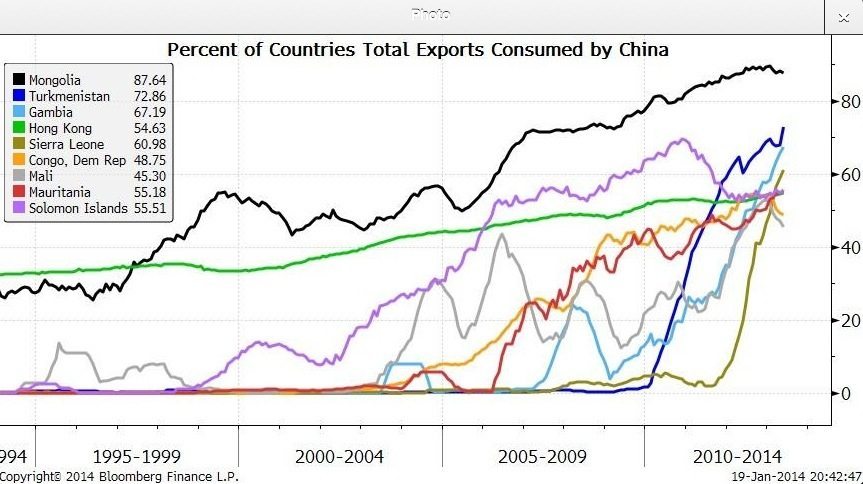
Bloomberg chief economist Michael McDonough tweeted this chart that shows the percent of country’s total exports consumed by China, this is a time bound chart plotting the increasing importance of China to a number of very small economies.
And this chart from McDonough shows the larger economies dependent on China for their exports:
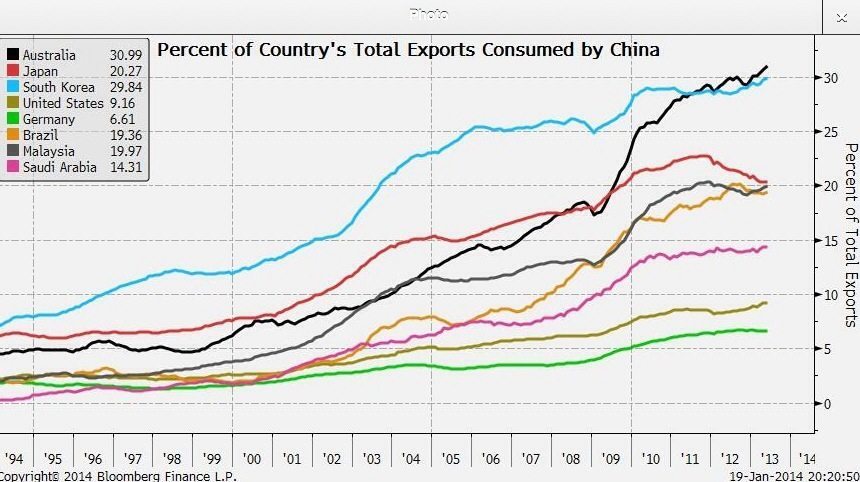
A marked slowdown in China would obviously have a significant impact on these economies.
Australia’s predicament, is looking increasingly tough
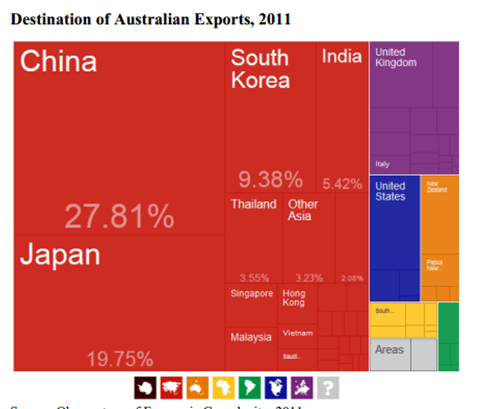
Its been described as “a credit bubble built on a commodity market built on an even bigger Chinese credit bubble, Australia looks like leveraged leverage, a CDO squared” by commentator Dylan Grice.
But it isn’t just at a national level. We’re also beginning to see the impact of the slowdown, the reforms, the credit crunch, efforts to curb pollution, and other issues in the earnings of various companies with exposure to China.
What are your views on China and the Chinese economy, whats your perspective, please share with us.
you are welcome, there’s more to come