

Examples of Games and Learning Outcomes (Les Buckley 2025)
Why Experiential Learning?
Experiential learning gives executives what lectures, readings, and case discussions cannot—real practice in real time. Instead of analyzing someone else’s decisions safely from the sidelines, learners are thrown into live situations where they must decide under pressure, exposing blind spots, habits, and biases they didn’t know they had. They fail safely and learn fast, getting immediate feedback with less risk. Because they act, not just discuss, they build embodied memory—making the lessons stick far better than anything heard or read. It’s energetic and social, demanding teamwork, negotiation, and alignment, not passive note-taking. Most importantly, it feels real preparing them to transfer learning directly into practice when it matters most.
Please note for most games the complexity/simplicity and specificity of the learning outcome can be tailored to the audience. N.B. If there is too targeted a relationship to current work situation, participants fall back on learned behaviours and constraints rather than trialing new approaches.
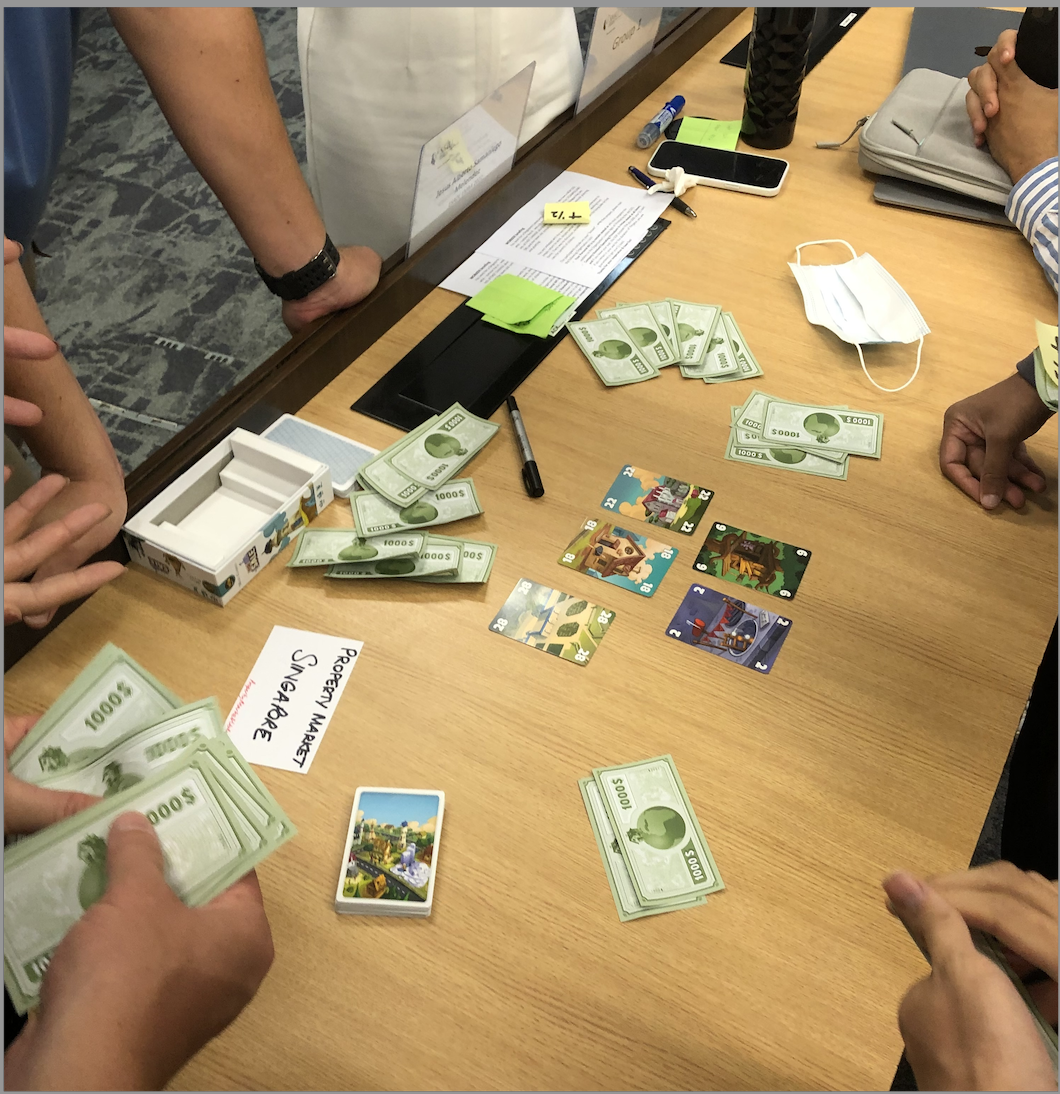
Use “FOR SALE” to learn Strategic Leadership (Direction, Alignment, Commitment)
For Sale exposes leadership behaviours in ambiguous, fast-moving contexts. Leaders sense direction by identifying where and how to gain an advantage, secure alignment by reading the group’s skills, risk appetite and decision-making preference adjusting accordingly, and shift commitment by effectively delegating strategy implementation to players under pressure. The two-phase and two round structure highlights how lack of shared situational awareness, over- or under-confidence, misalignment, lack of institutional learning from experience or lack of commitment to the strategy leads to suboptimal outcomes—mirroring real strategic execution failures.
Use “FOR SALE” to learn STRATEGIC AGILITY for leaders for teams – (recognize decide act)
For Sale is an excellent medium for enabling the learning of strategic agility, as it forces players to operate under time pressure, incomplete information, and shifting value contexts—mirroring reality. First, recognition speed is constantly tested as players must stay hyper-aware of the potential within markets and how other teams are playing, the relative strength of their own position, and the visible or implied intentions of other teams. Through experience participants quickly learn that curiosity and active scanning of both internal (their hand, their remaining cash) and external (opponent behaviour, market conditions) information provide the edge. Second, decision speed comes to the forefront as players must place quick, irreversible actions with limited data, forcing them to balance calculated risk with fast action. The auction format punishes hesitation and over-analysis, pushing individuals beyond their comfort zone. Teams must also cope with decision making under time pressure where the principle of consent not consensus rules — when is the time to make acceptable if not perfect choices swiftly based on available evidence, not waiting for perfect information or group validation. Finally, execution speed is critical where players must rapidly identify markets to play, how best to use their resources within the teams strategy and how to flex where necessary. Players quickly experience the trade-off between individual optimization and moving fast to deliver team-level outcomes, reinforcing the principle that speed often beats perfection. The game structure, pace, and hidden information simulate real-world leadership challenges where those who can sense, decide, and act faster—while managing limited resources—tend to outperform those who over-plan or hesitate.
(2) LEADING TEAMS; Sprawlopolis – co-operative card game designing a city (can also be used for understanding team development)
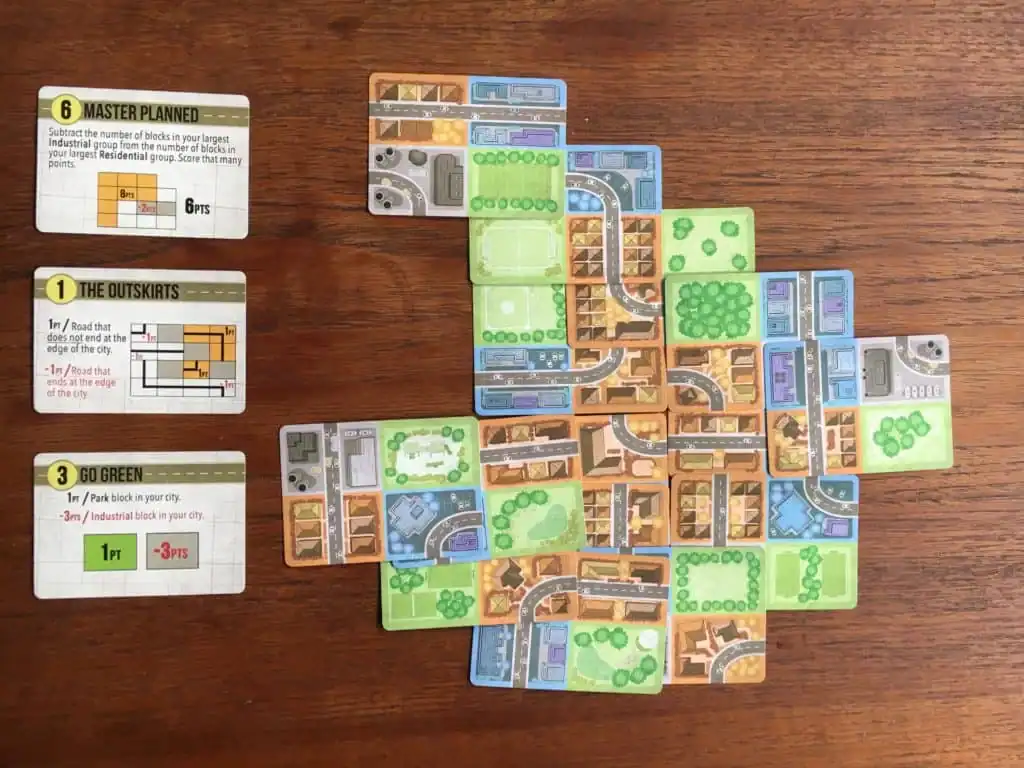
Sprawlopolis is a very simple cooperative, card-based city-building game. Leaders enable their team members to collaboratively build a city by placing overlapping cards to create connected zones (growing blocks of residential, commercial, industrial, and parks, while reducing encroach of roads). It mirrors the typical project leadership players face in real life. They must balance different and potentially conflicting scoring conditions—players collectively select three objectives in game—while managing road networks and block adjacencies. The tension for Leaders comes from constraints – limited placement options and potentially scoring objectives that often conflict – and time pressure to make and effect decisions. Success relies on effective diagnosis of objectives, efficient negotiation, joint problem-solving, and spatial reasoning to maximize collective points while minimizing penalties. The game is fast, re-playable, and highly adaptable for team-based debriefing on collaboration, trust, communication and project leadership. (It can also be used for pure team development – see Scaling Mt Everest next).
(a) Entry-Level Leadership (Directive vs Supportive Focus)
Sprawlopolis can assist emerging leaders to make visible the tension between task-based direction (driving placement decisions directively to meet clear objectives in a timely fashion) and people-based support (supportively creating space for team members to contribute ideas and feel ownership but recognizing the need for rapid action). The game makes this practical by showing how over-directing can shut down contribution, while over-supporting can cause drift or crippling indecision. Participants experience the impact of their behaviour, learning to balance task focus with team engagement in real time. The debrief highlights the paradox of leadership- to achieve the task the team must conflict over task achievement but to implement the strategy the team must co-operate in harmony. This paradox is solved utilising the concept of trust (ability, integrity, and benevolence) to enable the paradox to be solved.
(b) Executive Leadership (Sensing Direction, Securing Alignment, Shifting Commitment)
Sprawlopolis can be used in a more sophisticated way with senior leaders to surface how difficult it is for them to sense direction when objectives seem to conflict and overwhelming, much like in complex strategy execution. It forces leaders and teams to secure alignment by debating trade-offs openly—balancing different scoring conditions, road penalties, and placement risks—mirroring cognitive conflict management. Shifting commitment emerges when participants abandon personal preferences or suboptimal strategies mid-game to support the team’s evolving priorities, learning that success often requires collective ownership over individual brilliance. Once the leader enables players to trust each other, commitment flows from team harmony of collective action.
(3) TEAM DEVELOPMENT; Scaling Mt Everest – Card Game based Trek up Everest (Can also be used for Leadership development)

Scaling Mt Everest is a collaborative card game simulating a 12-day expedition where players build a continuous trekking path by overlapping map cards and tackling challenges like altitude sickness and avalanches. Players take turns adding cards to extend the route or to resolve challenges by covering required resource icons. Players score points by trekking further, conserving resources, overcoming challenges (but this uses resources), and reducing environmental damage. They lose points for failing challenges, over-using resources, leaving rubbish, or retracing their path. Each player holds a role card with private insights, creating asymmetric knowledge and decision tension during play.

(a) Team Development (form, storm, norm, perform)
In Scaling Mt Everest, players experience first-hand how new teams form around a shared goal—selecting 5 challenges as success criteria. Role cards with private insights immediately trigger role conflict as players push different agendas based on hidden information. As play progresses, teams naturally build informal working norms, deciding how to sequence actions, make trade-offs, and manage risk and conflict while building trust. Eventually, teams shift into performance mode, working fluidly toward maximising their score. The game makes this progression feel real, surfacing common team barriers and enabling reflection on what helps teams move from conflict to collaboration.
- Form: WHERE are we going? Agree on success goals by agreeing challenges.
- Storm: WHY there? Experience hidden role conflicts and competing strategies and building trust.
- Norm: HOW do YOU want to go? Develop shared ways of working through play and ways to surface and manage conflict.
- Perform: WHAT do we do next? Coordinate seamlessly to execute the trek plan.
The Scaling Mt. Everest gameplay ALSO forces players to confront the hidden dynamics that derail senior teams. Suspicion can start early, driven by hidden individual roles that mimic the lack of transparency in some leadership teams. Players face strategic conflict over risky or conservative plays. Some teams avoid conflict and stall; others engage productively. Teams that make clear decisions and commit perform better. When challenges fail, the blame game or silence reveals accountability gaps. The scoring system makes team results visible, exposing personal vs collective focus. The game creates a safe simulation for leaders to practice trust-building, conflict engagement, and accountability.
- Trust: Navigate hidden roles and motives.
- Conflict: Manage risk and strategy tensions.
- Accountability: Own outcomes, don’t deflect blame.
(4) INFLUENCING WITHOUT AUTHORITY; Secure the Jade Throne –social deduction game

Secure the Jade Throne is a social deduction, hidden-role game set in an Imperial court facing a succession crisis. Players are secretly assigned roles as Committed Loyalists, or the Whispering Fox (Secret Saboteur) and supporters. The game unfolds over multiple rounds where players elect succession decision leaders, debate choices, and reveal Court outcomes.
Core mechanics include:
- Hidden roles: Players’ true loyalties and agendas are concealed, creating deliberate uncertainty.
- Leadership rotation: Players take turns holding influence over group decisions, allowing shifts in perceived power.
- Open and covert signalling: Players send public and private cues to influence others, while some hide their real intentions.
- Team-based victory conditions: Loyalists win by securing the throne; the Saboteur and team wins by derailing the process or sowing chaos
The game environment simulates the messiness of real organizational change, where formal roles don’t always match real influence, and where success hinges on reading people, not just rules.
Secure the Jade Throne provides a dynamic platform for developing advanced stakeholder management and influence skills, especially under conditions of limited formal authority. Key learning points include:
Influencing Without Authority: Players practice mapping who holds real (not just formal) influence and applying targeted tactics to sway stakeholders.
In Secure the Jade Throne, players learn that influence without authority depends far more on informal power than formal roles. While leadership rotates, those who consistently shape outcomes do so through credibility, trust, alliances, and strategic communication — not by holding official control. The hidden-role dynamic forces players to conduct live power analysis: reading intentions, tracking shifting loyalties, and mapping who holds real sway versus who holds formal position. Players experience how trust functions as the key currency of influence — built through consistent behaviour and eroded through missteps. The game also exposes the need to use multiple influence channels — balancing open persuasion with subtle signalling and behind-the-scenes coalition building. Success depends on adapting influence tactics to audience and context, not pushing authority. Finally, players see that influence is cumulative: actions in early rounds build or damage the credibility needed for later success. They leave with a clearer understanding that sustainable influence comes from building relational capital and managing trust dynamics — not from positional power.
STAKEHOLDER ASSESSMENT
Secure the Jade Throne teaches stakeholder analysis and influencing in action, not theory. Players quickly realise that success requires reading the room, not just playing their own role. They must continuously map where others stand — committed, neutral, resistant, or covertly opposed — and adapt their tactics accordingly. Mobilising committed allies is about amplifying credible voices to shape momentum and narrative. Engaging fence-sitters requires reducing the perceived risks of alignment — providing clarity, reassurance, and safe entry points. Addressing resisters means surfacing unspoken objections and either converting them through influence or strategically isolating them. Perhaps most powerfully, the game forces players to detect hidden saboteurs — those whose formal signals mask opposing agendas. This sharpens their ability to foster collective vigilance, peer accountability, and transparent processes, which are core to stakeholder management in ambiguous, political environments. By the end, players better grasp that stakeholder strategy is not static mapping — it is an ongoing, dynamic process of relationship sensing and adaptive influencing.
Additional concepts
- Trust-Building: The game surfaces how trust is tested, earned, or broken — requiring players to build and maintain trust while staying alert for deception.
- Conflict Management: Participants experience how conflict — both visible and hidden — can disrupt progress, and they must practice constructive strategies to surface, manage, or neutralize it.
Ultimately, participants come away with a sharper understanding of how to navigate complex, multi-party dynamics, aligning diverse stakeholders toward shared goals even in the absence of formal authority.
(5) CULTURAL UNDERSTANDING; BARNGA – card game/ dice game to learn the impact of culture differences

BARNGA is a non-verbal card (or Dice ) game created specifically to prompt cross-cultural discussion. Participants first learn a simple game either a card game or a dice game based on playing with a common rule sheet. After a short practice, the rules are taken away and communication is restricted—no talking, writing, or signing. Players then begin a “tournament” where winners move up and losers move down onto different tables where they continue to play in the tournament. The twist is that each table has been given slightly different rules (e.g., which suit is trump, whether Ace is high or low; or whether you should add dice or multiply the spots ). Players experience growing confusion, frustration, and conflict (without the ability to ‘voice’ this) as they try to play the “same” game with others who silently operate on different assumptions.
( for non-card game literate groups)
(a) Understanding Cross-Cultural Differences and Conflicts (International Context)
Barnga powerfully simulates international cross-cultural misunderstandings, where superficial similarity hides deep differences in norms, priorities, or expectations. The game reveals how small, invisible rule differences create entirely different interpretations of the same situation, leading players to experience mistrust, frustration, and misjudgment even though they believe they are playing by the same rules. It powerfully surfaces the loss of voice and powerlessness felt when communication is blocked, forcing players to navigate uncertainty without the ability to explain, defend, or clarify their perspective—mirroring how cultural misunderstandings escalate when dialogue is missing or suppressed. A targeted case study can also be introduced and learnings about culture can then decode the case involving a global project team each applying different cultural rules to decision-making (e.g., consensus vs. hierarchy, speed vs. thoroughness). Players experience how lack of shared language and hidden assumptions derail cooperation. The debrief can link to Erin Meyer’s Culture Map, highlighting how misalignment on communication, trust, and decision-making styles creates real-world conflict unless surfaced and managed intentionally.
(b) Understanding Organisational Culture (Using CVF or Similar Assessment)
Barnga mirrors clashes between subcultures inside a single organisation—such as Sales vs. Legal vs. Operations—where everyone thinks they’re “playing the same game” but apply different unwritten rules. The game reveals how small, invisible rule differences create entirely different interpretations of the same situation, leading players to experience mistrust, frustration, and misjudgment even though they believe they are playing by the same rules. It powerfully surfaces the loss of voice and powerlessness felt when communication is blocked, forcing players to navigate uncertainty without the ability to explain, defend, or clarify their perspective mirroring how cultural misunderstandings escalate when dialogue is missing or suppressed. Linking the game an Organisational Culture Instrument (eg Competing Value Framework) allows participants to reflect on what is valued by themselves, within their “silo” (team, department, division) within their organisation c.f. client organisations. The game makes visible how differing cultures experience and interpret the same initiatives differently. Participants can explore how failure to recognise and reconcile these differences leads to internal misalignment, power struggles, and stalled execution. Additionally an appropriate short case study related to the organisation can be written to take this discussion further in more detail.
(6) COLLABORATION – WAMAYC or versions based on prisoners’ dilemma

Win As Much As You Can is a social negotiation and payoff game based on the Prisoner’s Dilemma. Players play in groups within two teams “Red” or “Blue” and play over several rounds, with payoffs determined by the combined choices of both teams- co-operate or defect. Two parallel Red-Blue games are run side-by-side; while the actual competition is between Red and Blue groups as a whole, players believe the competition is within the red and blue team- an incorrect assumption that is not questioned. The game typically introduces negotiation rounds, where representatives can attempt to build trust, align strategies, or deceive. Players experience emotional swings between cooperation and betrayal, with maximum collective payoff only possible if all consistently cooperate, which rarely happens due to mistrust and competitive incentives. The game can be tailored; for example Pandemic Response uses and initial team briefing to frame the dynamic being a battle over limited resources to prevent or cope with a pandemic. This enables a realistic sectoral context, adding relevance to industries like healthcare or government.
How to create an environment promoting Collaboration
WAMAYC creates an intense learning environment where participants experience how false assumptions, misaligned goals, and short-term self-protection quickly erode collaboration. The biggest barrier is the lack of clarity on what “winning” means—teams default to competing rather than aligning because no one clarifies whether success is individual, team-based, or collective. This exposes the barrier of competing interests, where players protect their own score even at the cost of group performance. The breakdown is accelerated by early betrayals or perceived dishonesty, which shift behaviours from open to defensive, confirming that trust—once broken—is hard to rebuild. Participants experience the importance of ability (can I trust that you are competent?), integrity (can I trust that you will do what you say?), and benevolence (can I trust that you care about my interests, not just your own and you won’t throw us under the bus?). Without these, collaboration stalls.
The game also makes visible how poor communication, vague commitments, or manipulative tactics destroy alignment. Participants learn that clear, open, and sustained communication, backed by credible action, is the only way to shift from competitive posturing to genuine, value-creating collaboration.