
In Secure the Jade Throne you step into a twilight court worthy of a North-Asian palace epic: the Emperor ails, a rival fills the Hall of Harmony with discord, and every whisper or nod may tilt the succession towards or away from the Emperors 5 year old grandson, and imperil the empire. Players form the Succession Council, yet each has a secret allegiance to support the jade throne and successor or sabotage and support the mysterious Whispering Fox and the House of the Gold Fan. Around the lacquered table a single question dominates: will honest counsel guide the realm to a peaceful succession, or will the knives of secretive saboteurs plunge the dynasty into chaos? Lets play.

For executive participants the design is a live simulation in influencing under uncertainty. To commence, each player receives a secret card swearing them to support either the Jade throne successor or the Whispering Fox. Before we commence – all close their eyes and only the saboteurs may see each other and the Whispering Fox (who may not know their supporters). Players must decide whom to trust with no initial evidence, identify how to signal reliability without revealing your true allegiance, and shape the agenda before hidden saboteurs shape it for you. The exercise surfaces three executive reflexes: recognising “tells” in ambiguous data, testing allies through small but irreversible decisions, and building a coalition quickly enough to out-pace covert opposition.
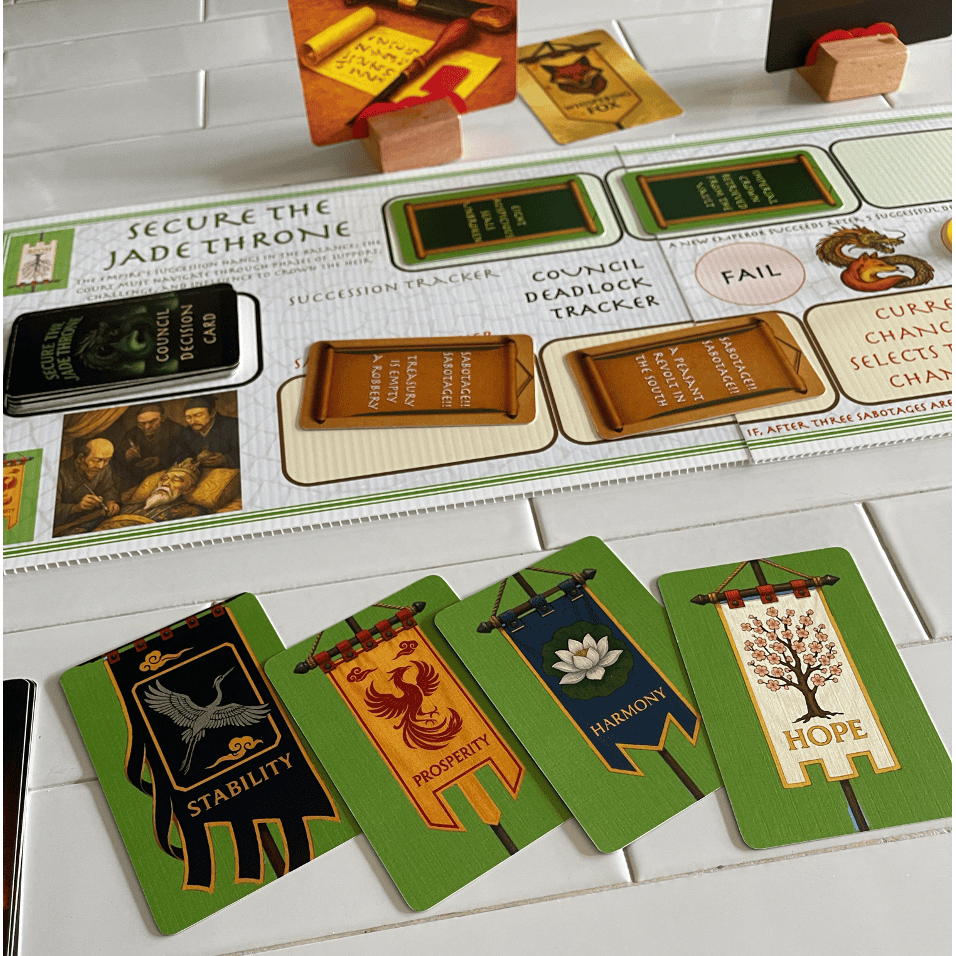
Play unfolds in brisk rounds. The council must make a series of decisions on succession, the role of Grand Chamberlain to orchestrate decisions rotates clockwise, its holder then choses a General to implement the council’s decisions. The Council then votes to accept or reject this pair to lead the next decision. The newly elected Chancellor secretly draws three cards- unbeknownst to players sabotage cards outnumber succession cards and so you may draw three sabotage cards as a loyalist – then discards one (buried unseen and facedown at the base of the decision deck), and passes the remaining two to the General. The General must choose one card to display face-up on the decision board—either jade Succession or a gold Sabotage — then buries the other unseen facedown under the deck. To win the Loyalists need 5 supportive jade decisions. The saboteurs need 6 sabotages. Decision selection is made in silence. But after accusations and explanations abound, yet every pairing and every card and every word becomes data that shapes the next vote when the role of Chancellor rotates again.
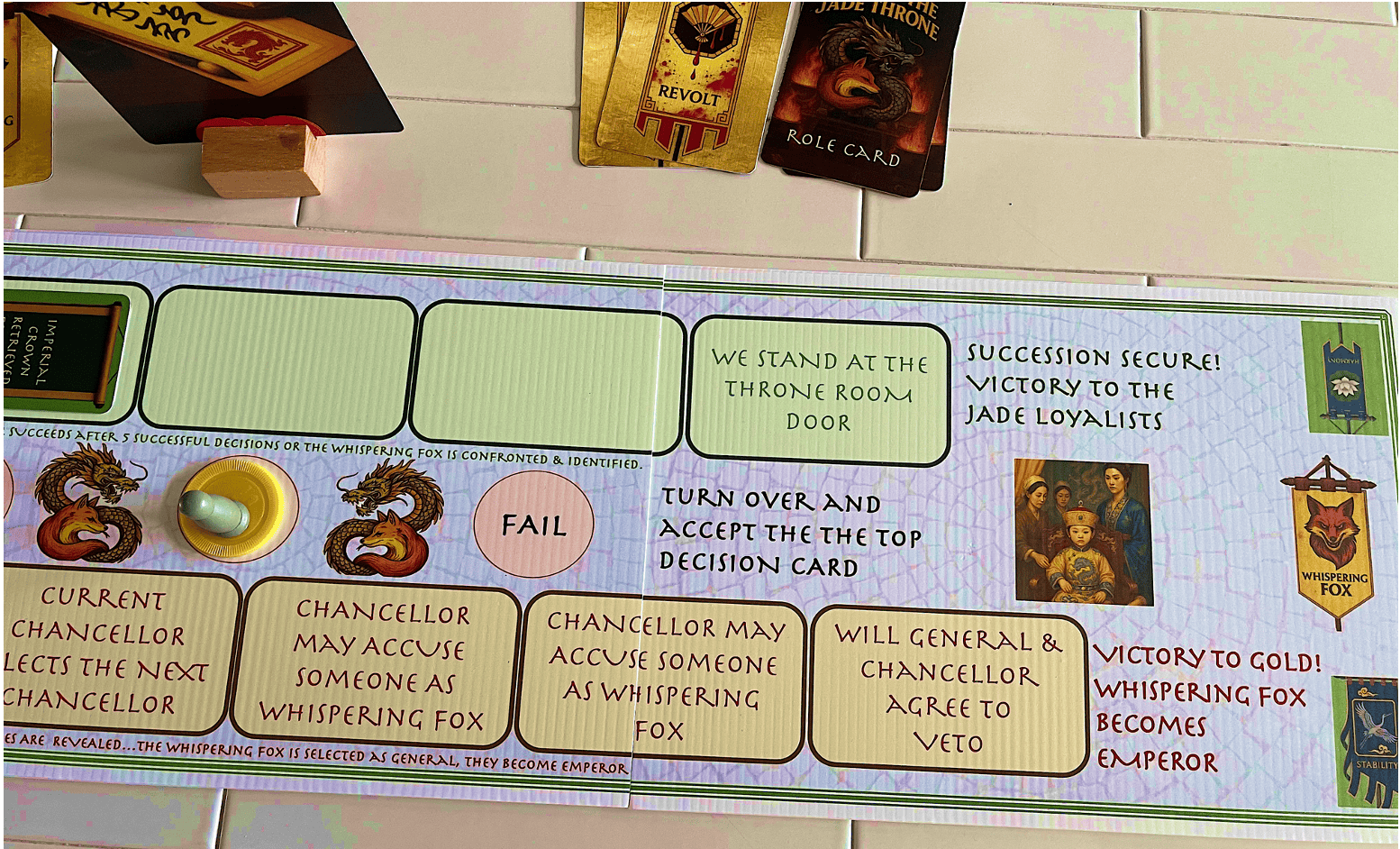
Victory is collective but asymmetrical. Loyal Courtiers claim the throne by revealing the five jade decisions OR by successfully accusing the Whispering Fox and the successor is elevated. The saboteurs win if 6 gold sabotage decrees are revealed or the saboteurs enable the Whispering Fox to be elected as General – and a coup ensues. Loyalists outnumber saboteurs. But sabotage cards outnumber loyal in the deck; and so even honest pairs are sometimes forced to play a gold sabotage card; the council must separate accidents from intent before it is too late.

When the chairs are finally pushed back, executives can map each round to real workplace dilemmas: the evolution of trust, the impact of limited information, presence of hidden agendas, the signalling value of consistent behaviour, and the speed at which credibility compounds—or collapses. The game’s tight loop of nominate-decide-reveal mirrors stakeholder meetings, project reviews, and cross-functional teams where trust is provisional and outcomes hinge on reading people as keenly as reading data.