

And the purpose of advertising is to Expand Your Customer Base.

In the last two weeks i’ve discussed the failure of benchmarking and the leaky bucket. If you benchmark against your competitors you can only hope to perform at best at their current level. Maybe you need to move outside your category to identify new and innovative ideas. Plus you leak customers despite your best efforts to patch your business it leaks.
So, after benchmarking and leaky buckets what enables businesses to grow.
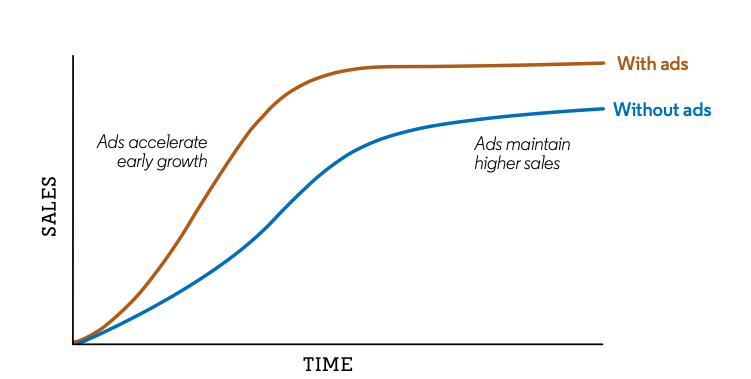
They advertise.
Intuitively, it might seem that there are two ways a brand might grow – either by gaining more customers (increasing penetration), or by selling more to existing customers (increasing loyalty). Many think both strategies are equally viable and some, working on received wisdom and “experience”, believe that loyalty is likely to be the more profitable route, because acquiring new customers is expensive.
In B2C, the overwhelming weight of evidence tells us otherwise. Decades of research by the Ehrenberg-Bass Institute have shown that the main way B2C brands grow is always by acquiring new customers and, as they do so, they always get a bit more business from existing customers as well. Loyalty is never the main engine of growth and only ever increases when penetration grows.
But does loyalty marketing perhaps work better in the B2B world, with its one-to-one service, dedicated account managers and well-resourced relationship building programmes?
Probably not.
There are some universal rules I have found for all brands in all contexts:
- All brands need message led brand building – Brand building is the main driver of long-term growth and involves the creation of memory structures that encourage decision makers to want to choose that brand. Without brand strengthening, growth will be weaker, activation will be resultantly weaker, pricing power will not improve and profitability growth will be severely reduced
- All brands need sales activation – Sales activation dominates short-term sales uplifts and involves behavioural prompts to encourage consumers to ‘buy now’. It is strongly boosted by brand building and is essential for efficiency. Without it investment will be weaker and growth will suffer
- The optimum balance between brand building and activation varies by context depending on the relative ease/difficulty of the two tasks
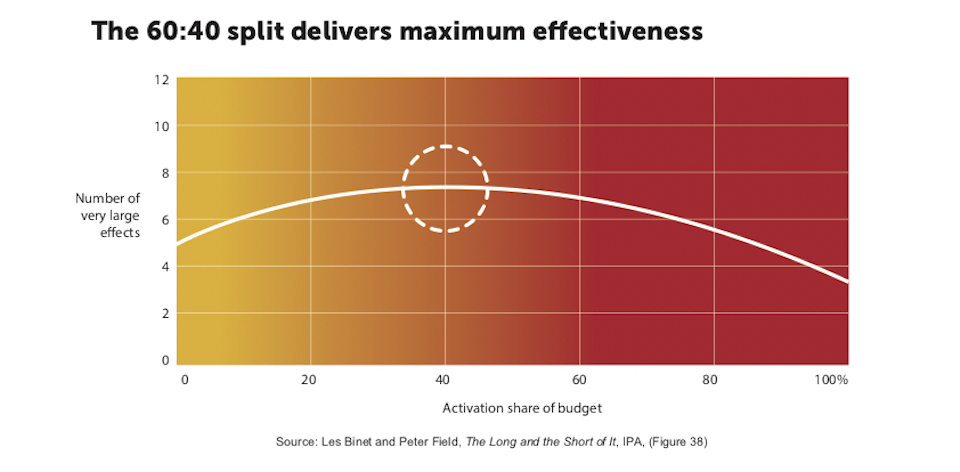
- The key factors that drive the optimum balance are the relative levels of emotional and rational consideration in consumer choice – where emotional consideration is high, brand building is easier; where rational consideration is high, activation is easier; where both are high, budget should be shifted towards the more difficult task. Despite what we may think, emotionality is greater in B2B than in B2C… will you be fired for buying the wrong toilet roll… probably not… but pick the wrong IT supplier and your career could be down the road.
- Penetration growth is always the main driver of growth for all brands. While penetration and loyalty go hand in hand, loyalty doesn’t increase without penetration increasing.
In addition, this latest research reveals that there are six contextual factors that brands must also consider and offset accordingly:
- Which sector your brand is in – e.g. Durables, FMCG, Financial Services, Other Services, Retail
- How consumers purchase your brand – e.g. offline, online, serial, subscription
- How your brand is priced – e.g. value/mainstream, premium
- The level of innovation applied to your brand – e.g. none, any, new variant, new sub-brand, entry into new category
- The life-stage of your category- e.g. new, established, declining, stagnant or low growth; medium or high growth
- How big your brand is – e.g. launches in first 1-2 years, launches after first year, small brand, medium brand, large brand.
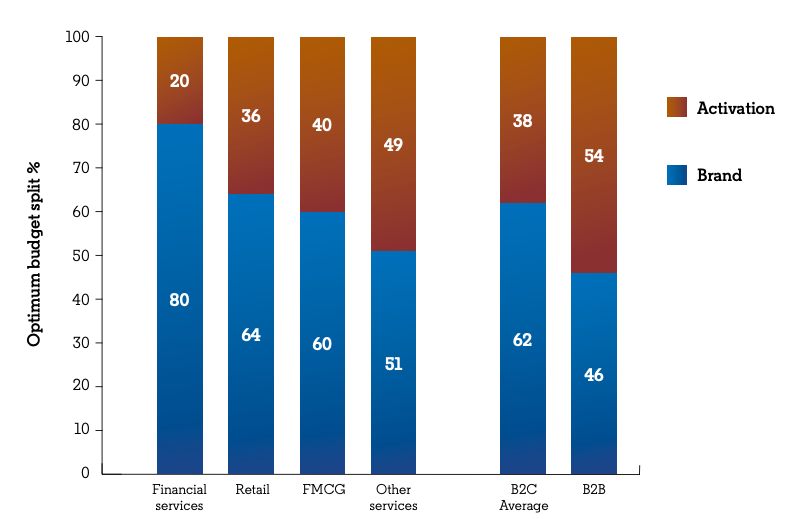
Flexing the formulas to your brand
Taking these considerations into play, and with each variable carrying a different value to offset, the role of management is to identify how much advertising should be done… typically you should advertise in advance of your share of market. If you have a 10% market share then you should look to have more than 10% share of voice. You can then look at the role advertising and activation takes, and I’ll look at that next.