
We are undergoing tremendous change. The CEO of advertising conglomerate WPP has said that “we’re seeing 10 years of innovation crammed into 4 weeks” as companies struggle with the impact of Covid-19 and rapid digitization.
I’m reminded of a great literary reference from The Leopard, by di Lampedusa, in particular the line ‘everything needs to change, so everything can stay the same.’
Now is the perfect time to apply Govindarajan’s Three Box solution in the face of implementing a change agenda

In charting our way into an unknown future… the past inevitably hold us back. Processes, approaches, plans that have made us a success in the past will inevitably have little relevance to tomorrow’s challenges.
This is a great theory… but how? How can I “forget the past”? What does that really mean.
let me show you two similar ways to accomplish this divesting of outmoded thought.
the first is a simple approach… a Pre-Mortem
Often in projects, the learning is all at the wrong end. Usually after things have already gone horribly wrong or off-track, members of the team gather in a “post-mortem” to sagely reflect on what bad assumptions and courses of action added up to disaster. What makes this doubly unfortunate is that those same team members, somewhere in their collective experience, may have seen it coming. In my experience many of the problems in implementing change can be predicted and prevented, but all too often prohibition on raining anything negative prevents open discussion.
How to address this? A pre-mortem is a way to open a space in a project at its inception to directly address its risks. Unlike a more formal risk analysis, the pre-mortem asks team members to directly tap into their experience and intuition, at a time when it is needed most, and is potentially the most useful.
Simply ask people in small groups to brain storm “Imagine next year and the project is dead; what could have killed it”. Give your team permission to be negative, to release all of their inner concerns that they normally would hold back. Gather the ideas, and you now have a rich list of things to manage, mitigate or insure against.
Another, more complicated approach is (modified) TRIZ
Like the Pre-mortem, TRIZ looks at what could hold you back. Use TRIZ at the start of a change implementation to identify behaviours and activities that limit effectiveness, and help the group finds ways to stop them.
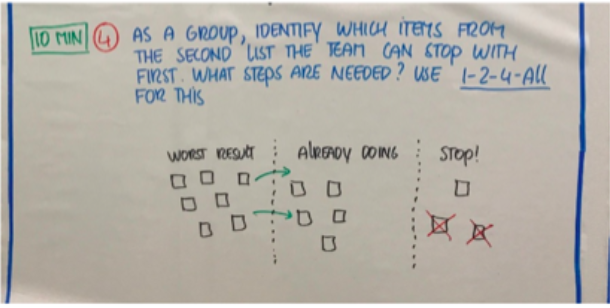
- Together, identify one unwanted result of the intended change process. If there is not an obvious one yet, brainstorm one with the groups;
- Split into teams 4-8 — we’re going to have 3 rounds of 10 minutes work each.
- R1; Give the group 10 minutes (3 minutes alone and 7 minutes as a group) to create a list of all it can do to make sure that it achieves the most unwanted result possible. Invite teams to be creative while making sure to keep it realistic;
- R2; Give the group another 10 minutes (3 minutes alone and 7 minutes as a group) to make a second list of the activities that the team is already doing that resemble or are closely related to items on the first list. Invite groups to be brutally honest by asking: “If you’re brutally honest, which activities from the first list do you recognize in how we already work?”;
- R3; Give the groups a last 10 minutes (same; 3 minutes alone and 7 minutes as a group) to make a third list of all the activities or behaviours from the second list that the group currently does and wants to stop doing. Identify the first steps to help stop these activities. Help teams to avoid the temptation to add new things to start doing — focus on what can be stopped, and how.
Here are two great exercises that will help you get rid of the parts of the past that will hold you back in the future.