

Hertz rental cars is bankrupt.
A company which thrived on adversity in the past, expanding with small cars during the 1970s oil shock and surviving on recapitalisation during the 2008 recession, has succumbed to Covid -19. The 2020 termination of business travel effectively signed Hertz death warrant.
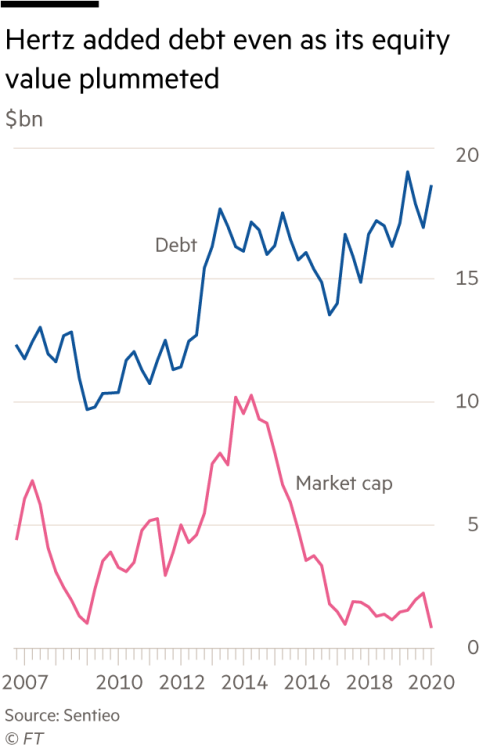
Hertz’s bankruptcy has drawn attention to the relentless build-up in corporate debt in the US, where companies now owe a record $10trillion — equivalent to 49 per cent of their economic output. When other forms of business debt are added in, including to partnerships and small businesses, that already extraordinary figure increases to $17trillion.
Hertz, which employed 38,000 people in 2019, and operated from about 12,000 locations, was unable to escape the weight of a $17bn debt pile. The bet that enabled Hertz to prosper in the 1970s has come unstuck in the 2020s. While other rental chains have taken out new loans to ride out the drought in travel bookings, but Hertz’s borrowing capacity was already spent: after 15 years of aggressive financial engineering, it owed $12,400 for every car worth $10,000.
Much of the money came from complex financial instruments that allowed creditors to demand their cash back when the company could least afford it… now!

Amid the prospect of a new generation of “zombie” companies unable to pay their interest bills, the pandemic is reviving the debate about whether it makes economic sense for the corporate sector to have taken on such a large volume of debt — and used this … not to invest for future growth but to pay dividends and buy back expensive shares both boosting share prices absent topline growth. Many ask whether there is a way to dig out this debt mountain without causing a broader crisis. The 2008 financial crisis prompted a similar discussion about excessive financial engineering, but the response in the decade since that crisis has been to increase leverage, not to wind it down.