

The amount of money you should invest in building the image of your brand is a very contentious subject. What is happening is the amount of investment in brands is falling, and the number of brands investing ahead of their share of market is decreasing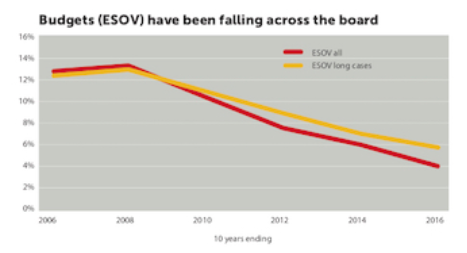 and the effectiveness of advertising campaigns has declined with Short-termism is rising.

But recent in-depth research by Binet & Field has shown ( see here , here and here) that to grow your business you need to invest more in image building advertising and avoid the short-termism of sales activation.
The research of Binet & Field demonstrated that brand building is most effective in the early years of a brand’s life, when penetration and market share are low. But what about spend efficiency?
The primary measure of efficiency is based on share of voice [SOV] analysis.
The simplest version of the model assumes that the equilibrium level of SOV is equal to share of market (SOM). In that case, growth is proportional to ‘extra’ share of voice (ESOV), defined as SOV minus SOM.
Brands that have an ESOV above the equilibrium level will tend to grow; brands that set their SOV below equilibrium will tend to shrink.
As brands get bigger, ESOV Efficiency rises; the bigger your brand the amount of EXTRA spend reduces as a proportion.
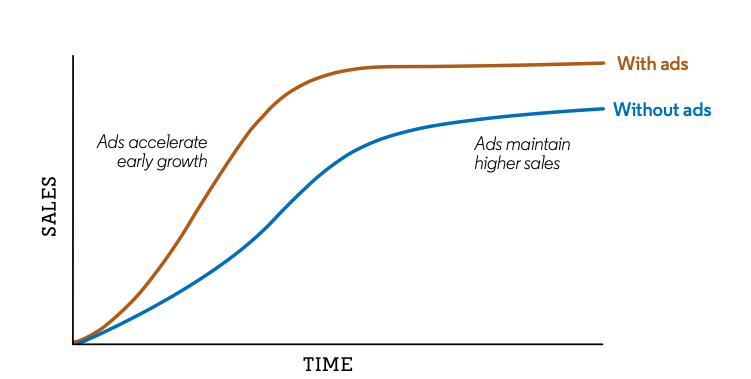
Bass diffusion Model
The fact that new brands can get away with low (or even zero) share of voice advertising spend makes good sense. The Bass Diffusion Model [i.e. product life cycle] predicts that new brands can grow exponentially in their early years, even without advertising. Some people will always try the new product unprompted, and if it’s good they’ll recommend it to their friends.
However, just because new and niche brands can get away with low share of voice doesn’t mean they should. For maximum long-term sales in a competitive environment, an image based brand launch needs to accelerate early trial as broadly as possible. But also, at some point, the brand will cease to be an interesting new contender for which brand building is relatively easy. Then, it will simply become one of the pack, and unless it has acquired a dominant position, brand building will be much harder. This argues for a shifting balance of image and activation over time: high activation at first whilst early trial is vital and brand interest is high; higher image building subsequently as brand interest starts to normalise and less enthusiastic ‘late majority’ adopters have to be won over.”
If you want more impactful image advertising reinforce your currently held images. Advertising works best when it goes with the grain of existing beliefs, rather than against them. Once a brand is established, relaunching or rebranding is slow and highly inefficient, and requires high spend levels over a long period.
PRICING is positively impacted by image advertising.
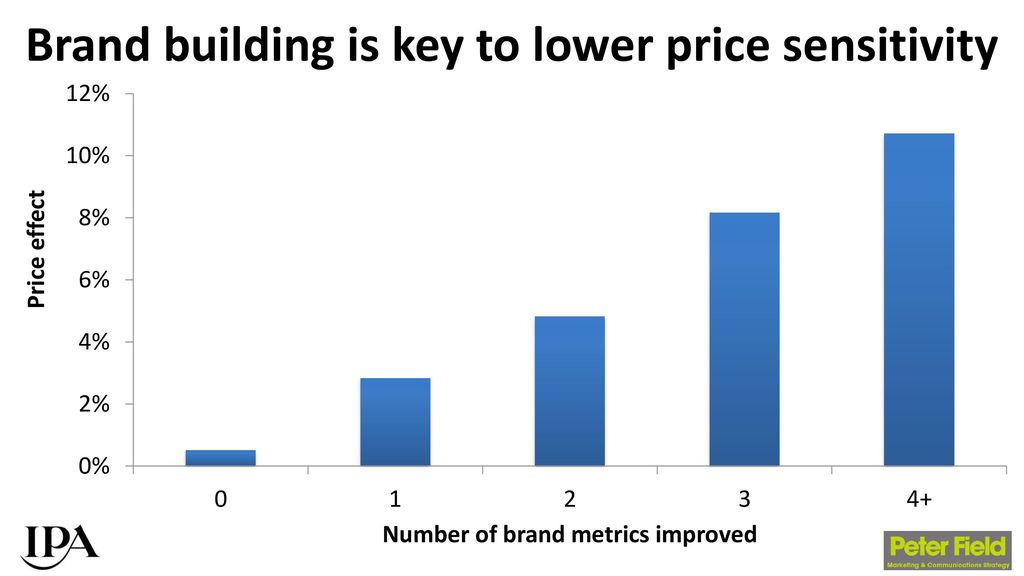
The key to reducing price sensitivity is brand building. The stronger the brand the more power you have to increase price. This cannot be achieved through short-term activation. In fact, price-based activation often increases price sensitivity.
It is very hard to reduce price sensitivity by rational persuasion. In fact, there are still almost no successful examples of this in the researched examples over 30 years. If you want to make people less price sensitive, you need to engage them emotionally; people are willing to pay more for the brands they love.
How can we change price position?
Here the evidence is unequivocal. Only emotional image building has the power to reduce price sensitivity and support premium prices. So firms that want to move their products upmarket need to spend more on brand building.
Are you considering repositioning your Brand upmarket? You have at least two options.
- The first is to reposition the brand as a whole. This is a slow and expensive business, as brand perceptions take time to change.
- The second option is to launch a premium sub-brand. This gets results faster.
Extra SOV Efficiency is high for launches so launching a premium version tends to be a quicker and less advertising-intensive way to recruit upmarket buyers. However, there are additional product development] costs involved, and there is always the risk of cannibalisation.