

Making the right things happen at the right time
Leadership is a complex and multifaceted concept that involves the interaction between leaders, teams, and context. Leaders are individuals who are responsible for guiding and directing a group of people towards a common goal or vision. Teams are groups of individuals who work together to achieve a shared objective, while context refers to the broader environmental factors that influence the actions and decisions of both leaders and teams. As these three elements come together a desired outcome may be created

Successful leadership is characterised by a team forging ahead to produce the desired outcomes , supported by a leader and cognizant of the context in which they operate. The leader is aware of the environmental factors that impact their organization and is able to adapt their approach accordingly. They communicate their vision and mission effectively to their team, providing direction and guidance towards a shared goal. The team, in turn, is motivated and committed to achieving this goal and is aware of the external factors that may impact their work. They work collaboratively, using their strengths and skills to overcome challenges and achieve success. By focusing on the context and working collaboratively, successful leaders and teams are able to create a desired outcome that benefits both their organization and their stakeholders.
This sets up the “situation” in which leadership takes place. This situation, of situational leadership, is the interaction between leaders, teams of their followers, and the environmental context in which they operate. This situation can and will change as the leader develops skill and experience as people within the team become more experienced and change and the environmental context which is subject to great change. Thus leaders must be particularly hyperaware of any potential changes in their team and environmental context.
In contrast, unsuccessful leadership is characterized by a breakdown in the relationship between the leader, team, and context, resulting in a failure to achieve desired outcomes.
Recognizing a gap between the leader and the context can be challenging but is essential for effective leadership. A leader may have a clear plan of what they want to achieve, but this may not be aligned with the needs and expectations of the environment in which they operate. This misalignment can lead to ineffective decision-making and a failure to achieve desired outcomes. To recognize a gap between the leader and the context, leaders need to be aware of the environmental factors that impact their organization and be willing to adapt their approach accordingly.
Similarly, recognizing a gap between the leader and the team is crucial for effective leadership. A leader may have a clear vision, but if the team is not aligned with this vision, it can lead to a breakdown in communication, a lack of trust and collaboration, and reduced morale and motivation among team members. To recognize a gap between the leader and the team, leaders need to be aware of the dynamics within their team, including communication styles, decision-making processes, and individual strengths and weaknesses.
Finally, recognizing a gap between the team and the context is essential for effective leadership. The team may be working towards a common goal, but if they are not aware of external factors, such as changing market conditions or customer needs, it can impact their ability to achieve their objectives. To recognize a gap between the team and the context, leaders need to encourage their team to be aware of external factors that may impact their work and be willing to adapt their approach accordingly.
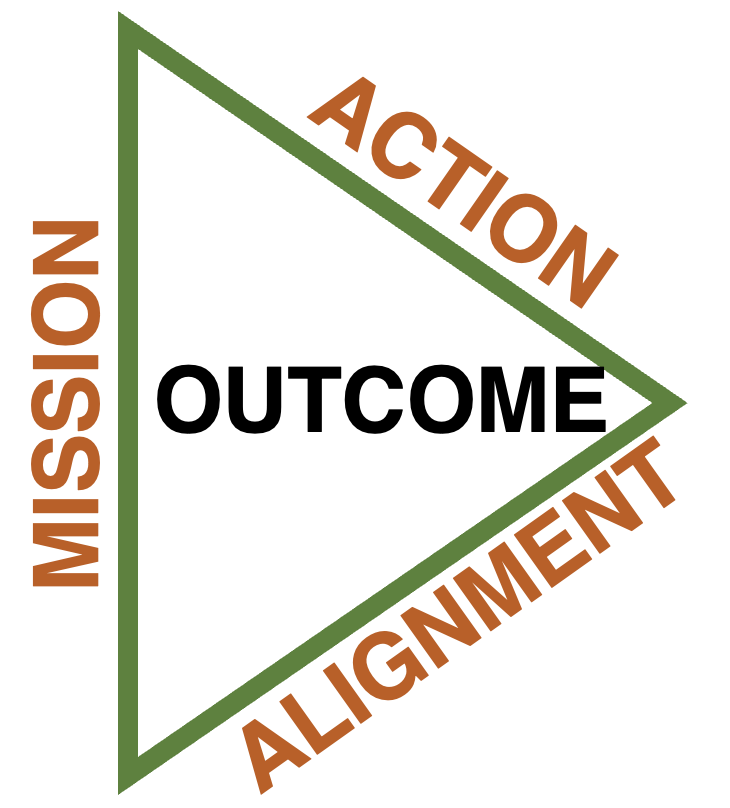
MISSION : approach to achieve the desired outcome in relation to the context and outcome — the direction identified to achieve the outcome .
- In groups with a strong mission: leaders and members clearly understand what group success looks like and is focused on accomplishing this in a coherent way. There’s understanding of a shared future and that could be clearly articulated as to why this strategy is worthwhile. There is agreement on what the outcome or collective success looks like.
- In groups with a weak mission: Members are uncertain about what they should accomplish together, or they feel pulled in different directions by competing goals. There is little agreement on priorities. People are torn in different directions resulting in wheel spin, running in circles or inertia.
ALIGNMENT: coordinated work within the group and integration of the different aspects of the work so that it fits together in service of the shared mission.
- In groups with strong Alignment: Members with different tasks, roles, or sets of expertise coordinate their work. All are clear about each others responsibilities. The work of individuals or the group fits well with other individuals or groups. There’s a sense of organisation, co-ordination and cohesion
- In groups with weak Alignment: Members work more in isolation, unclear about how their tasks fit into the larger work of the group and are in danger of working at cross-purposes, duplicating efforts, or having important work fall through the cracks. There is disarray, deadlines are missed, rework constantly required and duplication of effort. Individuals feel isolated and often in competition with others
ACTION : mutual responsibility within the group, to implement when people are making the success of the collective (not just their individual success) a personal priority.
- In groups with strong sense of Action: Members feel responsible for the success and well-being of the group, and they know that other group members feel the same. They trust each other share mutual responsibility and will stick with the group through difficult times. Thus giving the extra effort necessary, if the context changes, for the group to succeed. People express passion and motivation to act.
- In groups with weak sense of Action: Members put their own interests ahead of the group’s interests and contribute to the group only when it’s easy to do so or when they have something to gain. People ask “what’s in it for me” and people fail to walk their talk.
Strategic Leadership ARROW Framework
This introduces the idea of a strategic approach to leadership by bringing these two together as a single framework. Where mission is a result of leaders engaging with context to identify what outcome is desired by the organisation in alignment with organisational vision. Cohesion is a result of leaders and their teams interacting effectively and creating alignment. Action occurs when the team implement the aligned plan into the field to achieve the desired outcome

How can we achieve better strategic leadership?
What are the ways in which we can implement this framework? Here is a Toolbox of skills and capabilities for new leaders to develop their leadership abilities using the “Mission – Alignment – Action” model.
Mission: involves identifying issues within the context, setting a clear vision and strategy for the organization and communicating it effectively to employees. Leaders who provide a clear Mission enable their team members to understand the organization’s goals and how they can work toward achieving them. Here are three key skills and tools to implement them.
Strategic Questioning: Strategic questioning involves asking thoughtful and insightful questions that can help leaders to gain a deeper understanding of their organization, its goals, and its challenges, and to develop effective strategies for achieving success. Here are three tools that can help leaders to develop their strategic questioning skills:
- Six Thinking Hats tool is a method for asking strategic questions that can help leaders to explore a problem or issue from multiple perspectives. This tool involves wearing different “hats” to represent different ways of thinking, such as logical, creative, emotional, and critical thinking. By adopting different perspectives, leaders can ask better questions and gain a more complete understanding of the problem or issue.
- Force Field Analysis tool is a method for asking strategic questions that can help leaders to identify the forces that are driving or hindering a particular goal or objective. This tool involves asking questions to identify the driving forces that are helping to achieve the goal, as well as the restraining forces that are hindering progress. By identifying these forces, leaders can develop effective strategies to overcome the barriers and achieve success.
- Socratic Questioning tool is a method for asking strategic questions that can help leaders to challenge assumptions and gain a deeper understanding of an issue or problem. This tool involves asking a series of open-ended questions that encourage reflection, analysis, and critical thinking. By asking these questions, leaders can gain a deeper understanding of the problem or issue and develop effective strategies for addressing it.
Decision Making: Leaders need to be able to make effective decisions quickly and with confidence. Tools for decision making can include creating a decision-making framework, using data to inform decisions, and seeking input from stakeholders.
- Systemic Thinking: This tool involves understanding how different parts of the organization interact and affect each other. The tool includes steps such as mapping the organization’s systems and processes, identifying potential leverage points for change, and developing strategies to improve overall performance.
- Rational Decision Making: This tool involves using a logical and systematic process to make decisions. The tool includes steps such as defining the problem, gathering and analyzing data, identifying alternatives, evaluating alternatives based on criteria, and making a decision.
- Intuitive Decision Making: This tool involves using intuition and judgment to make decisions. The tool includes steps such as trusting your instincts, seeking input from others, reflecting on past experiences, and taking calculated risks.
Visioning: Leaders need to have a clear understanding of where they want to take their organization, and they need to be able to communicate that vision effectively to their teams. Tools for visioning can include creating a vision statement, developing a strategic plan, and setting SMART (specific, measurable, achievable, relevant, and time-bound) goals.
- Developing a Compelling Vision: This tool involves creating a vision that inspires and motivates employees to achieve the organization’s goals. The tool includes steps such as identifying the organization’s values and purpose, engaging employees in the visioning process, and communicating the vision effectively.
- Setting a Strategic Mission: This tool involves developing a strategic plan that outlines the organization’s goals, objectives, and action plans. The tool includes steps such as conducting a SWOT analysis, setting SMART goals, and creating an implementation plan.
ALIGNMENT involves creating a work environment that fosters collaboration and teamwork, so that employees are aligned and working together to achieve organizational goals. Leaders who promote Cohesion ensure that everyone is working toward the same goal and that all efforts are aligned and coordinated. Here are three key capabilities to achieve cohesion and tools for each.
Communication: Leaders need to be able to communicate effectively with their teams and stakeholders. Tools for communication can include active listening, giving and receiving feedback, and creating a communication plan.
- Active Listening: This tool involves actively paying attention to what others are saying and seeking to understand their perspective. The tool includes steps such as focusing on the speaker, asking clarifying questions, summarizing what was said, and showing empathy.
- Giving and Receiving Feedback: This tool involves providing feedback to others in a constructive and effective manner, as well as being open to receiving feedback. The tool includes steps such as focusing on behaviours, being specific and timely, using “I” statements, and being open to feedback.
Collaboration: Leaders need to be able to work effectively with others to achieve shared goals. Tools for collaboration can include team-building exercises, creating a shared vision, and fostering a culture of trust and openness.
- Building High-Performing Teams: This tool involves creating a team environment that fosters collaboration, innovation, and high performance. The tool includes steps such as clarifying roles and responsibilities, building trust, setting clear goals, and creating a supportive team culture.
- Managing Conflict: This tool involves addressing conflict in a constructive manner and finding win-win solutions. The tool includes steps such as identifying the source of conflict, listening to both sides, finding common ground, brainstorming solutions, and implementing an agreement.
Influencing with and without authority: Leaders need to be able to influence both formally and informally.
- Power of Persuasion. Persuasion is the ability to convince others to adopt a certain point of view or take a specific action without using formal authority. This can be achieved by building a compelling argument that addresses the interests and concerns of the target audience. Effective persuasion involves active listening, understanding the other person’s perspective, and adapting the message to their specific needs and concerns by using logos, ethos and pathos.
- Building a network of allies; In most organizations, decisions are rarely made by one person, but rather through a process that involves consultation with others. Building relationships with key stakeholders who can help support your ideas or initiatives is an effective way to influence without formal authority. This involves identifying individuals or groups who have the power to impact your goals and building a rapport with them based on trust and shared interests. Building a network of allies can also involve identifying common goals and working collaboratively to achieve them.
ACTION involves fostering a sense of commitment and dedication among employees, so that they are motivated to work hard and achieve organizational goals. Leaders who inspire Action create a work environment that fosters a sense of purpose and belonging among employees, which in turn motivates them to work harder and stay committed to the organization. Here are three key capabilities to achieve action and tools to implement this.
Motivation: Leaders need to be able to motivate and inspire their teams to achieve their goals. Tools for motivation can include creating a sense of purpose, recognition and rewards, and creating a positive work environment.
- Goal Setting: This tool involves setting clear, challenging, and achievable goals that motivate employees to perform at their best. The tool includes steps such as setting SMART goals, communicating goals effectively, tracking progress, and providing feedback.
- Intrinsic Motivation: This tool involves tapping into employees’ internal motivation by creating a work environment that fosters autonomy, mastery, and purpose. The tool includes steps such as providing meaningful work, offering opportunities for growth and development, and recognizing employees’ contributions.
Developmental Guidance: Leaders need to be able to process of providing support, advice, and feedback to individuals to help them improve their skills, knowledge, and performance. This can provide a comprehensive and integrated approach to supporting individuals in their professional and personal development.
- Coaching for Performance: This tool involves providing feedback and guidance to employees to improve their performance and achieve their goals. The tool includes steps such as setting clear expectations, providing feedback regularly, setting development goals, and monitoring progress.
- Mentoring for Development: This tool involves providing guidance and support to employees to help them develop their skills, knowledge, and career aspirations. The tool includes steps such as establishing a mentoring relationship, setting development goals, providing guidance and feedback, and monitoring progress.
Resilience: Leaders need to be able to manage stress and bounce back from setbacks. Tools for resilience can include mindfulness practices, self-care routines, and stress-management techniques.
- Building Resilience: This tool involves developing the ability to bounce back from setbacks and overcome obstacles. The tool includes steps such as cultivating a growth mindset, practicing self-care, developing coping strategies, and seeking social support.
- Managing Stress: This tool involves managing stress effectively to prevent burnout and maintain well-being. The tool includes steps such as identifying sources of stress, developing stress-management strategies, practicing mindfulness and relaxation techniques, and seeking social support.
Make more and better leadership happen. When you notice that there aren’t many leadership processes in place, create them. When there are useful leadership processes in place, make sure people have the skills to participate in them effectively. And when existing leadership processes no longer seem to be producing the needed Mission, Cohesion, and Action, explore new ones.
For example, consider:
- To create more Mission: Does a more diverse group of people need to be involved? Are you asking the right questions to create the best scenarios? Are you making good decisions in appropriate time how can you speed the process without losing quality?
- To create more Cohesion: When a new strategic initiative is being launched, does your staff have the skills to analyze its implication for their own work? Do you need to meet more regularly with your peers to prioritize work? Are clearer accountability structures needed?
- To create more Action: Are more honest conversations about proposed changes needed? Can you match members of your staff with projects that they are most enthusiastic about, while still assuring that all the projects are adequately resourced?
Here, I have presented the concept of strategic leadership with a framework of how to achieve this.
My belief is that strategic leadership involves the interaction between three constituents – leaders, teams of their followers, and the environmental context in which they operate – to create a situation. This situation can and will change primarily as the environmental context changes in response to the economy, stakeholders and competitors., hence the need for leadership agility which is the ability of leaders and team to rapidly respond (or create or anticipate) such changes.
Leadership maturity develops as the leader builds familiarity with the skills and builds experience and thus greater credibility, and integrity. Equally team members become more experienced, and trusting of leaders based on experience.
Successful leadership can be characterized as achieving outcomes by combining leader, their team, and the context, with a shared mission, alignment, and a focus on action to achieve desired outcomes. I have highlighted the importance of recognizing gaps within this Leadership ARROW between the leader, context, and team, and identifying the appropriate tools to bridge these gaps to achieve sustained success.