

While today’s pricing is low… See my previous post, tomorrow’s Oil pricing will inevitably rise, and there will be accompanying spikes in the pricing.
Why?
The answer is Simple demand-supply economics.
There is no steady equilibrium in Oil production. Oil is a finite commodity and the wells which produce oil, tend to produce less oil each year. While demand tends to increase by a modest 1-1.5% per year (around 1 million barrels a day) , without new sources of oil the production of oil declines by around 6% per year as older wells run dry ( around 5.5 million barrels a day).
This means purely to match demand, there needs to be a 7.5% increase in production annually.
Also, unlike many commodities, oil is subject to arbitrary shortages caused by geo-political activities- for example, a US initiated sanction on Iran = oil supply decreases, or ISIS militants take Mosul = oil supply reduction, problems in Venezuela = oil supply reduction.
And so a simple equation to assess the future price of oil is
Oil Price = Production Cost (real cost of securing new sources of oil) + Security Premium (how much you will pay to avoid unplanned politically induced shortages)
Here’s a great waterfall graph showing the underlying dynamics of oil, to maintain current production volumes we need to find 5.5 million new barrels of oil each day!
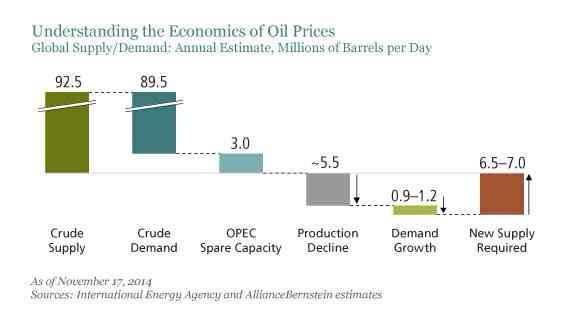
Additional supply from US shale will help meet some of that demand growth. But medium term new investments in ultra-deep water and oil sands are still needed. According to analysts, some of these projects require oil prices of at least US$80–90 to be economical. As they will be new fields they need a high oil price to justify the cost of exploration, drilling and installing pipes.

Immediately available spare capacity also matters for these calculations. Saudi Arabia controls most of the industry’s spare capacity, which amounts to about three million bbl/d, according to analysts estimates (see graph). That’s not really a lot considering that troubles in a major producer such as Libya, Iran, Iraq, Nigeria or Venezuela could cut supply by more than one million bbl/d.
It also feeds into the security premium; the extra cost you must pay to ensure smooth supply. Consumers are anxious to sustain smooth oil supplies no matter what, and oil companies tend to pay to secure it when capacity is tight—or when there’s a perceived threat to supply. This explains why the oil price spiked in June as ISIS drove on Baghdad and took out Mosul and their oil wells. On average its believed the security premium adds about US$10 to prices.
Taken together, all of these factors suggest an equilibrium oil price of US$90–100, according to analysis. Of course in the short term, if production rises faster than demand, a glut of oil can push prices below this range. But if low prices persist, investment will be suppressed and spare capacity will tighten. Then, prices are likely to begin rising again.
In the past few years we have become accustomed to oil pricing around US$100/barrel as any short term glitches were covered by Saudi Arabia adjusting production to keep the market balanced and prices fairly stable.
Saudi officials recently suggested that they might no longer be willing to cut supply to balance weaker demand and US supply growth. This may force short term pricing lower… But not forever.
If US$70-80 oil pricing is sustained for a year or more, the impact on reducing investment in new oil production will be significant and create the potential for a future spike in oil prices . In our view, it’s only a matter of time before the market begins to recognize this—and starts to push up oil prices again.
Information from this post was found here
good summary for me, maybe even better than local press
thanks for posting