

Currently I’m doing a review of possible future courses, and it’s interesting to think about the topics our participants may need assistance on. That got me thinking and a bit of research based on my recent experiences.
In our “new normal”, we’re working in virtual environments and the latest from Harvard Business tells us that our new working status “virtually coping with COVID” results in team members that now have a lack of clarity, fading interpersonal connections, low motivation, and overwhelming workloads. . CIPD research during COVID has shown that communicating through electronic media, team members share less information with each other, have a harder time interpreting and understanding the information they receive, and give delayed feedback. Furthermore, working in virtual environments makes it harder to spot non-verbal cues, such as tone of voice, warmth, attentiveness, all of which add to the difficulties of sending a clear message.
Worse than that, even before COVID we knew that working in Virtual teams was significantly harder and much less productive than face-to-face team performance. Research from MIT Sloan 2018 identified that 82% virtual teams did not achieve their goals and that 66% of experienced managers FAILED when they started leading virtual teams according to Evernote research.

NEW APPROACH FOR VIRTUAL TEAMS
In response to this virtual team challenge, I have reformulated the classic Mount Everest team development simulation to replicate the challenge of virtual teams. In addition to the online simulation, we’ve created an in-depth introductory video which explores three key issues. Firstly, encouraging potential participants to consider the difficulty of working in virtual teams… making conscious their virtual challenge. We ask them to identify the road-blocks they currently face and to identify potential future challenges. We also encourage the potential virtual team to meet before the simulation to review these potential challenges. Secondly, we also highlight the need to actually practice building virtual teams, turning this new knowledge into action. We emphasise that our practice session will be conducted in a psychologically safe environment enabling participants to learn from possible challenges and mistakes, and to create potential strategies to overcome these in real life. Finally we introduce the simulation and the challenges of climbing Mt Everest in a virtual team.
What are the Learnings
In addition to the typical learning points of the need for teams to become more explicit in their communication to overcome the triple trial of asymmetric information, asymmetric goals and asymmetric capabilities, we have found that our participants highlight the following five critical gaps
- Distance is a killer- not just physical distance but also the decline in affinity (shared values, trust and interdependencies) that a virtual environment can create
- Communication is much harder (in the absence of non-verbal cues and the increased strain of life on zoom or teams)
- The decline in personal connection (teams become more task focused, spending less time on team engagement)
- Reticent team members become invisible (the drive to complete tasks in shorter times means the introverted or more junior members receded into invisibility)
- Empathy declines (especially for leaders tasked with solving problems).
This feedback is validated by research from CIPD 2020 and MIT Sloan.
How to we address these challenges.
Steve McConnell in 2017 said that the “half life of trust was six weeks” for virtual teams and as more and more people work virtually I believe this half live is diminishing. The foundation on successful teams is the creation of a trusting environment and the successful management of conflict (promoting cognitive conflicts to spur innovation and restraining affective conflicts). In our session we find building trust to be a priority by looking at the formal and informal ways to engage all team members in a psychologically safe environment.
One extra new positive from this online simulation is that the typical pitfalls of using online tech in teaching (logging in, slow broadband speeds, inability to communicate clearly) are pertinent reminders of the challenges of the virtual environment. What was once a pitfall now becomes an essential teaching aid.
I have come to believe that this new virtual engagement has a much deeper engagement and a much more beneficial outcome than the normal class setting. But, why?
WHEN DO LEARNERS WANT TO LEARN
This is a great segue to my next section… when to teach skills…. sorry maybe i should rephrase… when is best for learners to learn.
I wondered WHY the virtual Mt Everest made such a positive impact, and made the realisation that most learners typically only want to learn when circumstances compel to learn and use the learning. And our current virtual work environment is causing significant performance problems in learners lives. Our session has provided learners with potentially tangible and beneficial insights to create better results.
The insight here is simple, when people become conscious of their incompetence they actively seek and appreciate learning. The virtual Mt Everest was provided at the right time for the learning process.
How can this inform other training decisions? One particular time of conscious incompetence is the period of organisational career transitions; when people are promoted beyond their competence inside their current organisation. The most important of these transitions are when the subject matter expert (product manager, technologist, accountant, etc) becomes a team leader (or the team leader becomes a strategic leader, but that may well require a more personal engagement). The period just before or after this transition is a critical time for executives to learn new skills. SMU Executive Development has a series of both open enrolment and customized modules to assist this transition. It’s important to time this intervention when the participant is conscious of their level of incompetence in the new role. Leave this too long, and the executive has to develop their own responses to new challenges and often these must be unlearned before further learning takes place.
So what skills do these new manager need? Recent investigations has again shown that these skills are relatively generic but also are not easy to learn while on the job. HR consultants PI has identified the top 5 skills expert executives transitioning into management need…
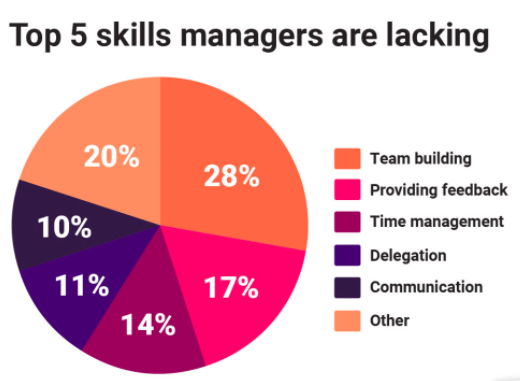
Certainly not rocket science, but certainly essential to performance.
So in review we know what transitioning managers need to know and we know when the engagement needs to be done, all that remains is for you to find a great learning partner.