

With the start of a new year upon us, its time to look forward to what we have in store in 2015. What are your thoughts? Doom and gloom or a bright new dawn?
Mine are, more of the same, we’ll be struggling through for a couple more years… generally I believe there will be a modest increase in the business environment driven by a more positive view out of the USA, dragging Asia into growth. But overall National Governments have insufficient tools to recreate strong growth experienced in the past, but sufficient means with which they can stave of depression. We’ll be meandering along for quite a while until “something turns up”.
I’m not an economist, and so as a laymen I’ve tried to piece together some of the better thinking I’ve seen on the web.
One concept, raised a year ago by Larry Summers of Harvard University is the term “secular stagnation” to describe what the developed world is going through. This was also commented on by Martin Wolf a year ago also. It seems they believe we’ll reflect what has happened in Japan for the past few decades.
Weak consumer demand and excess savings will make it impossible to stimulate growth with the usual tool of low short-term interest rates, he argued. Unlike previous periods of no-growth, or recession like the 2000 tech bubble or the 2007 recession, there will be some fundamental forces at play that have created this and will continue to keep growth diminished.
This time there are some major shifts in the west which indicate the US, Europe Australasia and China are unlikely to be the drivers of future growth. The key amongst this is a significant ageing of the developed worlds population.

An ageing population could hold down growth and interest rates through several means. The most direct is through the supply of labour. An economy’s potential output depends on the number of workers and their productivity. In both Germany and Japan, the working-age population has been shrinking for more than a decade, and the rate of decline will accelerate in coming years (see chart). Britain’s potential workforce will stop growing in coming decades; America’s will grow at barely a third of the 0.9% rate that prevailed from 2000 to 2013. Even China’s working age population is set to decline.
The Economist states, all else being equal, a half percentage-point drop in the growth of the labour force will reduce GDP growth by a similar amount. This is now coming into effect in the US, and Western Europe as the post-war baby boomers consider retirement. It happened in Japan a decade ago. As populations age, more and more effort will be spent saving for retirement (depressing consumption) rather than spending on marriage, babies, housing and education.
The size and age of the population also influences how many customers and workers businesses can tap, and so how much they will invest, and thus a decline in spending customers depresses business.

And so we are now entering into a different world, a business environment in the West where growth is no longer propelled by a youthful population growing and spending. The US and the West is entering into a Japan like permanently low growth phase where more people are considering saving rather than spending.
This will also impact on Asia- not the decline in working population- the working population of ASEAN is set to increase still.
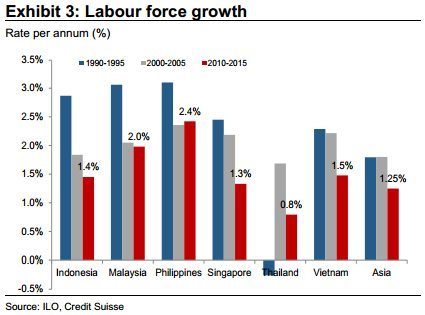
But will there be high paying jobs for all these new workers?
Thinking abut our current economic environment, where do all our fantastic manufactured products go? Most to the West. If Western demand slows, we will need to boost local demand, led by increased wages. BUT if wages increase without increasing productivity then the work will migrate to other low cost centres, maybe even back to Europe and the US where higher wages are supported by even higher productivity.

So we are in for different and more challenging times.
We can’t assume strong growth in Asia no matter what. Our future is still linked to the West. We have a challenging future ahead.