
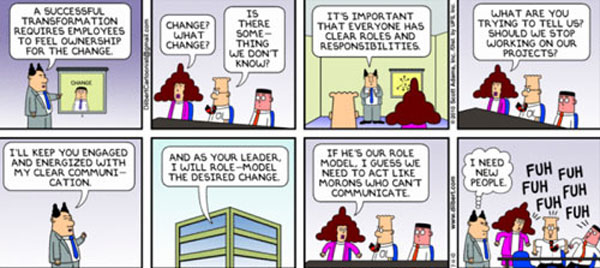
We appear to be in a state of constant change- reacting to a changing economy, reacting to political change, reacting to environmental change… all these external factors mean we need to recalibrate our strategies and potentially change course.
How can executives better cope with change?
If you give your managers a complicated process to follow (especially one which takes time to figure out how to complete and is slow to implement) they will probably do the bare minimum they need to meet that process while cutting corners where they can. That’s bad enough, but if you then proceed to continually change the process you gave them, the disconnect will usually result in the changes getting ignored, leaving you thinking that tasks are being completed one way, when in fact the direct opposite is happening, nothing is happening because people are dazed and confused. Nobody understood what to do, what the changes were, or why the entire thing was important in the first place. So they ignored your orders.
A solid change management strategy stops that by bringing the people in your company closer together, teaching them a consistent strategy across the whole company, managing their expectations and letting them voice their concerns. So here’s my view on what you need to consider in change management.
Change management strategy principles
No matter what method or model you’re using to support your changes, there are eight core principles which hold true throughout the entire process. In other words, if you don’t keep the following at the forefront when you’re planning how to enact a change, the overall success of the operation will suffer.

I’ll go through each in turn, but to summarize you need to:
- Clearly define your change
- Keep your language simple
- Start at the top…
- … But also teach the front lines
- Understand and use your culture to your advantage
- Tie changes to strategic and emotional benefits
- Encourage behaviour shifts, not just actions
- Support your changes with a formal framework
Let’s get started.
Define the change
Change management exists as a practice to help changes be consistently and successfully applied across an entire company. As you’d expect, this is incredibly hard to do (if not impossible) if you don’t have a set definition of the change you’re going to make.
It’s no good giving vague benefits or descriptions; you need to lay out exactly what the change will be, how it will be achieved, how it will be tracked or measured, and what success metrics it should affect. It’s a single description or document that anyone in your company should be able to read, understand, and take action on.
A critical element to remember here is what you say will NOT be interpreted exactly as you hope for, There is a wide gap between the sender of the message and what the receiver understands. The lesson is to keep your messages simple, and keep repeating them until people understand what you want.
Keep it simple
If you don’t keep your changes simple, nobody will want to take action on them. You need to be able to describe them in language which anyone can understand, and immediately see the benefit of.
If you can’t easily describe it, then you might be trying to do too much at once. Take a step back and break up your change into smaller chunks which can be enacted over time. That way you don’t risk alienating your employees or team members by ripping up their entire routine (although this can be necessary in dire situations).

Start at the top…
Before you try to convince your front line employees of the changes you make, it’s important to have your upper staff presenting a unified front. If you don’t make sure that everyone agrees on the changes and how they should be done, you could end up with each team taking a drastically different approach, leaving your success to random chance.
Worse still, if your teams aren’t unified in how they’re making changes, tracking any progress you make will become next to impossible, as there won’t be any common factors to track.
As such, you need to start your change management strategy with your managers. Make sure that they see eye-to-eye on what changes need to be made, how they should be done, what their ultimate goals should be, and so on (ideally by meeting with them all at the same time).
Perhaps most importantly, listen to any feedback that they have on the changes. Department managers will know the effect that any changes will have (maybe even better than yourself), and so discounting their say on the matter will only hurt your company and your relationship with them.

Plus, having a unified approach across your teams which you can rely on will let you sit comfortably in the knowledge of what’s happening. Corners aren’t being cut without your knowledge because everyone agrees on the united approach.
… But don’t forget the front lines
Upper management and team leaders might be able to coordinate the changes at a smaller level, but without listening to those on the front line you’re leaving massive room for error and dissent. So, once you’ve gotten your team leaders on board, you need to do the same for every employee.
Depending on the size of your company it might not be possible to meet with every employee one-on-one or even in small groups. Even if you could, they might be unwilling to voice their concerns and/or questions face-to-face.
Instead, try either getting each manager to explain the changes to their team and fielding questions or hosting a large-scale meeting/webinar to explain the changes to everyone at once. Either way, be sure to encourage questions and feedback at the end, and also include an anonymous way to do the same (a query box or anonymous online question form), since this will allow anyone too shy to speak up to still give their feedback and feel like their voice is being heard.
Use culture to your advantage
A large part of managing change when it comes to the human elements of your company is knowing what your company culture is, along with its strengths and weaknesses. If you know how everyone works, communicates, what they like and dislike, what they do well, and what they don’t, you can plan out the best way to apply the changes you make, be it using new software or changing a process.
If, for example, you knew that a large portion of your team lunched together in small groups and you wanted to encourage cross-team collaboration and chatter, you could organise regular group lunches from the company to foster those connections and where managers could deliver simple messages in an informal way.
The ultimate change management strategy is to make sure everything runs smoothly rather than alienating your workforce with massive shifts in your practices. If you don’t know how they currently work and communicate, what you think is a minor alteration could become a massive rift, leaving the team to feel like they’re being ignored as people.
Tie changes to strategic and emotional benefits
The term “employee engagement” gets thrown around by many (including myself), but when managing change in your company you truly need to engage them on a logical and emotional level. It’s not enough to tell someone “this will help you work quicker” or “this program will make your job easier in the long run” – you need to link your changes to benefits that they will be personally motivated to achieve.
A couple of quick examples are:
- Having more time to spend on interesting tasks they enjoy doing
- Completing projects in advance to avoid late-night stints
- Branching out into more varied duties
These aren’t just employees after all – they’re people with differing interests, goals, and desires, and by linking the changes to benefits which appeal to them as people you can naturally encourage them to stick to the new way of doing things.

Encourage behaviour shifts, not just actions
Telling an employee to perform an action will get the task done, but it won’t stop them from returning to their previous routine as soon as the project’s initial enthusiasm wears off. Telling them how to perform the new action will alter their behaviour, and after a few repetitions, suddenly the change has become their new routine.
This comes back to considering the people in your company rather than just the technical aspects – saying how to approach a given task along with its new goals and thought process is a much more effective way of making sure that your changes stick.
Plus, if you can inspire a particular attitude among your team you can encourage them to more closely stick to their goals and produce high-quality work. You turn a team of people just doing what they’re told to a group with a central purpose, who aren’t afraid to take action to further that goal above and beyond their usual duties.
Or, at least, you’ll change their routine for the better. You can’t win them all, but every little helps.
Support your changes with a formal framework
Without a set framework to follow you don’t stand a chance of being able to consistently deploy and track any changes made in your organization.
Documented processes benefit businesses of literally any size (and even personal tasks) by giving a repeatable set of instructions which provide a set standard of quality. You need to have a set framework to follow if you want to have any kind of consistency. Beyond that, you can only track and measure your success if you’re consistent, and you can only reliably improve if you can track your success.
In short, unless you use a set method for deploying your changes, you won’t be able to collect enough information to know how to improve your business. Speaking of which…
Having a change management strategy lets you control your future
Change management sounds like an imposing term, but as you’ve seen above, the majority of it is just taking a logical approach to the changes you make in your company and planning out what you’ll need to do as a result.
So by both encouraging change and increase employee adoption of those changes, companies can both adapt to the times and customer demands while accurately knowing how everything is handled. Again, humans are creatures of habit, and if there’s an easier way to carry out a seemingly complex task, chances are that the easy avenue will be taken.