
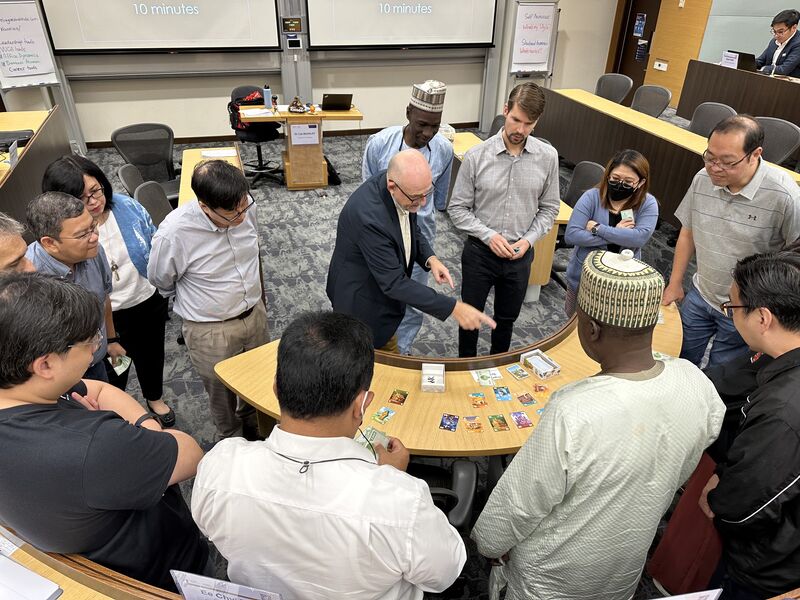
I have been using games to assist learning for over five years. Initially I used simulations- a software based approximation of real life situations to enable learning of almost real life experiences. But simulations are expensive, have a computer based interface and rarely mimic real-life interactions… the computer and simulation are as much an actor as the learners.
Looking for something more relatable, cost-effective and realistic I have added physical board and card games to my teaching skill set .
These games, in my experience provoke a different and maybe a better learning environment . Why?
Using serious games played face-to-face can dramatically increase learners intrinsic motivation to participate , experience and potentially learn. Studies suggest that leadership and business skills development is best acquired through experience and reflection, yet many traditional training programs are unable to deliver this type of learning opportunity. While classroom environments can be an effective channel, such as transferring knowledge with live questioning. This is often less effective as this knowledge while potentially learnt is not activated via practice and experience. One critical learning barrier faculty face is the knowing-doing gap. Games force learners to do, they bring agency into learning.
Serious games for serious learning
Recent advances in “serious games,” such as game-based and simulation-based environments, can help enhance learning and skill development. While many may be skeptical about using games to develop skill sets, early adopters are already seeing results. The US Army has employed serious games to address challenges in training and development. While soldiers were well-trained in weapons and war tactics, they needed to increase their familiarity with other cultures’ values, norms, and environments when deployed and games and simulations have been used to provide this. Personally I use two similar games to highlight how small differences in unwritten rules impact behaviour and performance.
In addition, lets consider how powerful and addictive playing games is. The psychology behind this points to four key reasons for such high engagement :
- We receive instant feedback. Gaming creates a world that allows us instant results based on our performance. Author Ron Friedman explains, “When we pick up our smartphones and settle in with a good game, we immerse ourselves in a world that offers instant feedback on our performance and a sense of accomplishment when we succeed. A world where every task offers an opportunity to grow our competence, enhance our skills, and earn recognition.” We know almost immediately how well we did on a particular task, fueling our need for feedback and recognition.
- We experience a sense of flow. Time passes quickly when playing games. How many times have you been so immersed in completing a task within a game that you lose track of time? Psychologists refer to this as flow, a state in which we are completely absorbed in an activity and unaware of all other stimuli. Your ability to concentrate on the task at hand becomes effortless and reduces barriers to actions and learning. You just “do” … and this agency is a critical part of current (or new) behaviour awareness.
- Progressive difficulty makes us want more. All games can have levels that inspire you to continue to work toward the goal. Games are less about the given task, because, let’s face it, playing cards or placing tokens is not that engaging . Games with human and physical interaction create a progressively more difficult environment in which our need to achieve kicks into overdrive. We’re continuously pushed toward higher levels of performance that reinforce that state of flow. Friedman’s research suggests that we are most engaged when our skills are stretched and when we are building expertise. Playing games with colleagues does that.
- Games are intrinsically gratifying. Advancements in neuroscience reveal that when we learn and acquire new information, our production of dopamine rises. This explains why playing games is so enthralling. The release of dopamine actually makes everything more interesting. Our moods usually improve, also.
These attributes—receiving feedback instantly, experiencing flow, progressive difficulty, and intrinsic gratification—are powerful mechanisms to promote adult learning. This intersection of psychology and games helps us understand the allure of using games to assist us help people learn essential work-related skills.
But how does playing games help learning?
The majority (80 percent) of key soft skill development comes from experience. Our mental models of how manage at work derive from our personal experience. However, experience alone is not enough to learn and develop critical capabilities. “We do not learn from experience . . . we learn from reflecting on experience.”
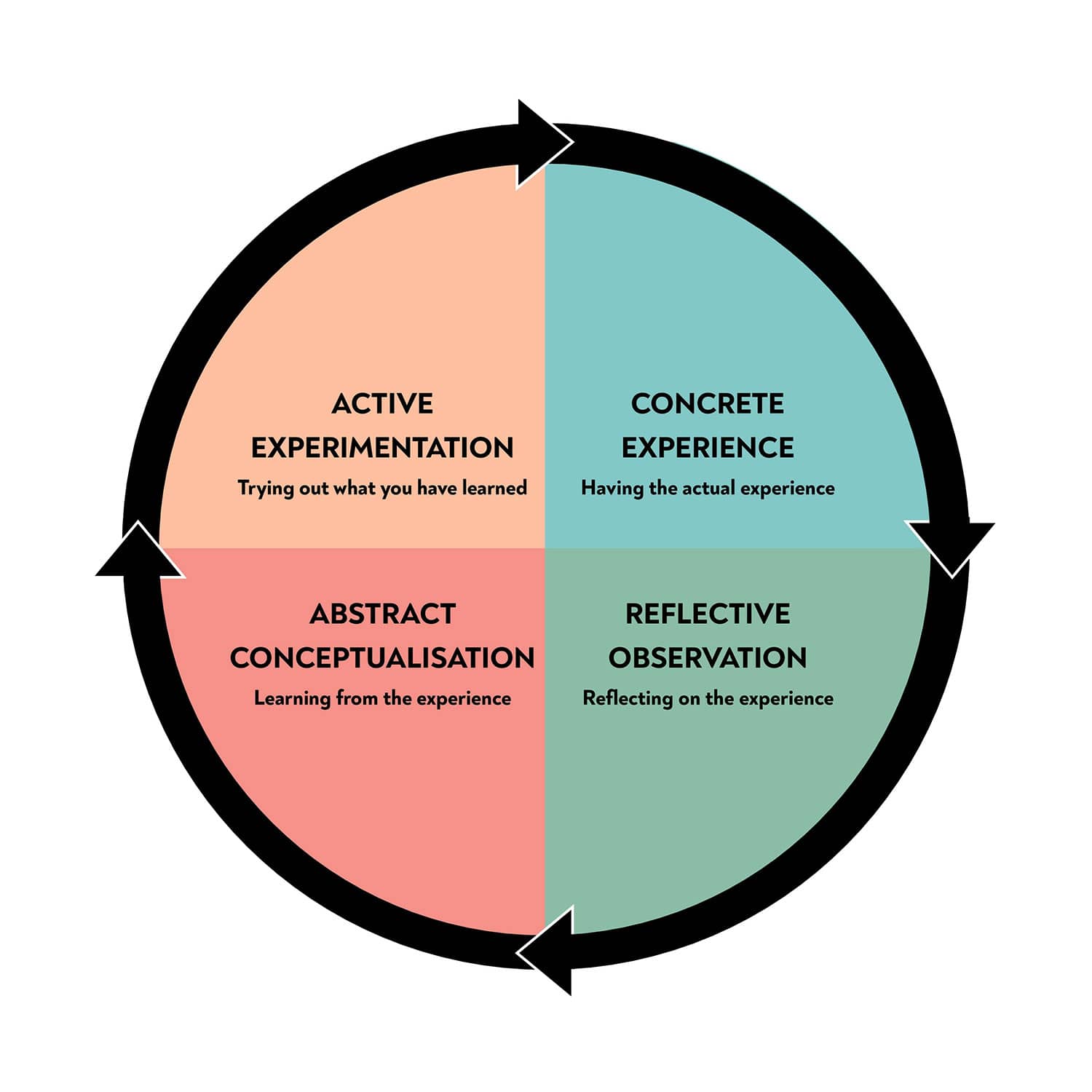
Learners need to experience a variety of situations, which are then stored and retrieved from memory as needed. Each time they work through a challenging decision, they have an opportunity to practice asking the right questions and puzzling through possible alternatives. Over time, this process becomes more efficient and they begin to quickly recognize solutions they would have missed before. Playing games provides a risk-free short-cut to creating these learning experiences.
The critical element for learning is not playing games per se, it’s the time set aside to reflect- self-reflection and group discussion on lessons learnt and linking game play to potential skill enhancements. Facilitators can assist by introducing abstract theory to provide a scaffold to learning. Learners are then encouraged to take these ideas and commit to apply in real-life situations to complete the learning cycle.
Using physical games also reinforces social engagement and emphasises the benefits of team learning in a face-to-face environment .
For all these reasons I see using games for skill development is a key augment to traditional learning processes.
(title picture courtesy of Singapore Management University – Executive Development showing the author playing games)