

Matt Stoller has recounted the importance of unremitting optimism in creating and perpetuating the Afghanistan debacle- a major “change” project steeped in failure. It’s a prime example of unachievable aims pursued by the over-optimistic. He illustrates his thesis using the satirical 2017 move War Machine, starring Brad Pitt as an exuberant and deluded U.S. General who encapsulated the eternal and unremitting optimism who comes to Afghanistan with a spirited can do attitude and a coterie of yes-men (the movie sis closely based on reports of actual US Generals and their actual “optimism” strategy)
This unremitting positiveness pervades business as much as the military. So how can we discuss the dreaded ‘f’ word without being made a scapegoat?
The skill and expertise to mitigate risks is under-appreciated, if not openly resented when most believe a “can-do” attitude conquers all.
I have experienced executive leaders who see challenges to their ideas as evidence that you are not on their team – that you are just being negative and actively undermining their authority. Ideally, there should be a safe environment culture in all firms where you and your colleagues are empowered to raise different points of view. But often such corporate culture is ignored by leadership.
In light of this and after helping executives learn how to share their views in a non-negative way, I’d like to share three techniques to introduce a critical perspective into a discussion, to get a group to take on different points of view and think about why a program might fail.
The evidence: companies value positivity and a “can-do” attitude
Daniel Kahnemann
Being positive is much valued in society. We want to work with people who are agreeable and supportive of our ideas. Optimism and positivity are required to keep pushing through difficult situations. Delivering change in organisations is extremely difficult and involved engagement influence and persuasion. While confidence is a prerequisite, successful project delivery also requires likely or potential failure points to be identified and avoided or mitigated. Facing uncertainty and making educated guesses is part and parcel of managing change.
Oliver Burkeman
There is some recognition in organisations of the risk of overconfidence and incorporating uncertainty into decision making- called risk management. While there could be vague permission to say things your leader might not want to hear, that is not a guarantee your leader will listen. Even with an obligation to dissent it is still difficult to explain why something might fail without being painted as a resistor or a defeatist.
Ultimately, the reason for challenging ideas is that it increases the likelihood of your success. Someone challenging our idea means we can adapt it to suit the situation.
I’m sure we’ve all been in this situation; your leader presents a solution, declaring that their approach “always worked”. Many leaders actively seek the “silver bullet” or “magic pill” that will easily and quickly solve their next challenge. You think at the very least, the intended benefits highlighted in silver bullets or magic pills are occasionally not achieved and there should be a simple review of potential unintended consequences to ensure the plan doesn’t lurch into failure.
in support of this aim … here are three techniques that I have applied to create a safe environment to disagree with your leaders.
1. The playful devil’s advocate – create a dissenting role.

We all know the role of the devil’s advocate. Unfortunately, it is often used in the corporate world as an excuse to say things people don’t want to hear. Often in a tone and style that irritates everyone. Originally used by the Vatican – the devils advocate was empowered to raise inconvenient views or ignored truths.
This approach is best used proactively by the self-aware leader to identify someone in the team to temporarily play the role to promote discussion and prompt alternative views.
When playing this role, autonomously, try to deliver your critique with charm and humour, this can go a long way to blunting any impact on the leaders ego and allow them to listen without immediately switching to defence.
Try to avoid sounding or appearing negative, as that will undermine your insight. In the situation I raised before, maybe making a playful aside about other ideas that ‘always worked’ but fell short, could have set a tone of mild scepticism and given the leader an opportunity to think through the silver bullet approach.
Try to bring this role into all your meetings and share the responsibility around so an individual isn’t playing this role. If someone loves this role, try to discourage them for always taking on the burden… maybe they need to wear a yellow hat?
2. Six Thinking Hats – try a process that promotes different points of view

Another process focused way of switching thinking is to use Edward de Bono’s Six Thinking Hats to switch perspectives. The Six Thinking Hats (or modes of thinking) are deliberately designed to get a team to try a different point of view and actively promote discussion and different options.
90% of errors of thinking are errors of perception, not logic.
Edward de Bono
- White – presents the data or information known or expresses a neutral view.
- Red – expresses feelings, hunches and intuition rarely voices in business.
- Black – applies judgment, the devils advocate or the reasons why something may not work.
- Yellow – brings positivity, brightness and optimism.
- Green – exudes creativity, identifies the possibilities, alternatives and new ideas without judgement.
- Blue – manages the process of thinking to get the job done.
If your team already knows and uses the Six Thinking Hats you could say, “I think we’re wearing our Yellow hats (sunny optimism), what would our Black hat (the devil’s advocate) have to say?” Alternatively, if you have time, you could step through the Six Thinking Hats process and bring a full range of points of view.
The tricky part to introducing something like Six Thinking Hats is people may already have been exposed to it and discounted it. To introduce it as a new concept in the middle of a meeting can be a challenge as it takes some time to explain and understand. It is worth being aware of the technique, especially as it has made wearing the Black Hat famous. Try to bring this process into your organisation as a means of promoting discussion.
3. Premortem – a technique to reward people for thinking about failure

A simpler technique, that sounds modern and gets straight to why something might fail, is the premortem. It was created by Gary Klein, a research psychologist in the field of naturalistic decision making.
A premortem is the opposite of a post-mortem. Rather than find out why something failed once it has failed, the idea is to imagine – using perspective hindsight – why did it fail (in the future). The key is to imagine it has failed, rather than why it might fail.
The premortem introduces the different perspectives (much like a playful devil’s advocate), it does it with everyone in the room (much like the Six Thinking Hats) and the key is, it is a relatively little used concept so it has newness on its side and it sounds interesting.
Gary Klein
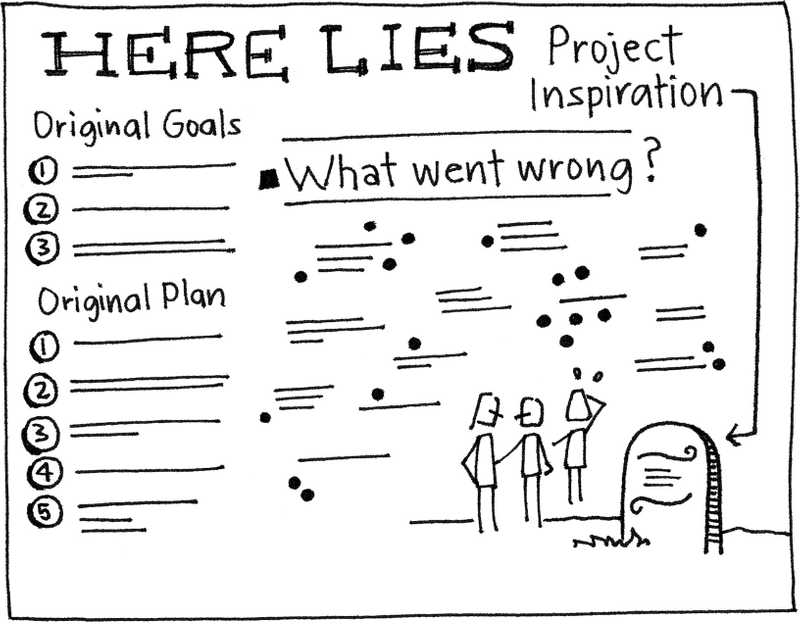
- The leader asks everyone to imagine the spectacular failure of the idea/project/program at hand at sometime in the future.
- Everyone in the room independently and silently writes down every reason why it failed in the future. Silence is key as the first person to speak in a group dictates the discussion.
- Each person takes the group through one of their reasons why it failed
- Proceed around the group sharing and noting ideas- without comment or criticism
- the leader does not speak until all the ideas are presented. Then uses this as source material for revising (or killing) the project by mitigating or avoid the potential failure points.
All three approaches can quickly and easily dispel over-optimism and ignorance. The purpose is NOT to kill the idea, but to bring realism and insights into your discussion so appropriate plans for implementation or new idea generation. Please try all three depending on the situation you are in.