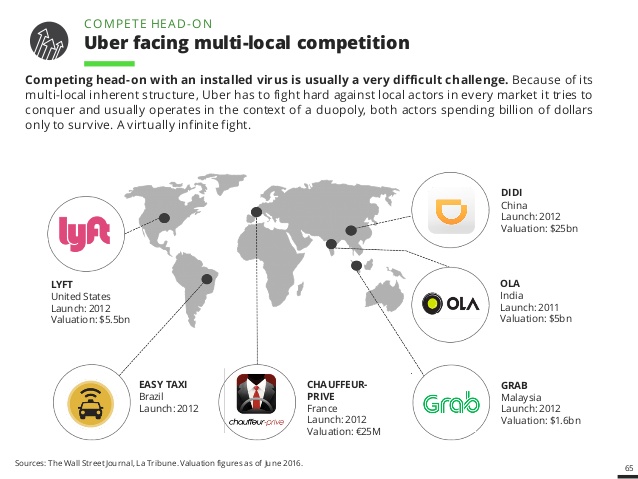
The problem with ride-sharing is simple; Lyft and Uber are losing a lot of money.
They are doing so to increase market share: To drive taxis out of business.That they are losing money, and the fact that they are highly valued means that they, and all their investors, expect that they will eventually stop losing money and start making it hand over fist.
In other words, having driven their competitors largely out of business, they will now raise prices. Once they are an oligopoly, they will charge oligopoly prices.They may be slightly lower than taxi prices in the end, because unlike taxi owners and drivers they don’t have to pay the capital costs (obviously not using that term in the way Silicon Valley does) of their vehicles, and they can pay near-starvation wages to drivers as long as the job market at the bottom end remains loose (ie. for the foreseeable future. Despite the unemployment rate, the truth is, it’s still hard to get jobs near the bottom).In other words, Uber and Lyft will squeeze additional profits out of their drivers and provide a very small decrease in prices (perhaps).From a “business” perspective, it is fair to say that Lyft and Uber’s main function is to take money from the world’s savviest investors and use that money to offer everyone subsidized cheap rides.

Lyft lost nearly a billion dollars just last year, and Uber’s losses are even more staggering. And this is with the benefit of being able to exploit drivers by treating them as contractors rather than employees—something that could very well change one day, and which would raises costs considerably.
You do not need to be a financial genius to see that the only real path to profitability for Lyft and Uber is to raise prices so that rides actually bring in more money than they cost…. there are basically three possibilities:
1) The Bad (For Uber and Lyft, Not Necessarily For Society) Scenario. After burning through literally tens of billions of dollars from venture capitalists and sovereign wealth funds and institutional investors and all the world’s smartest people, it finally becomes clear that these companies cannot reach profitability, because once they finally raise their prices high enough to allow them to make $$$, people are much less enthusiastic about calling a car.
2) The Medium Scenario. After putting the taxi industry out of business through clever and semi-dirty regulatory arbitrage and huge investor subsidies, Lyft and Uber become, essentially, the taxi business all over again, as regulations and organized labour catch up to the technology. This reinvented taxi business is moderately profitable and stable but not really anything that would necessarily inspire all this hype Nor billion dollar valuations . Congratulations, tech geniuses—you spent decades tearing down and then rebuilding the taxi business, arriving back where you began without adding any value and wasting several tens of billions of dollars.
3) The Good For Uber and Lyft and Definitively Bad For Society Scenario. If the long-term plan of these companies succeeds: then they destroy public transportation in America and in the rest of the world. Lured by cheap, subsidized rides, bus and subway ridership falls for years, leading governments to reduce prioritization of public spending and then more or less cease investment in new public transportation, which makes existing public transportation worse, creating a feedback loop that further incentivizes the public choosing Uber/Lyft over the train/bus. Once it becomes clear that public transportation has been crippled in major cities, ride-sharing companies can start raising their prices in peace, safe from competition. The companies will then at last become wildly profitable—by, in essence, extorting the public for transportation services that our dysfunctional government is not providing.then the real bloodbath starts… Uber plans to beat Lyft the only way they can by keeping subsidising riders until only they remain, oh but there are many many potential competitors
… such is the proposed business plan, valued at hundreds of billions by savvy investors
heres the latest on how well the Uber and Lyft shares are performing