

Covid-19 lockdown has provided me with more opportunities than normal to think. As someone paid to assist professional managers learn, I’ve taken this opportunity to reconsider my own learning journey and to reconsider when in my career “training” would have given me real insight not gained from “experience”… and then to apply this to my executive engagements and try to rethink how I would have approached my own personal learning.
I’m going to make two points… one brief, one more lengthy.
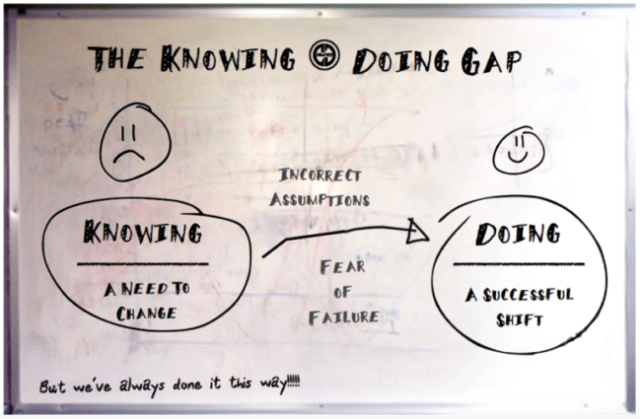
Firstly, when I engage with Executives as we move into using simulations I illustrate the “knowing:doing gap” with two photos of David Beckham*… one playing (he does this one day a week) and one practicing (he does this five days a week)… that’s professionalism, a deep focus on honing the skills that make you effective. “Professional” managers rarely if ever practice… whether because of fear of failure or embarrassment or laziness or poor scheduling. Using Executive simulations more than anything else gifts Executives the opportunity to practice… to fail and to learn.
Secondly, I’ll discuss why Executive learning during career transitioning is best. I have found personally and in engaging with others that we are most open to learning when we are consciously incompetent. When’s that? When we transition into a new role.
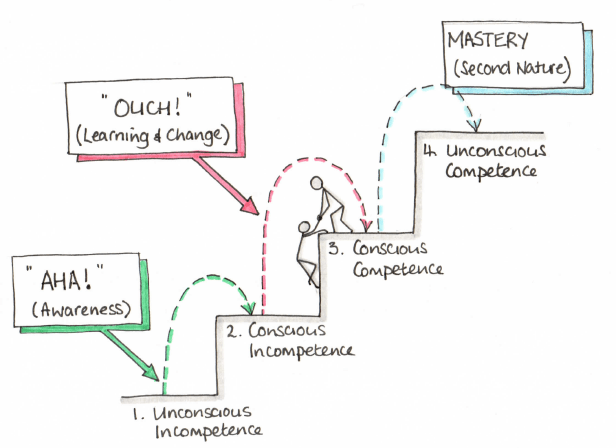
Thus for me, and I hope you, the topic of career transitioning… from subject matter expert to team leader, from team leader to organisational leadership and lastly transitioning out of a leadership roles … were or can become critical parts of personal development.
Upon reflection it is these brief times of conscious incompetence that I would have definitely benefited from external intervention via “training”. Providing access to new theories and an ability to put theories into practice in a ‘safe’ environment would have speeded my competence development at a time when I was both willing and enabled to try new things.
And in this frame of reference I’ve found that facilitating the Harvard Business School Everest simulation to be a great way of engaging with executives to talk about how they must make their first career transition AND give them the opportunity to practice new theories and ideas.

I engage with many talented youthful executives who are startled to receive feedback after the Everest simulation that they are ineffective in their teams because of poor or non-existent communication or lack of effective influencing skills. All are very effective experts in their own fields, often managing complex products or processes within their organizations successfully. They are downright Ed shocked to receive this feedback, often for the first time (Everest Simulation has two inbuilt questionnaires to assess participants)
How could these people be so successful and yet so unsuccessful at the same time?
It’s simple. Being a great subject matter expert doesn’t automatically translate into being a great team player or team leader. In fact, subject matter expertise can become a liability as you progress in your career.
Subject matter experts singularly focus on their domain knowledge. They apply their technical acumen, analytical skills and ability to hyper-focus on solving complex issues within their narrow area of expertise. They’re given the most difficult problems and achieve quick resolutions by dedicating their attention to this knowledge area. What is often neglected is developing relationships, understanding organisational dynamics, perspectives relating to other functions and their differing needs, and the broader business strategy. As a result, most don’t think multi-dimensionally, which is required for successful cross-functional collaboration and complex organisational problem solving presented in the Simulation.
Everest Simulation - http//forio.com/work/harvard-everest-leadership-teamwork-simulation/
In other words, subject matter experts’ tremendous value is also the source of their failure as team leaders, unless they consciously change their mindset. Here’s how I think people can transition from being a subject matter expert, to becoming a powerful cross-functional leader:
- Know the content or business issue at hand. Within the Everest Simulation there are a number of issues along the way that deflect the team and leadership from achieving their objectives. In any meeting, the topic at hand requires your analytical attention. Expertise is useful here, but it isn’t enough. Leaders need to cultivate a keen understanding of the issues facing the business and the other functions, and contribute probing questions and points of view.
- Facilitate the process. This is a critical part of the Everest simulation. Observe the initial process the group uses to address issues. Is it well organised with an agenda? Are the steps clearly outlined? Is everyone agreeing about the problem, it’s priority, and how to solve it? How is progress tracked and achieved? To lead you must notice these things and communicate your observations about the process to help the team overcome obstacles and continue moving forward without seeming like a dictator.
- Consider others’ psychologies. This is a critical dimension of the Everest Simulation. Not only are there are underlying tensions between the different members and their clashing objectives and also a clash with the objectives of the team but each team member brings with them their own distinctive personality. A successful team leader must quickly “meet with” everyone both individually and as a team to assess their personalities, emotions, needs and triggers is critical to influence them. What are your colleagues’ psychologies, and how does this knowledge inform how you work with them? Are they sensitive to direct statements, or is it okay to get right to the point? Adjust your approach accordingly.
- Understand other departments’ perspectives. Recognising how other departments work and how other leaders think are both critical. IN Everest this is more at a personal level than a department but recognising and navigating conflicting objectives is vital. What’s important to them? What do they need from you to be successful? Let this information inform your interactions with them. For Subject matter experts its simple there is one ob
- Surf group dynamics and politics. Everest is set up to share information differently with different people. Then to create situations where the team must share this information openly to reach a conclusion. Most teams do not achieve this because the team leader is unable to create a psychologically safe environment. People clam up, refuse to share, afraid of being criticised. New team leaders must observe how power moves through their group. What are the relationships between team members? What hierarchies exist? Actual power usually doesn’t honour the organisational chart. Use your observations to communicate strategically so the team digests your message and learns to trust each other.
- Practice self-awareness. It’s crucial to be aware of your state of mind as a new team leader. Are you confident and feeling included? Are you frustrated or angry? Are you triggered by someone else’s difficult behaviour? Are you tired, energised, bored? When under pressure of the Everest simulation I can see often affable leaders become tense and dictatorial as their leadership style is tested, Knowing how you behave in these different emotional states is essential; moderate your own behaviours accordingly to stay on your game.
The Everest Simulation is a fantastic test of bth creating team dynamics and of testing a subject matter expert who you would like to encourage into leadership. The simulation tests the individual and after debriefing and discussion and your can encourage them to think along these multiple tracks simultaneously — beyond relying on their domain knowledge and skill. Thos who can learn quickly are more likely to become a successful and impactful senior leader.
I wish I had been part of the Everest Simulation run by SMU Executive Development when I transitioned from a technical expert to team leader.
* why David Beckham… I was present when he scored a superb penalty goal as England defeated Argentina in Sapporo (https://youtu.be/j0auFwzzXus)