

A few weeks ago, I set out to bust a number of marketing myths using data based opinions to really understand how businesses can grow. I’m a big fan of Byron Sharp’s work at the Ehrenberg-Bass Institute and use his research and files to help explain how businesses and brands can grow to become market leaders.
Last week i looked at a brand’s customer base and made the case for using mass marketing as an effective strategy to engage light consumers and use this as a base for long-term brand growth.
Today, I’ll be breaking down the difference between differentiation and distinctiveness, and which of the two really and sustainably unlocks the potential for business innovation and growth.
BRAND DIFFERENTIATION IS NOT THE KEY
For as long as I have been involved in business, I’ve heard and then told my colleagues that we must strive to be different.
The books I’ve read have told business men to differentiate themselves, and that being different was the ONLY route to success. Funnily enough all of these Marketing textbooks looked exactly alike both in their set out and in their examples- not really a great example of differentiation, if being different was the strategy to win.
Differentiation is the idea that only a different perceived meaning of a brand will resonate with consumers. and that consumers are looking for different things from different brands. If you are the same as others then you will be lost amongst the competition. To stand out you need to be different.
In other words, traditional wisdom has it that if consumers do not perceive a brand as different, it may as well not be sold.

And so businesses strive for any difference that they can trumpet to consumers – makes colours bright, washes whiter- you’ve heard the taglines. And then brands strive to create their own “category” to dominate- the bright colours washing powder category, the whiter washing powder category, assuming that consumers take the time to search specifically for their needs- mmmm my white shirts are looking dull, so I need a whiter white powder, Oh, but also my colours need to be bright so I’ll buy some brighter colour powder as well.
Conversely, Sharp explains this concept of differentiation as the “reason to buy” for the consumer. He notes that almost all Academics have touted that brands and Businesses will only succeed if their consumers perceive them as different from their competitors. I was of this view as well, until I read Sharp’s books and research. The truth, however, is that consumer research shows that brand perception scores within all categories actually tend to be quite similar- consumers can’t see a difference between different brands. They don’t even see different categories.
For example, consumers will likely rate competitor companies A, B, and C similarly on attributes such as how trustworthy or efficient they are and their rapport or relevance. Not only that, but the attributes consumers associate with particular brands tend to overlap with those of other brands. Ford is just as different and unique as Toyota or Mitsubishi.
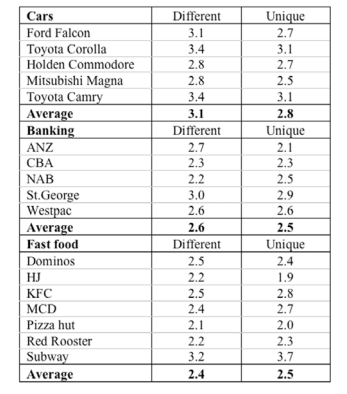
This isn’t to say that there are no differences in perception. Obvious functional aspects of a brand are reflected in these consumer perception surveys: for example Chinese brands are perceived as Chinese, German brands as German, and luxury brands as luxury.
We can see, then, that we have just stumbled upon another marketing myth. Despite what we have been told as being the most important facet of building successful businesses, the very best brands and businesses aren’t perceived as unique nor different from the competition. In fact, brand differentiation is consistently quite weak across the spectrum, regardless of size: consumers simply don’t perceive brands within a category as being particularly different from each other.
So, we can conclude two things
- the consumer groups who buy these products are similar if not the same (see previous post)
- and differentiation isn’t occurring at the brand level. Top brands have many competitors that look like them
Thus Brands are wasting time and effort in trying to appear different, or creating a category apart from their competitors, as customers don’t use differentness or uniqueness as a reason to buy into a brand. Consumers will continue to buy Dominos pizza, even if they don’t rate it as particularly different from PizzaHut or even KFC or McDonalds!
There is some difference in perception of brands being different and unique. If you use a brand, you are more likely to believe a brand is different and unique than if you don’t use a brand. Here’s another example from Sharp

Consistently across UK and Australian markets for different categories, consumers who use a brand believe that brand more unique and different (reinforcing their good taste in selecting a brand rather than a brand owners skill). Maybe, then, positive brand perception is created by brand usage?
DISTINCTIVENESS CREATES BRAND GROWTH
Enter distinctiveness, what i perceive to be the true marketing aim.
Distinctiveness is a brand’s ability to stand out so that buyers can easily identify it. Sharp defines distinctiveness as a brand looking like itself. This characteristic is far more critical for brands than differentiation, as they need customers to quickly notice, recognize, and recall their brand over others. Not only this, but distinctiveness, or branding, is legally defensible. Branding can be trademarked, but points of differentiation cannot.
So how can a brand be distinctive? Associate your brand with unique category relevant elements that show customers what brand is. These can include colours, logos, tag-lines, symbols, celebrities, or even advertising styles. In defining these elements, brands can begin to craft a story around who they are, making sure this story resonates and lingers with their consumers.

These elements are critical, as they play to the neuroscience that helps construct and reinforce memories. As such, the repetitiveness and recognizability of these elements helps consumer choose more easily and with less effort. The more consumers can rely on an implicit reaction to a brand, the more likely they are to buy that brand.
STRIVING FOR UNIQUENESS AND PREVALENCE
In establishing their brand elements, brands should aim for unique trade-markable icons, colours, designs, tag-lines, smells, sounds, logos. Elements that are NOT associated with other brands within your category. If you are a soft drink- try to avoid a red colour and an hour glass bottle shape- that signifies Coke.
Uniqueness is the idea that customers don’t associate the range of a brand’s assets with those of a competitor (you don’t mix McDonalds “arches” with KFCs “Colonel” even though they both use red as a key brand colour). A desire for uniqueness makes sense: if a brand element reminds a customer of a competitor more so than of your own brand, you’re encouraging that customer to think of your competitor. If a brand element is unique to your brand, every time a customer sees it, they can strengthen the memory structure linking that element to your brand, increasing likelihood when seeing it, remembering it when they want to buy in your category in the future. Uniqueness simply makes your brand more identifiable.
Prevalence, on the other hand, is the idea that the majority of customers link your brand to your brand element. For example, when customers see a “swoosh,” they know that that product belongs to Nike. And here’s another marketing myth: prevalence can’t be built overnight, or with one single instance. This element-to-brand link, which signals a brand to a consumer, is built through consistency over a long time. For example, with the Nike brand, the “swoosh” initially appeared next to the word “Nike” for over a decade before Nike management believed they could separate the two and just have the swoosh stand alone as a brand element to represent the business.
When brands produce a consistent set of associations, they create an accessible impression in consumers memories. In other words, when ever a consumer sees your brand in an appropriate place (Nike Swoosh on the shoe of an athletes, or in an athletic advert), they can seamlessly strengthen the element-to-brand link in their mind. This memory structure is then strengthened as they receive the same cues over and over again.
Uniqueness and prevalence together help establish brand distinctiveness. Distinctive brands, in turn, are thought of more often and are able to achieve greater market share. How can i tell whether I have a good brand icon- simple research assessing these two elements will provide you with an answer- and the strategy is explained below

and heres a case study on the elements associated with Johnnie Walker Whiskey
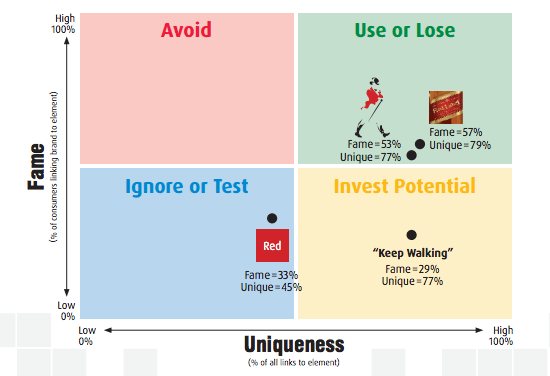
Ultimately, then, such activity can help brands grow their customer bases in the long run. It’s important to re-emphasize here that brands cannot create strong brand associations in their consumers minds overnight. That’s why brand consistency is so important: the most iconic brands in the world are such because of consistent and constant use of their distinctive brand elements, over many many years.
Today, I’ve contrasted brand differentiation and brand distinctiveness, concluding that brands must establish distinct brand elements and have consumers remember these in order to win in the marketplace. Not only this, but brands must consistently and relentlessly promote those brand elements over time, in order to create a retrievable impression in consumer’s memory. Of course, brands should continue to invest in a best-in-class product or service and strive for innovation in their field; but when it comes to external communications, brands must first focus on distinctiveness.