

Why, when millions are out of work and unemployment is climbing, zero or negative interest rates mean retirees have stopped spending, Covid-19 has wrecked international and domestic demand and resulting GDP is in double digit collapse, are stock-markets on a seemingly inexorable the rise? What special protection do investors have that the rest of us lack?

In a New York Times op-ed article, the Nobel-winning economist Paul Krugman explained what’s driving the “disconnect between rising stocks and growing misery. The real economy, as opposed to the financial markets, is still in terrible shape,” he wrote in the article, titled “Stocks Are Soaring. So Is Misery.”
He said that “the truth is that stock prices have never been closely tied to the state of the economy,” adding that they were disconnected from indicators such as jobs and economic output.
Krugman goes on to comment that the market values of those disconnected stocks primarily tech companies I highlighted, had little to do with their profitability or the economy. “Instead,” he said, “they’re all about investor perceptions of the fairly distant future.” Apple’s price-to-earnings ratio stands at about 33, suggesting that only about 3% of the value investors place on the company reflects the money they expect it to generate over the next year. “The profits people expect Apple to make years from now loom especially large because, after all, where else are they going to put their money?” he wrote. “Yields on U.S. government bonds, for example, are well below the expected rate of inflation.” So Krugmann believes very Low interest rates and demand for some return, any return is causing a share bubble.
In a similar vein, Yanis Varoufakis (exGreek Finance Minister) proposes the following response as to why the divide in A Lannan Foundation virtual talk published at his website.
His view is more about Government policy, noting that every time the US Fed or the European Central Bank or the Bank of England pumped more money into commercial banks, in the hope that this cash would be lent to companies which would in turn create new jobs and product lines, the opposite happened.
As an example, consider the following chain reaction: The European Central Bank extended new liquidity to Deutsche Bank. Deutsche Bank could only profit from it if it found someone to borrow this money. Dedicated to the banker’s mantra “never lend to someone who needs the money”, Deutsche Bank would never lend it to the “little people”, whose circumstances were increasingly diminished (along with their ability to repay any substantial loans), it preferred to lend it to, say, Volkswagen. But, in turn, Volkswagen executives looked at the “little people” out there and thought to themselves: “Their circumstances are diminishing, they won’t be able to afford new, high quality electric cars.” And so Volkswagen postponed crucial investments in new technologies and in new high quality jobs.
But, Volkswagen executives would have been remiss not to take the dirt-cheap loans offered by Deutsche Bank. So, they took it. And what did they do with the ECB-monies? They used it to buy Volkswagen shares in the stock exchange. The more of those shares they bought the higher Volkswagen’s share value. And since the Volkswagen executives’ salary bonuses were linked to the company’s share value, they profited personally – while, at once, the ECB’s firepower was well and truly wasted from society’s, and indeed from industrial capitalism’s, point of view.
Interesting. And here’s evidence of the “thinking” that goes behind such a strategy.
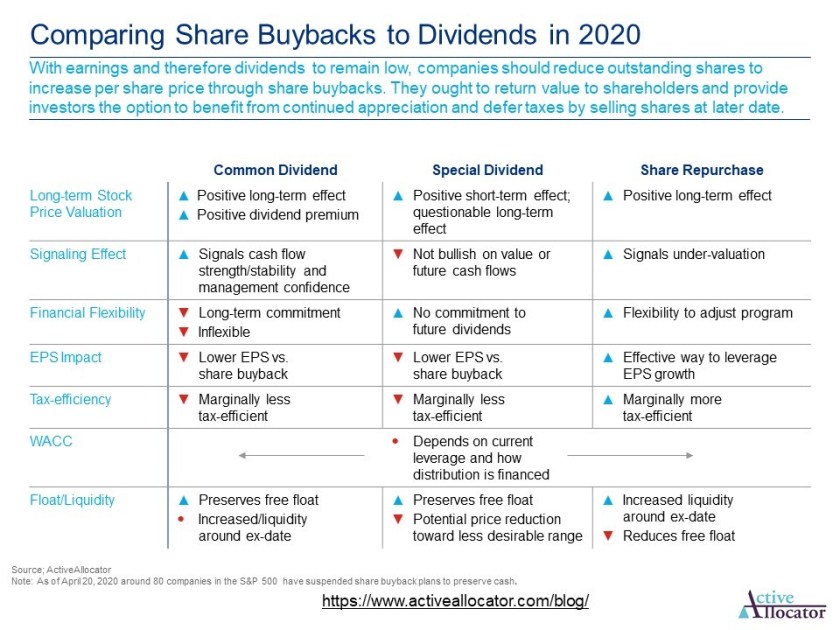
I have written earlier about the incompetence or malfeasance of US Airlines amongst others, borrowing to buy back shares now paying Politicians (aka lobbying before elections) to be “bailed out” (this good public money after bank loans) to reward their incompetence or criminal intent.
Executives charged with sustainable business growth will obviously seek out a risk-free guaranteed bonus- but are Boards of Directors so oblivious to this that it still continues. Valueless share reduction eats into necessary reserves or burdens companies with value-destroying debt. Having successfully crippled themselves they invest into lobbying politicians for “bail outs” so their incompetence or malfeasance continues.
So whether is lots of cash in search for any returns or corporate chiefs seeking bigger bonuses, this will not end well.